



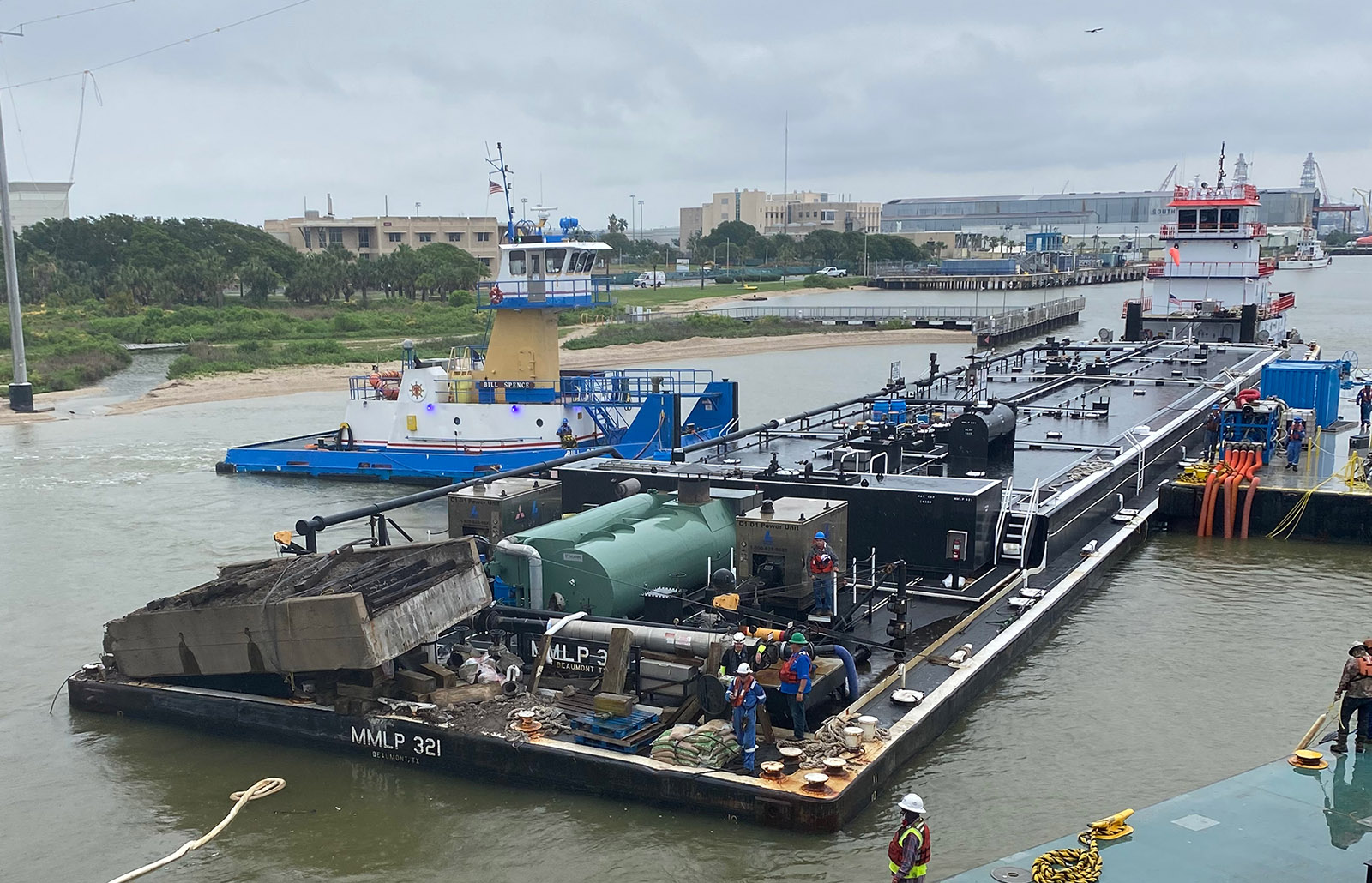
The National Transportation Safety Board (NTSB) has released a report detailing its investigation into a May 15, 2024, allision between the LCPL Phillip C George and a terminal dolphin near Galveston, Texas, which led to a barge breakaway and, ultimately, an estimated $8.4 million in damages.
The LCPL Phillip C George, owned and operated by Martin Operating Partnership, also known as Martin Marine, is a twin-screw, 2,660-hp towboat that measures 81’8”x34’1” and was built in 2011. On the morning of May 15, 2024, the LCPL Phillip C George left from Texas International Terminal (TXIT) with a pair of tank barges (MMLP 321 and MMLP 322) arranged end to end. Each barge carried about 24,000 barrels of vacuum gas oil, “a thick heavy petroleum byproduct of the crude oil refinement process,” according to NTSB.
At the time of departure, around 9:35 a.m., winds were from the southeast at 8 knots, with gusts to 14 knots, and the predicted tidal current was 0.5 mph (0.4 knots), flooding to the west. The captain, after checking the weather report and contacting the Coast Guard’s Vessel Traffic Service (VTS) Houston-Galveston had no concerns with getting underway with the tow in a “strung-out” configuration, according to the NTSB report.
“About 0937, when the stern of the LCPL Phillip C George was clear of the end of the barge berth, the captain came full ahead on the propulsion,” NTSB stated in its report. “She intended to steer the tow through the breakwater and turn to starboard (east) for the planned transit outbound through the Galveston Channel.”
About a minute later, the head of the lead barge passed the easter breakwater dolphin and entered the Galveston Channel with a forward speed of 2.8 mph.
“As more of the tow entered the channel, the captain saw that the tow was being set to the west, sliding sideways in the direction of the Pelican Island Bridge and the west breakwater dolphin,” the NTSB stated.
At 9:39 a.m., the stern of the LCPL Phillip C George cleared a piling at the northern end of the TXIT slip, which allowed the captain to steer hard to starboard, with the port engine full ahead and the starboard engine reserved, in an attempt to turn the tow to starboard.
“These efforts to turn to starboard were unsuccessful,” the NTSB stated. “The force of the current continued setting the tow to the west, and at 0941, at a speed of 2.7 mph, the port quarter of the LCPL Phillip C George contacted the west breakwater dolphin.”
The impact caused the port coupling and center line of the lead barge to part, while the starboard-side coupling remained intact. In the moments that followed, the captain attempted to maneuver the LCPL Phillip C George in order to stop the lead barge from drifting toward a line of power transmission poles and the east side of the Pelican Island Bridge. That effort was unsuccessful, and at 9:46 a.m., the aft port corner of the lead barge a power transmission pole, causing one end of the power line to fall onto the deck of the barge and the other end into the water. A deckhand aboard that barge said the cables were sparking and, upon that impact, the last wire connecting the two barges parted. The barge then drifted freely toward the Pelican Island Bridge, contacting a bridge pier less than a minute later and causing a concrete section of a defunct railroad bridge that runs alongside the Pelican Island Bridge to collapse onto the barge. The impact punctured the barge’s no. 3 port cargo tank, which led to vacuum gas oil flowing onto the deck and into the waterway.
A small boat launched from Texas A&M Galveston’s campus recovered the deckhand from the loose barge and returned him to the LCPL Phillip C George. The pilot aboard the LCPL Phillip C George, who had relieved the captain, returned to the TXIT terminal to drop off the aft barge, then returned to the site of the allision to aid in containment efforts. After being relieved of the helm, the captain notified the Coast Guard and Martin Marine officials of the situation.
According to the NTSB report, the towing vessel’s rubber fendering protected it from being damage, and the aft barge was not damaged. The lead barge sustained about $257,913 in damage, while the salvage operations cost about $621,383. About 20,000 gallons of vacuum gas oil flowed into the waterway, with all but about 129 gallons recovered. The NTSB valued the lost cargo at about $22,225. The cleanup operation cost about $7.21 million. The Texas Department of Transportation originally estimated repairs to the bridge would cost $306.250.
The NTSB concluded that the probable cause of the allision and barge breakaway was “the captain not being able to overcome the effect of the tidal current, which was stronger than predicted.” While the predicted current speed at departure was 0.6 mph, the measured current speed was 1.12 mph at the time of the casualty.
Besides the event with the LCPL Phillip C George, the NTSB identified two other similar events, one occurring in July 2023 and the other in January 2025.
“As a result of these casualties, on February 25, 2025, VTS Houston-Galveston included restrictions in their VTS Policy for Restricted Mooring, Bunkering, and/or Lightering Locations for the TXIT docks,” the NTSB found. “Tows can no longer be strung out for flood departures, an assist boat is required for all flood movements, and there are to be no transits on a flood greater than 0.5 knots (0.6 mph).”
