



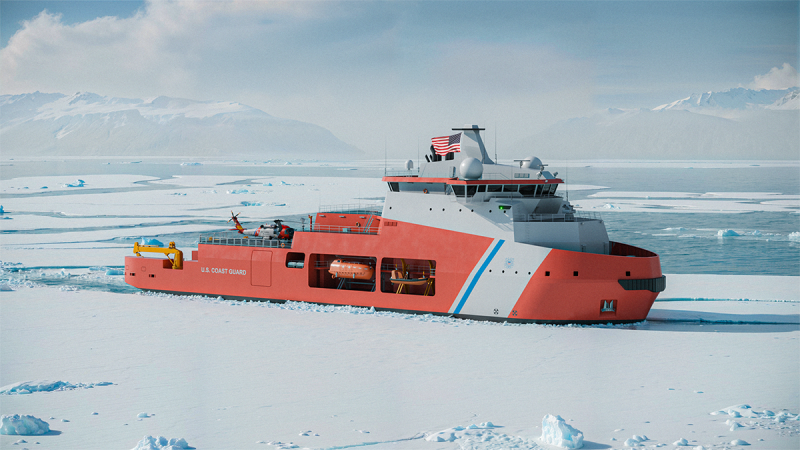
The U.S. Coast Guard has finalized a $3.5 billion contract with Davie Defense Inc. for the construction and delivery of five Arctic Security Cutters (ASC), a new class of Arctic icebreaker, the Coast Guard announced on Wednesday.
The first vessel is scheduled for delivery in 2028, with all five ships to be delivered by February 2035.
“Finalizing this contract represents decisive action to guarantee American security in the Arctic,” Adm. Kevin E. Lunday, commandant of the Coast Guard, said in a statement. “The Arctic Security Cutters will deliver the essential capability to uphold U.S. sovereignty against adversaries’ aggressive economic and military actions in the Arctic. These cutters will ensure the Coast Guard’s ability to control, secure, and defend our northern border and maritime approaches.”
Two of the cutters will be built at Helsinki Shipyard in Finland, a Davie Defense affiliate, while the remaining three will be constructed at Gulf Copper facilities in Galveston and Port Arthur, Texas. The five ships are part of a broader U.S. government initiative to field a total of 11 Arctic Security Cutters.
The remaining six vessels are to be built under separate contracts awarded in December. Bollinger Shipyards, Lockport, La., holds a $2.14 billion contract to construct four ASCs at its Houma, La., shipyard, with first delivery expected in 2029, while Finnish shipyard Rauma Marine Constructions holds a contract for two additional cutters to be built in Finland, with first delivery in 2028. Bollinger's vessels will be built to a design by Seaspan Shipyards, Vancouver, Canada, developed in partnership with Aker Arctic Technology, Helsinki.
The Coast Guard initially awarded Davie Defense's contract in early February, making it the third ASC contract awarded. Those initial awards allowed shipbuilders to begin planning while final details were negotiated. Today's finalized contract with Davie Defense is the first of the three ASC contracts to have its terms fully defined; the Coast Guard said it plans to finalize the two remaining contracts soon.
"Today's news marks a major milestone in the ASC program and reinforces Davie Defense's role in delivering next-generation cutters to strengthen U.S. Arctic readiness and maritime security," said Philip Burns-O'Brien, CEO of Davie Defense. "We are proud to work alongside the Coast Guard to advance this strategic program and strengthen America's icebreaking capability."
Davie Defense is the U.S. arm of Inocea, a U.K.-owned maritime group with operations in Finland, Canada, and the U.S.
James Davies, co-founder of the Inocea Group, said, "The Arctic is increasingly strategic to global security and economic resilience, and these vessels will provide the U.S. Coast Guard with critical capability in a region where reliability and operational readiness are non-negotiable."
The Coast Guard says the ASC fleet will be used to assert U.S. sovereignty, protect Arctic shipping lanes and energy and mineral resources, and counter foreign malign influence in the region. A stronger icebreaking force would also allow the service to better secure Alaska's borders and maritime approaches, support commerce critical to economic prosperity, and respond to emergencies in one of the world's most remote and demanding operating environments.
The U.S. icebreaker fleet has long been considered critically understrength relative to those of Russia and China. Russia operates more than 40 icebreakers, including several nuclear-powered vessels, while the Coast Guard currently relies on a handful of aging heavy and medium icebreakers. Expanding Arctic presence has become a stated priority across multiple U.S. administrations amid increasing competition for Arctic shipping routes and natural resources.
The overseas construction of some ASCs is authorized under a presidential memorandum signed by President Trump, who determined the existing U.S. icebreaker fleet insufficient to meet operational demands. The memorandum directed a phased approach that builds select vessels abroad while onshoring the expertise needed for follow-on domestic construction, a strategy formalized through the Icebreaker Collaboration Effort (ICE) Pact, a trilateral agreement between the U.S., Canada, and Finland.
Davie Defense said in a press release that the Texas construction work is intended to build long-term domestic shipbuilding capacity. Gulf Copper already fabricates modules for the U.S. Navy's Flight III Arleigh Burke-class destroyers. Davie Defense acquired Gulf Copper's Texas shipbuilding assets in 2025, a move the company said created new jobs and revitalized American shipbuilding capability.
The company announced that up to $1 billion in new investment is planned for the Gulf Copper facilities. A groundbreaking ceremony is scheduled for June 1 in Galveston.
