



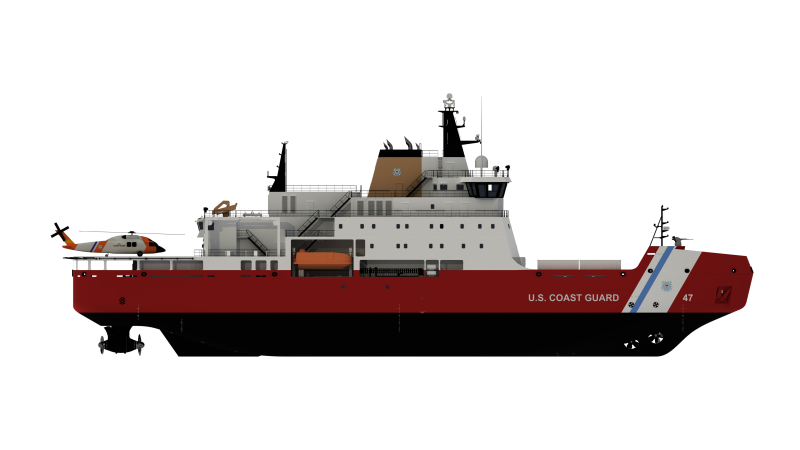
Seaspan Shipyards announced the company has signed agreements with Bollinger Shipyards, Lockport, La., and Finland’s Rauma Marine Constructions to provide its Multi-Purpose Icebreaker (MPI) design for the U.S. Coast Guard’s Arctic Security Cutter (ASC) program. The design sets the stage for up to six new heavy icebreakers to join the U.S. fleet.
Under contracts announced last week by the Coast Guard, Rauma will construct up to two cutters in Finland for delivery beginning in 2028. Bollinger will build up to four additional vessels in the U.S., with the first hull expected in 2029.
The MPI design was originally developed for the Canadian Coast Guard under Canada’s National Shipbuilding Strategy in partnership with Aker Arctic Technology Inc. Seaspan says the Polar Class 4 platform is “production-ready,” enabling work on the ASC program to proceed on an accelerated schedule.
The 328'x67'x21' design will run on diesel-electric propulsion using variable-speed generation with a DC-bus system that supplies 10,100-kW of installed power and 7,200-kW of propulsion power. The ships are designed for operations in first-year Arctic ice at speeds up to 4 knots in 1 meter (3.28’) of ice.
Key performance characteristics include a 12,000-nautical-mile range, gross tonnage of 7,606 tons, displacement of approximately 9,000 tons, and accommodations for 85 personnel. The vessels will be built to Lloyd’s Polar Class PC4 notation.
Seaspan said the vessels are designed for long-range, multi-mission operations in extreme Arctic conditions including icebreaking, sovereignty patrols, search and rescue, and environmental response. Seaspan said it has already identified major systems suppliers as part of the Canadian program, which the company says allows the U.S. program to move directly into construction with reduced design risk.
“The MPI design is a true success story under Canada’s NSS,” Seaspan Shipyards CEO John McCarthy said. “The interoperability resulting from a common design and supply chain between the Canadian and American coast guard fleets will create countless opportunities for collaboration throughout the vessels’ operational lives… and generate significant lifecycle cost savings for both countries.”
The company said the MPI also aligns with the Icebreaker Collaboration Effort (ICE Pact), a trilateral U.S., Canada, and Finland initiative aimed at strengthening Arctic maritime capabilities and industrial cooperation.
Seaspan highlighted that the company’s current orderbook includes the world’s largest portfolio of icebreaking vessels under construction, including a PC2 heavy polar icebreaker and up to 16 MPIs for the Canadian Coast Guard. The Vancouver-based yard has already delivered four ice-capable government vessels and in 2025 completed Canada’s new Offshore Oceanographic Science Vessel.
The ASC fleet will supplement and eventually succeed the Coast Guard’s aging heavy icebreakers, expected to expand the service’s ability to maintain Arctic access as traffic and strategic activity increase in the polar regions.
