



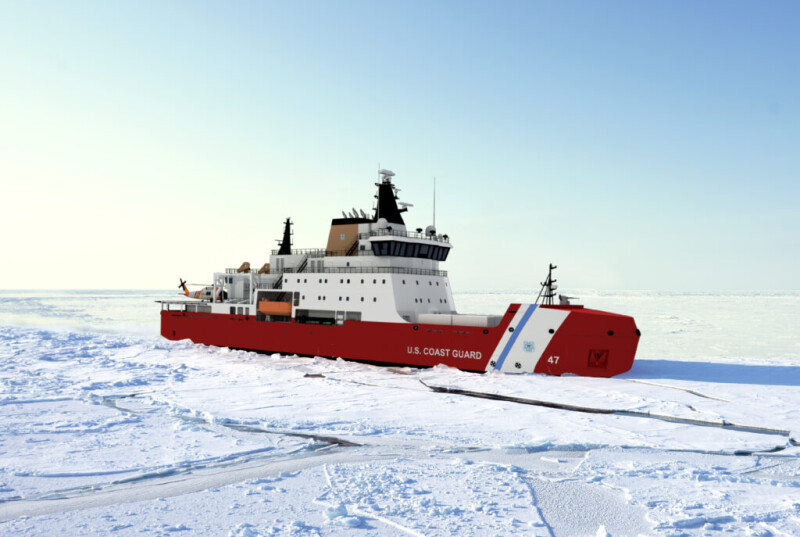
On Oct. 9, U.S. President Donald Trump and Finnish President Alexander Stubb signed an agreement authorizing the construction of up to 11 icebreakers to strengthen U.S. Coast Guard operations in the Arctic.
The presidential memorandum establishes a new class of Arctic Security Cutters (ASC) and permits limited foreign construction to meet urgent national security needs, a White House press release said. Under the agreement, up to four cutters will be built in Finland under 14 U.S.C. 1151(b) and 10 U.S.C. 8679(b), "followed by the leveraging of Finnish expertise to construct up to seven new ASCs in shipyards located in the United States," the White House said.
Bollinger Shipyards, Lockport, La., in partnership with Rauma Marine Constructions (Finland), Seaspan Shipyards (Canada), and Aker Arctic Technology Inc. (Finland), have been selected for the design and construction of six Arctic Security Cutters according to a Bollinger press release. Bollinger said the project will use the Multi-Purpose Icebreaker design developed by Seaspan and Aker Arctic.
Under the initial production plan, Bollinger said, "Bollinger and its partners will be responsible for the construction of six state-of-the-art icebreakers. The first three vessels will be built simultaneously by Rauma in Finland and Bollinger in the United States, with production of the remaining three vessels to be built in the United States. Delivery of the first three vessels is expected within 36 months of the contract award."
Rauma CEO Mika Nieminen said his company “is ready to deliver the Arctic Security Cutters on an accelerated timeline in close cooperation with our U.S. partner and allied industry. Together, we will provide the Coast Guard with the world’s most capable Arctic security vessels.”
The Coast Guard estimates it requires at least nine Arctic-capable cutters to maintain year-round presence in the region, the White House said.
Foreign construction is described as a temporary measure to address an immediate capability gap while supporting the eventual expansion of U.S. domestic shipbuilding capacity. The White House said the collaboration with Finland will bring advanced shipbuilding knowledge and technology to American yards and “result in billions of dollars of new investments in America.”
The ASC program is being pursued under the ICE Pact trilateral framework between the United States, Canada, and Finland, intended to strengthen allied Arctic industrial capacity and interoperability. Canada’s Davie Shipyard will contribute by producing a separate class of ice-capable vessels based on its Multi-Purpose Polar Support Ship design.
According to program officials, the ASC will be capable of breaking four feet of ice, traveling 12,000 nautical miles, and operating more than 60 days without resupply. The class will support missions ranging from national defense and maritime sovereignty to scientific research and search-and-rescue.
