



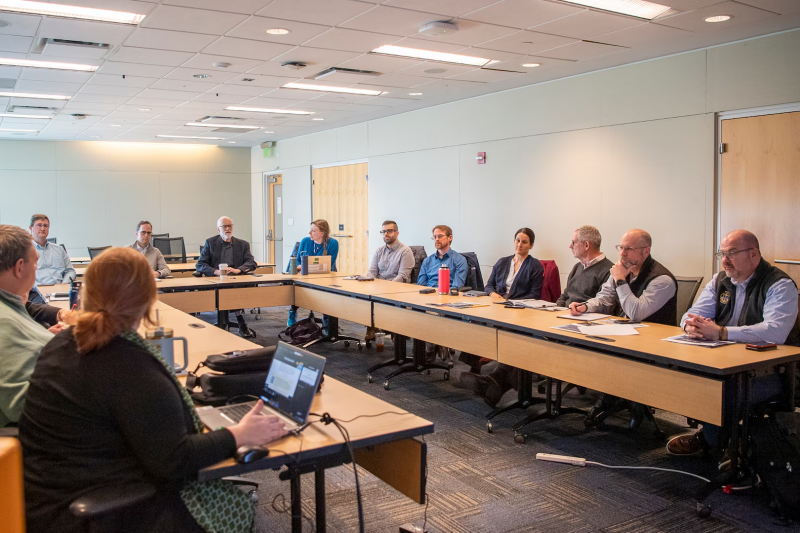
Naval Surface Warfare Center (NSWC) Carderock Division hosted leadership from the Webb Institute on Feb. 26 in West Bethesda, Md., as part of an effort to strengthen the Navy’s longstanding relationship with the naval architecture and marine engineering school.
The visit highlighted collaboration between Carderock (the Navy’s primary center for ship design and naval engineering) and Webb, which has educated naval architects and marine engineers since 1889. The partnership is supported through an Education Partnership Agreement and the Naval Engineering Excellence for the U.S. Navy (NEXUS) initiative.
Through the NEXUS program, Webb faculty and students can use Carderock’s research facilities and technical expertise to work on real-world naval engineering challenges. The collaboration also integrates Navy-focused coursework and research projects into Webb’s curriculum to help prepare engineers for work on increasingly complex naval vessels.
Among the visitors were Mark Martecchini and Matthew Werner. Werner recently took on the role of NAVSEA Professor, a position established through the NEXUS initiative to help strengthen the naval engineering workforce pipeline.
NEXUS is a joint effort involving the Naval Surface and Undersea Warfare Centers, the Direct Reporting Program Manager Maritime Industrial Base office, and Naval Sea Systems Command’s engineering directorate.
“There has never been a more critical time for our naval engineering community,” said Pete Small, chief engineer at NAVSEA and commander of the Naval Surface and Undersea Warfare Centers.
During the visit, Webb leaders toured Carderock’s technical facilities, including the David Taylor Model Basin and the Maneuvering and Seakeeping Basin. Discussions with Carderock engineers covered topics such as hull-form design, propulsors, vessel structures, and acoustic and signature performance.
The visit concluded with a luncheon where Webb leadership met with alumni currently working across the NAVSEA enterprise, including engineers at Carderock, NAVSEA headquarters, and various program executive offices.
Navy officials said the partnership helps ensure a pipeline of naval architects and engineers prepared to support future ship and submarine programs.
