



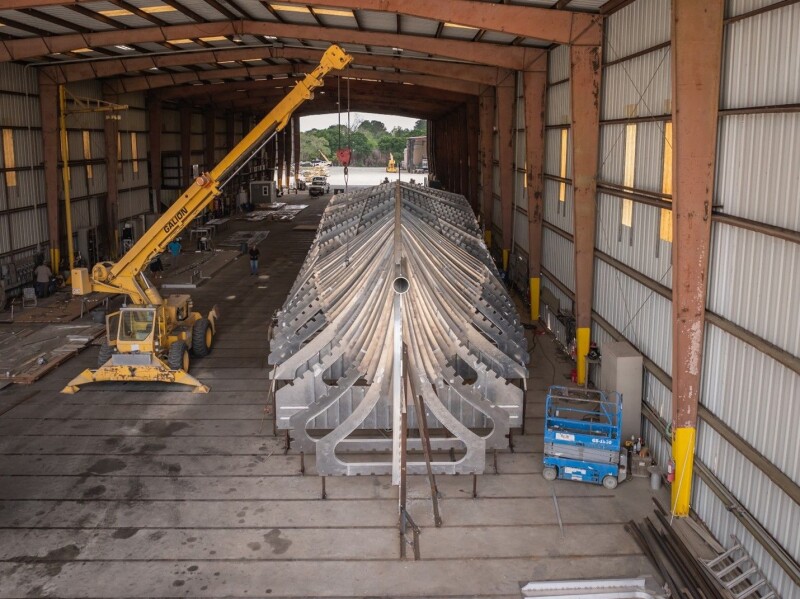
The United States' largest military shipbuilder Huntington Ingalls Industries Inc. (HII), Newport News, Va., announced April 21 that it will build four additional Romulus 151 uncrewed surface vessels (USV) at Breaux Brothers Enterprises, New Iberia, La., expanding on the single Romulus 151 already under construction at that facility.
The move marks a transition from prototype development to initial production for the Romulus program, which HII describes as a modular family of AI-enabled USVs intended for the U.S. Navy, U.S. Marine Corps, joint forces, and allied partners.
"Romulus represents a shift in how we deliver unmanned capability to the fleet," Andy Green, executive vice president of HII and president of HII's Mission Technologies division, said in a press release. "We are combining shipbuilding experience, scalable manufacturing, proven autonomy, and strong industry partnerships to move quickly from prototype to operational deployment. The progress we are seeing today — including these initial production vessels — reinforces that we are on a disciplined path to deliver meaningful capability at speed and at scale."
The Romulus platform is designed to support a broad range of naval missions, including intelligence, surveillance, and reconnaissance; mine countermeasures; strike operations; counter-unmanned systems; and the launch and recovery of unmanned underwater and aerial vehicles, according to HII.
The vessel family is engineered for serial, repeatable production, with a common manufacturing approach and autonomy baseline intended to carry across multiple vessel sizes, HII said.
The production expansion is tied to HII's broader unmanned manufacturing strategy, which includes the Breaux Brothers assembly facility and the company's High-Yield Production Robotics (HYPR) initiative. Introduced in March alongside an expanded facility plan, HYPR applies industrial robotics and digital quality systems to unmanned platform manufacturing, with the stated goals of reducing unit costs, improving schedule predictability, and enabling higher production rates.
"Romulus is engineered from the outset for scale," Green added. "By aligning design, autonomy, and manufacturing, we are creating a production model that delivers predictable outcomes and positions us to meet growing demand for autonomous maritime capability."
