



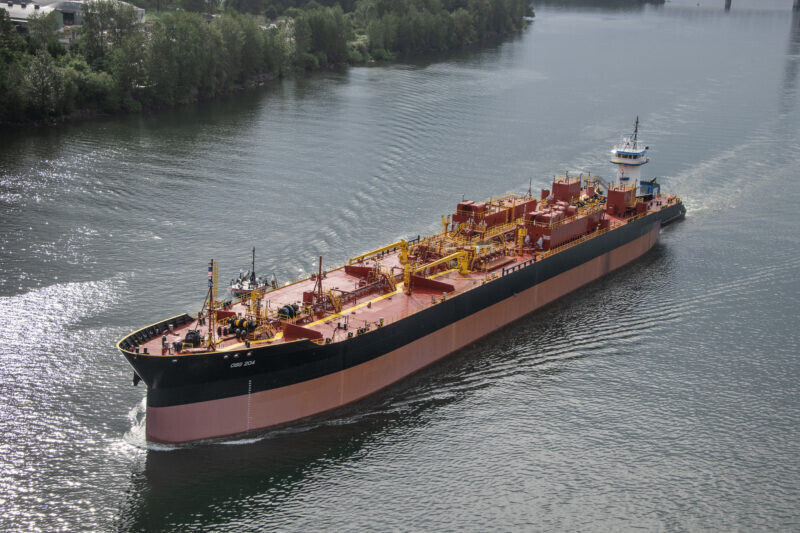
As the Iran war enters its eighth week, the Trump administration is weighing whether to extend a 60-day Jones Act waiver originally issued March 18 to ease the movement of oil between U.S. ports. The waiver, intended to address rising fuel costs, has drawn continued opposition from domestic maritime stakeholders.
The American Maritime Partnership this week urged the administration not to extend what it described as a “historically long and broad” waiver, arguing it undermines U.S. maritime policy and workforce stability.
“An extension of the current historically long and broad Jones Act waiver would blow a hole in the Trump agenda to restore American maritime dominance,” said Jennifer Carpenter, president of AMP. “Waiving the Jones Act exports American jobs to foreign carriers, lets them skirt U.S. laws, and throws open our maritime borders. Any extension would be an affront to hundreds of thousands of hardworking Americans who put this country—not foreign powers—first.”
AMP also launched a dashboard tracking fuel price trends and waiver activity, asserting that the policy has failed to deliver the intended relief at the pump. According to the group, national average gasoline prices have increased by $0.324 per gallon since March 15, the last U.S. Energy Information Administration update prior to the waiver’s implementation.
The waiver allows foreign-flagged tankers to transport oil between domestic ports, temporarily bypassing Jones Act requirements that cargo moving between U.S. ports be carried on U.S.-built, -owned, and -crewed vessels.
According to data cited in Axios reporting, approximately 40 foreign-flagged tankers have delivered—or are in the process of delivering—oil between U.S. ports, increasing available capacity by roughly 70%. The White House reported that these vessels have transported about 9 million barrels of oil under the waiver so far.
Administration officials pointed to impacts in Alaska, where imported jet fuel under the waiver is said to account for roughly half of the state’s average monthly consumption.
However, questions remain about transparency surrounding the data. The figures cited by the White House have not been publicly released by the Maritime Administration under Section 501(c) of the Jones Act, limiting independent verification.
A sample of vessels operating under the waiver, as reported by Axios, includes foreign-flagged tankers such as JPS Elli (Liberia), Torm Agnete (Denmark), Chrysopigi Lady (Singapore), Stena Imperator (United Kingdom), and Cabo Deseado (Marshall Islands), among others.
The Offshore Marine Service Association likewise spoke out against the extension.
“To put it simply, a waiver extension sells out our American maritime industry and the foundation of our Navy to benefit oil traders and foreign shippers. Now is the time we should strengthen U.S. maritime capacity, not weaken it,” said Smith.
Despite industry pushback, the administration appears open to extending the waiver. One adviser told Axios that the president “likes what he sees” and may continue the policy as long as geopolitical pressures persist.
“As long as the Iranians are a threat and raising fuel prices, the president would like to keep the waiver in place for as long as is necessary,” the adviser said.
The decision comes as policymakers continue to balance short-term energy concerns with long-standing maritime policy goals tied to domestic shipbuilding, workforce development, and national security.
