


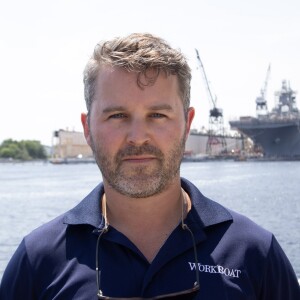
Brian Junes is walking me through the morning checklist aboard the orange-hulled pilot boat Columbia, moored at the Skipanon terminal, ticking through 39-line items with the unhurried precision of a man who has done these enough times to know that skipping one could matter. Junes is the marine transportation manager for the Columbia River Bar Pilots (CRBP), and before we untie from the dock, he and his crew want to be certain everything is where it needs to be.
“These guys,” Junes says of his operators, “we do so much training, just exercises in the safety aspects, that it’s been drilled and drilled and drilled. You’ll see, these guys are dialed in. Sometimes when you do drills, people are going through the motions. That’s never the case here. There’s no complacency. Everyone knows what the stakes are.”
“The human life is our number one priority,” Junes adds, pausing and pointing toward Capt. Michael Tolley, the pilot standing a few feet away. “It is his safety.”
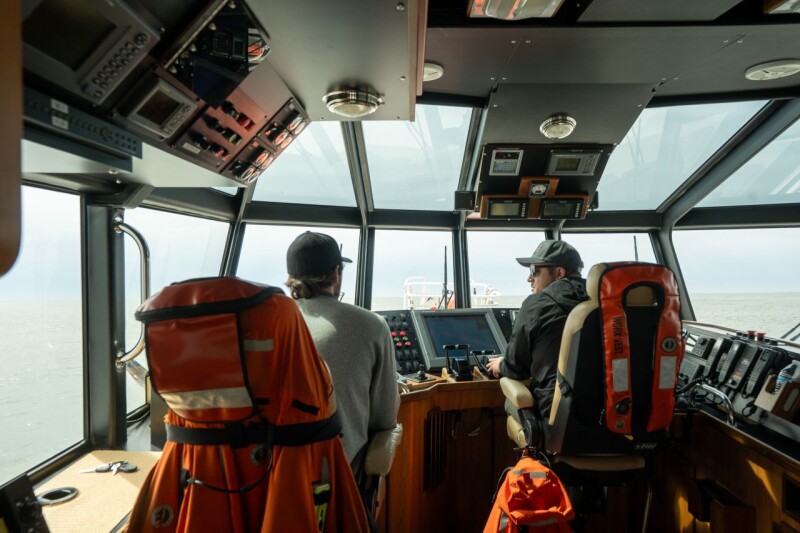
That philosophy extends into every aspect of the operation. Junes explains that during a transfer, the crew is prepared to keep the vessel fully operational even if machinery alarms sound while a pilot is climbing the ladder. “We have all of these engines on the boat,” he says. “We’re prepared to explode all of these engines on this boat while he’s getting up the ladder. There’s no shutdowns to these engines. If we blow an oil line alongside while he’s on the ladder, we’ll get an alarm, but nothing’s going to shut off. All the guys know that [Capt. Tolley] comes first.”
Outside, the April morning is as cooperative as the Columbia River Bar ever gets. Temperatures hover around 65°F, southwest winds blow at 10 to 15 knots, visibility stretches beyond 10 miles, and seas run about 4' on a seven-second period. Someone on the crew describes the conditions as “a lake.” It won’t always be that way. Buoys off the bar have recorded waves reaching 80', with wind speeds topping 80 knots. Crewmembers have even reported side windows touching waves in heavy weather.
"The maximum wave height we'll do a transfer is 22 feet," Junes says.
It is precisely because of what the Columbia River Bar can do on its worst days that today's drill matters so much.
THE BOAT
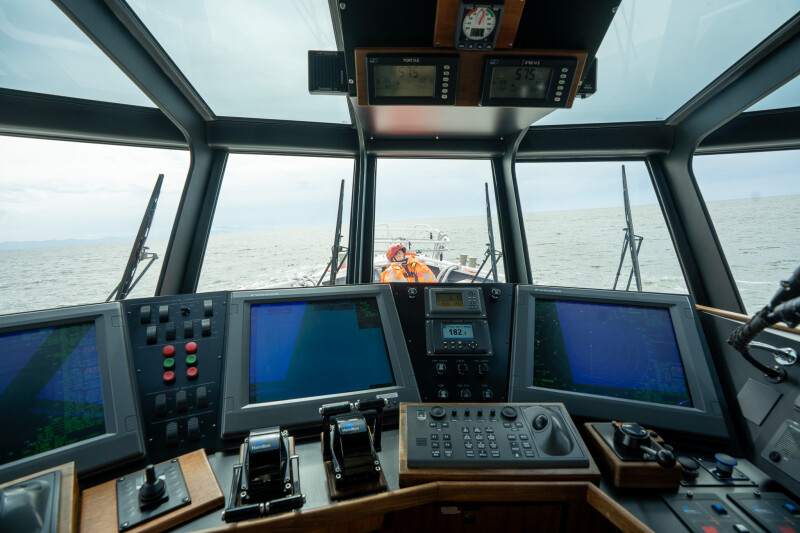
We depart Skipanon at 1205 hours and head out aboard the Columbia, a 72.8'x21.3' pilot boat with a 3.6' draft, designed by Camarc Design Ltd., Dunoon, U.K., and built by Kvichak Marine, Seattle, in 2008. She is a purposeful machine designed for one of the most demanding assignments in the maritime world.
Propulsion is provided by twin MTU 16V2000 M70 diesel engines producing 1,410 hp each at 2,100 rpm, driving ZF 3050 electric-shift gearboxes at a 2.037:1 ratio and connected to Hamilton 651 waterjets. Each jet is capable of moving roughly one million gals. of water in 10 seconds — the equivalent of an Olympic-sized swimming pool — and together they push the Columbia to a top speed of 30 knots.
The speed matters in a man overboard scenario, especially in unforgiving conditions. To demonstrate the maneuverability of the vessel, operator Reese Johnson dumped the buckets at 30 knots and stopped the vessel in its own boat length.
Electrical service comes from two Kohler 40-kW generators. The boat carries 1,500 gals. of fuel and 75 gals. of freshwater. Navigation is handled by a full Furuno electronics suite. On board is also a Lucas automated CPR device.
"We're an hour out," Junes explains. "One guy's got to run the boat. So that means one person would have to do CPR for an hour straight, and CPR isn't going to be effective that way. So we've got a Lucas that auto-does the CPR, and he can run the boat, stay with the pilot, help with everything else, and monitor."
THE DRILL
By the time the Columbia reaches Buoy 8, the ride starts to remind me that the "lake" these guys spoke to was still a river mouth connecting to the Pacific. We reach Buoy 2 at approximately 1245, and the exercise goes live at 1255.
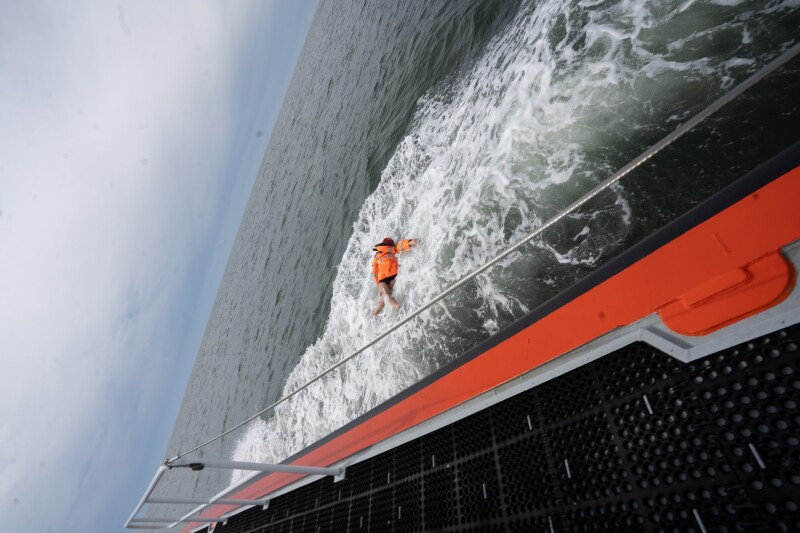
The drill simulates what no one in the CRBP wants to ever have happen: a pilot going into the water while boarding or disembarking a vessel. The rescue dummy, dubbed Capt. Oscar, is tossed overboard from the Columbia approximately one nautical mile south of Buoy 2. At the same moment, an ACR ResQLink 450, a 406/121/AIS personal locator beacon, is activated. Within one minute, the signal appears on ECDIS plotters, radars, and SEAIQ. Within two minutes, the 406-MHz signal is received by USCG Station Cape Disappointment.
When Oscar hit the water, the Columbia’s operator Johnson broadcast a mayday call on Channel 16, stated that a bar pilot was in the water and that they were responding, and the call is immediately acknowledged by the Coast Guard. From that moment, the drill's chain of events snaps into motion.
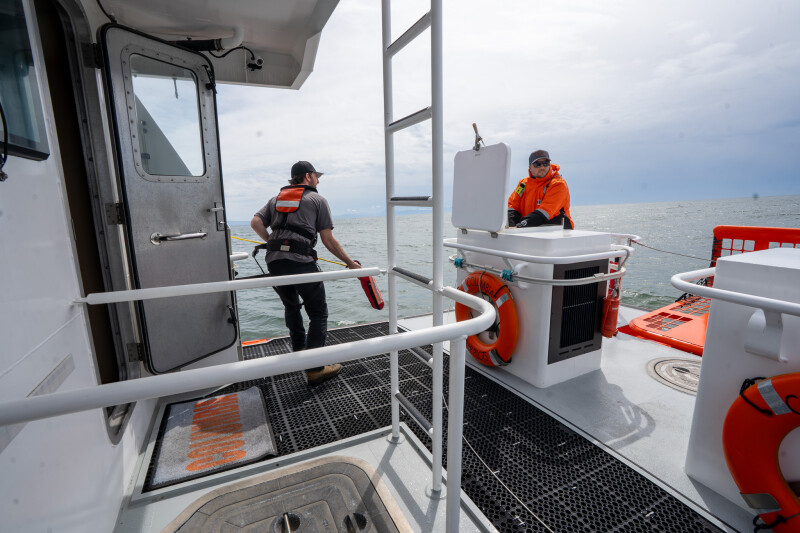
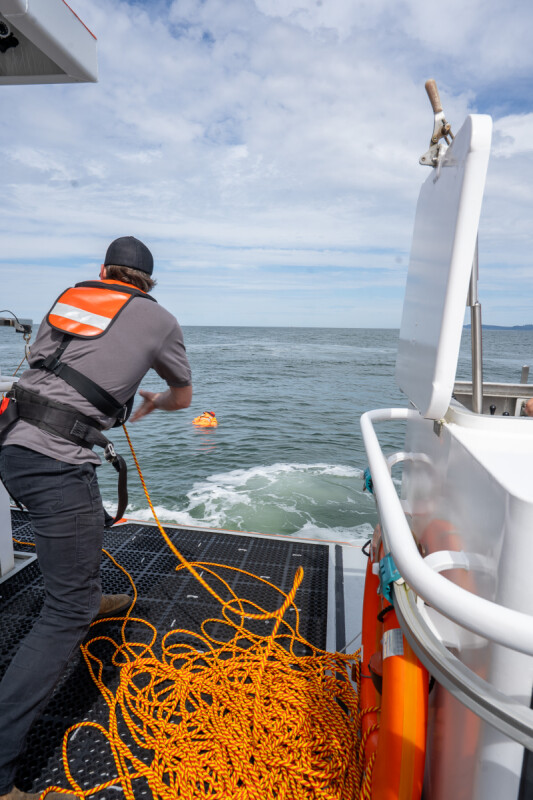
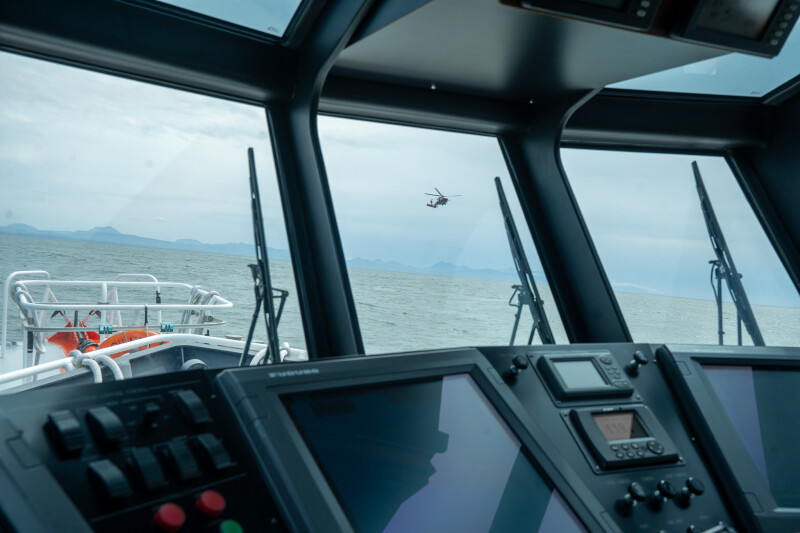
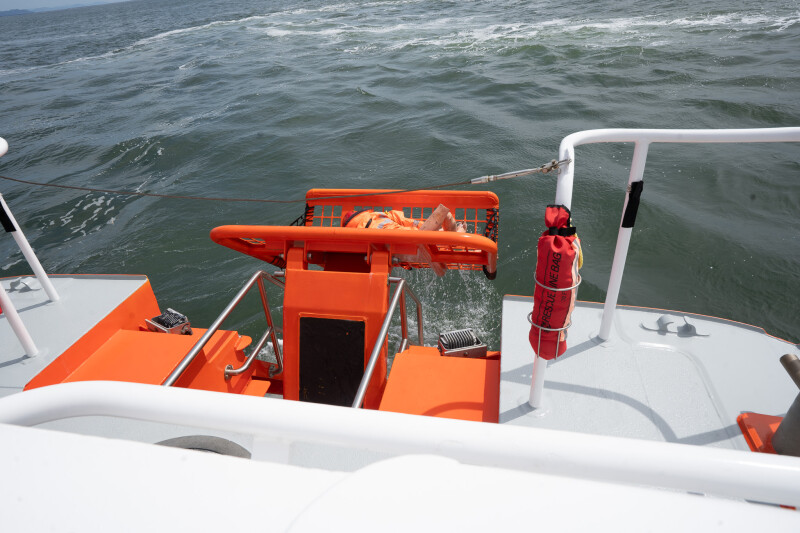
"Once the dispatcher hears that radio call, he's going to contact the number one pilot," Junes had explained to me earlier. "And the number one pilot is going to take over as the quarterback. He's going to start throwing these calls out there." In this case, that was Capt. Tolley, who was reached by phone at 1306 hours.
Meanwhile, operator Johnson and deckhand Carsen Kunz are already working, taking over controls on the aft deck and readying a life-sling to be thrown. At 1258, three minutes after Oscar went in, the Columbia pulls alongside. A speed bag is thrown and the davit lowered. At 1259, Oscar is recovered using a life sling. At 1300, a second method was demonstrated: the CRBP's self-designed stern basket, a scoop that drops below the waterline to retrieve an unconscious or incapacitated pilot. Once recovered safely, Oscar is then returned to the water to allow the exercise to continue.
Total recovery time from splash to basket retrieval is five minutes. Most of these drills record six to eight minutes.
"Reese will probably have the pilot back in three, four, maybe five minutes," Junes had predicted the morning before the drill. He was right.
THE RESPONSE
The Mayday call had already set a parallel sequence in motion offshore. The U.S. Coast Guard's response unfolded methodically over the next hour.
At 1312, a USCG helicopter arrives on station. At 1324, a rescue swimmer is deployed. Two minutes later, Oscar is recovered by the helicopter crew and the simulated medevac clock began. At 1328, USCG Motor Lifeboat 47267 arrives on scene. At 1333, the helicopter departs with Oscar, simulating transport to a hospital. The MLB crew later recovers Oscar at 1348, checked vitals, commenced CPR protocol, and simulated heading to Ilwaco for a medevac handoff.
The exercise concludes at 1406 when the Columbia makes the final recovery and turned back toward Skipanon, arriving all-fast at 1440.
Capt. Tolley logs every timestamp, every complication, every observation. Among the notes: the MLB 47267 was not broadcasting AIS during the exercise; a detail flagged for follow-up. Communications were solid throughout: Channel 16 for the initial Mayday, then switched to Channel 22A, with good comms from Sector Columbia River. The PLB performed exactly as advertised.
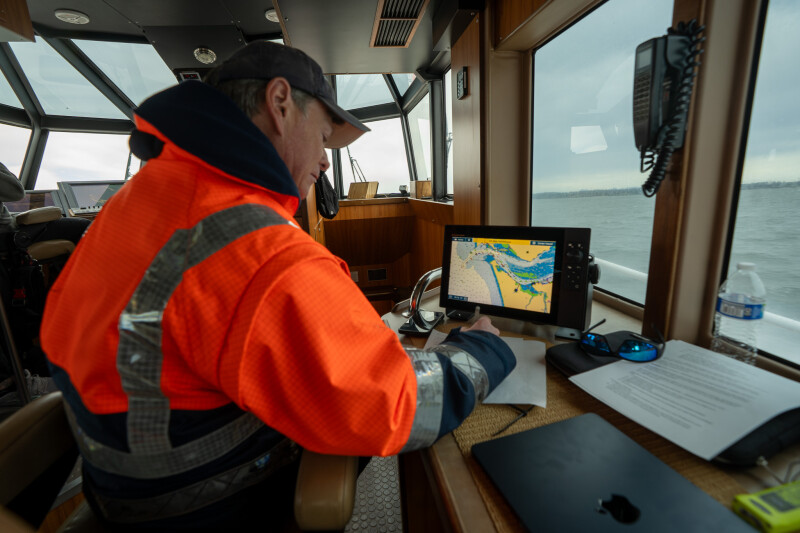
"What we're simulating is what would happen if we couldn't get the pilot on," Junes says. "What if it's dark, stormy, foggy, all the things. Twenty-foot seas. And we lose the pilot. So, then all these assets will be responding with their search patterns. The helicopter will be involved in all the different kinds of things."
In the fall, the CRBP plans to run the same drill at night, with strobes on, at 1900 hours. The conditions and the stakes will be much different.
AT THE DOCK
Back at Skipanon, with Oscar safely stowed aboard the Columbia, Junes walks me through the station, including the logistics, the systems, the infrastructure behind keeping these boats ready to go on any sea state at any hour. The CRBP doesn't think of maintenance as something done when time allows. It's the foundation of everything.
Today was a good day. Conditions were kind. The CRBP runs this drill so that on the day that none of those things are true, the outcome is still the same.
