



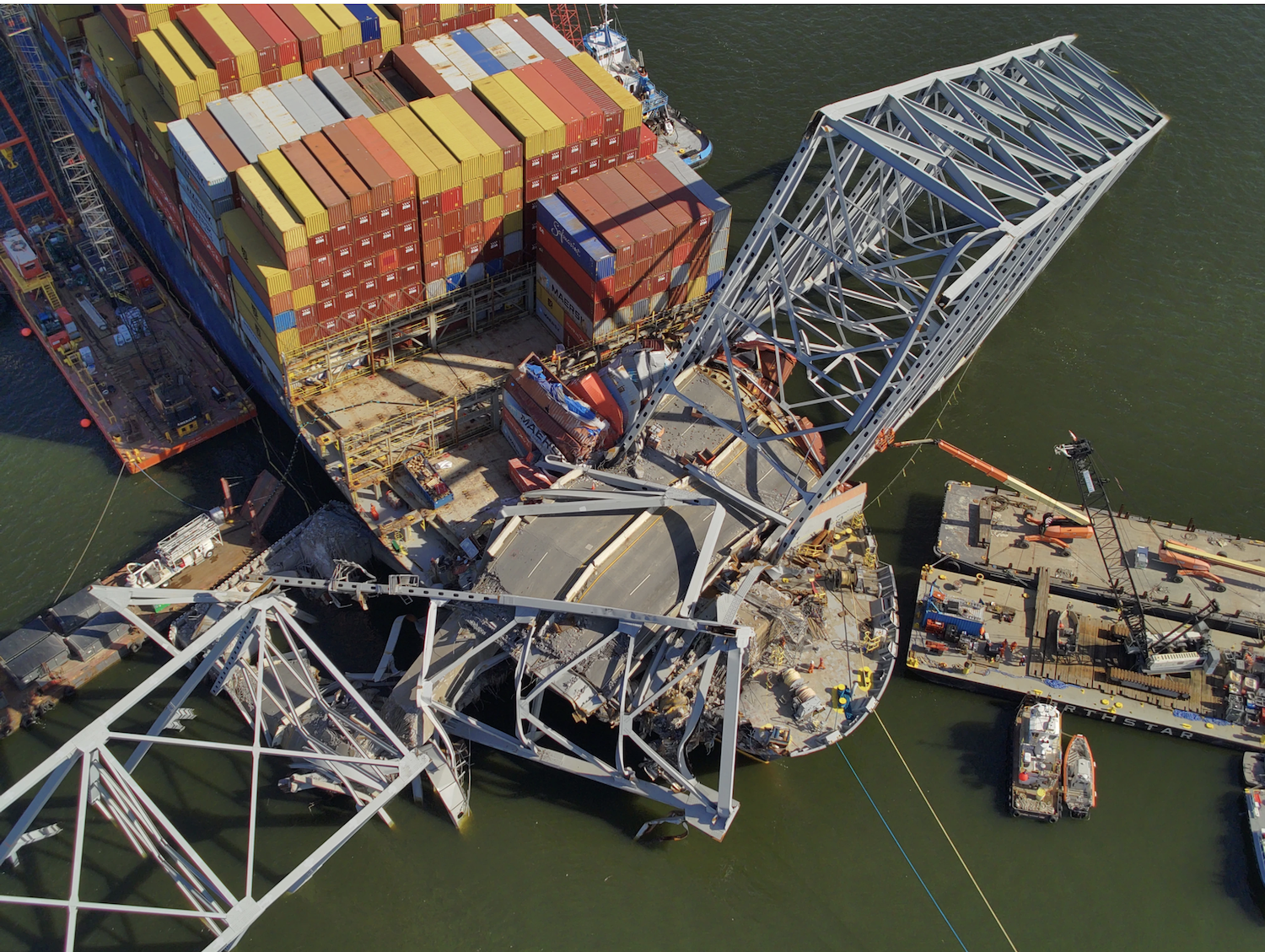
Federal prosecutors have charged a pair of corporate entities and a shoreside technical superintendent in connection with the March 26, 2024, allision between the Dali and the Francis Scott Key Bridge in Maryland. The allision led to the immediate collapse of the bridge, the death of six construction workers, and an extended closure of the waterway.
The indictment alleges the allision caused an economic loss of at least $5 billion.
Singapore-based Synergy Marine and Chennai, India-based Synergy Maritime, along with Radhakrishnan Karthik Nair, who worked for both companies as the technical superintendent for the Dali, have been charged with conspiracy, willfully failing to immediately inform the U.S. Coast Guard of a known hazardous condition, obstruction of an agency proceeded, and false statements, according to an announcement from the Department of Justice. The Synergy corporations were also charged with misdemeanor violations of the Clean Water Act, Oil Pollution Act, and the Refuse Act for discharges into the Patapsco River, including shipping containers and their contents, oil, and the Key bridge itself.
“The collapse of the Francis Scott Key Bridge was a preventable tragedy of enormous consequence,” said Acting Attorney General Todd Blanche following the unsealing of the indictment. “This indictment is a critical step toward holding accountable those whose reckless disregard for maritime safety regulations caused this disaster.”
As the Dali left the Port of Baltimore, heading out to sea, the ship lost power twice in a four-minute period as it approached the bridge. The indictment alleges that a loose wire in a high-voltage switchboard likely caused the first loss of power. According to federal prosecutors, the Dali originally was equipped with system redundancies and automatic restart capabilities, which would have allowed the ship to quickly regain power after a blackout.
According to indictment, the defendants allegedly altered the ship to rely on a flushing pump to supply fuel to two of the Dali’s four generators. That flushing pump, though, was not designed to automatically restart following a blackout. As a result, the vessel’s generators were starved of fuel, which led to the second blackout and the crash. The indictment argues that, if the Dali had used the proper fuel supply pumps, it would have regained power in time to avoid the allision.
“The indictment reveals a pattern of deception and egregious violations that led to the unsafe operation of the Dali which recklessly endangered the public and resulted in the ship striking the bridge,” said Special Agent in Charge Jimmy Paul with the FBI’s field office in Baltimore. “This indictment should send a message to all ship operators that circumventing safety requirements and breaking U.S. laws will not be tolerated. I am proud of FBI Baltimore’s investigative teams who worked diligently over the last two years to find the truth and to hold those responsible accountable.”
The Dali struck one of the Key bridge piers at about 1:29 a.m. March 26, 2024, causing the immediate collapse of the bridge. The ship channel leading to and from the Port of Baltimore fully reopened about 11 weeks later, on June 10, 2024.
