



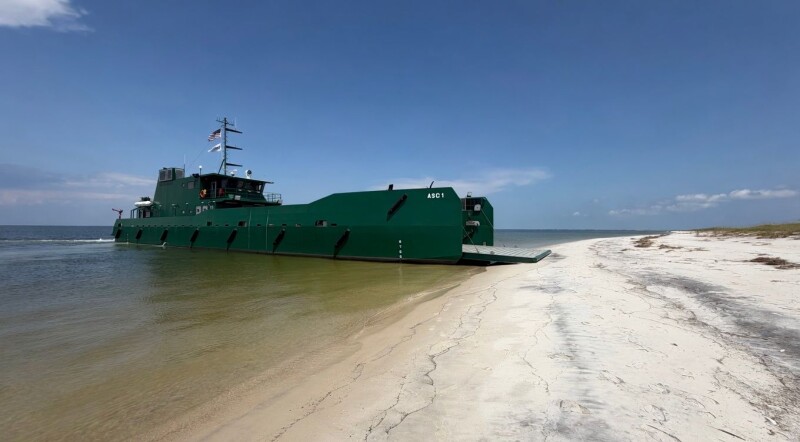
The Marine Corps Warfighting Laboratory (MCWL) has completed technical acceptance of the first Ancillary Surface Craft prototype, a roll-on/roll-off landing craft built through a partnership between Birdon America Inc., Denver, and C&C Marine and Repair Inc., Belle Chasse, La.
The technical acceptance, which verifies that the newbuild meets all engineering, contractual, and performance specifications, clears ASC 1 to enter a testing and experimentation phase run by MCWL to work out requirements for moving troops and cargo ashore in the Pacific without relying on ports, piers, or causeways.
"Achieving technical acceptance is a crucial first step in our rigorous testing regimen," said Aaron Hatfield, maritime program manager in the Science and Technology Division at MCWL, which designs and tests new combat ideas, technology, and wargames. "This validation assures that the craft's advanced systems and robust design are ready for MCWL to begin hands-on technical experimentation, ensuring we can meet the extreme operational demands of the Indo-Pacific theater."
The Marine Corps awarded the ASC prototype contract to Birdon America, the U.S. arm of Australian shipbuilder Birdon, Port Macquarie, in 2024. The following year, Birdon announced it had tapped C&C Marine to construct the vessels at its shipyard in Bell Chasse, near New Orleans.
According to the Marine Corps, the partnership intermediary contracting arrangement allowed it to place the job with a "nontraditional shipbuilder" and shorten the timeline from concept to a delivered prototype.
The 150'x30' craft was designed by Birdon as an affordable, production-friendly design that could be built in under 12 months.
Drawing 4'11", the ASC can beach bow-first on unimproved, shallow-gradient, and unsurveyed shorelines, delivering personnel, equipment, and fuel over what the Corps calls the "last tactical mile." The vessel can transport up to 46 tons of cargo and 40 combat-loaded Marines while executing vital shore-to-shore maneuver, mobility, and sustainment. It includes a fuel transfer system for vessel-to-vessel and vessel-to-shore operations.
The Marine Corps said the ASC is fully operational in Sea State 5 and built to survive conditions up to Sea State 7, and that it carries a forward-looking sonar system intended to let crews navigate uncharted shallows and read beach gradients.
The ASC now moves into limited technical assessments crewed by Birdon craft masters and engineers alongside Australian Army personnel, with MCWL overseeing the evaluations. The Marine Corps said the ASC will initially run with a hybrid crew pairing Marines with contracted mariners, a step toward independent Marine Corps operation of small surface craft.
The Corps described the ASC as a complement to the larger Medium Landing Ship, which transports forces between islands. The ASC, with its shallow draft and waterjet propulsion, is meant to carry sustainment into landing sites the larger ship cannot reach. Together, the service said, the two give a stand-in force a path from an intermediate staging base to the beach.
"To support Expeditionary Advanced Base Operations (EABO), our forces must remain highly mobile and sustained without relying on fixed, vulnerable ports," said Col. Kenny Jones, Science and Technology Division director at MCWL. "This prototype allows MCWL to immediately execute hands-on experimentation, test tactical concepts, and put real hardware in the hands of Marines. By exploring the ASC's traditional bow-first beaching physics alongside other experimental platforms, we are actively reducing programmatic risk and perfecting the requirements for the future naval fleet."
The craft is built for logistics and maneuver, though the Marine Corps said later test phases will evaluate force protection and self-defense configurations.
