



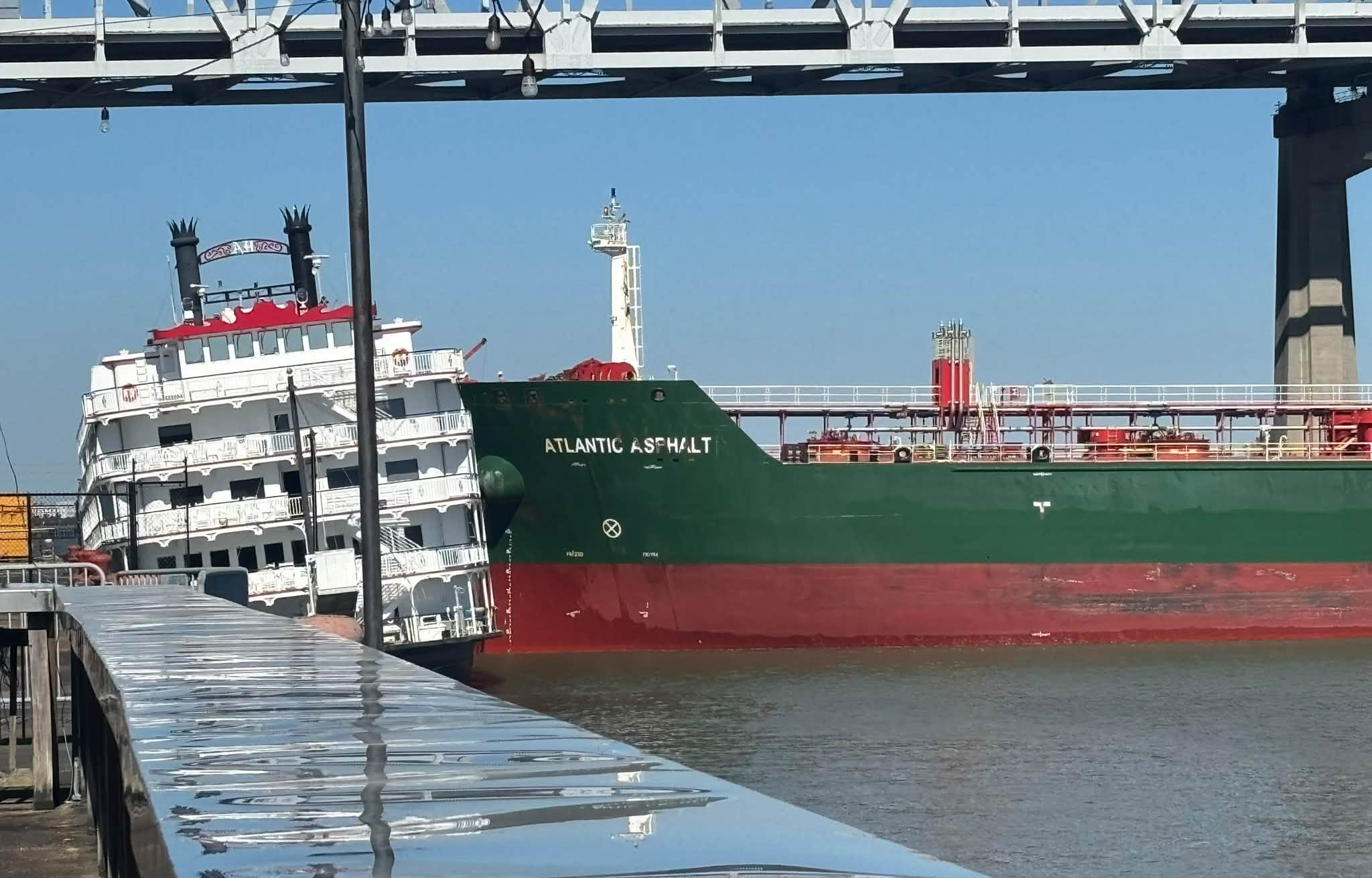
The American Cruise Lines riverboat American Heritage capsized and sank Nov. 13 on the Mississippi River in New Orleans after it was struck around 12:30 p.m. by a northbound tanker, the Atlantic Asphalt.
The Atlantic Asphalt, which sails under the Marshall Islands flag, reportedly lost power or steerage as it passed under the Crescent City Connection bridge, then veered sharply to starboard. A pilot with the New Orleans-Baton Rouge Steamship Pilots Association (NOBRA) was on board the ship at the time of the collision.
The American Heritage was docked directly in front of the Port of New Orleans administration building, having arrived earlier in the morning to conclude a weeklong cruise on the Mississippi River. Passengers, primarily older cruisers, reportedly were set to spend one more night aboard the vessel before heading home the next day.
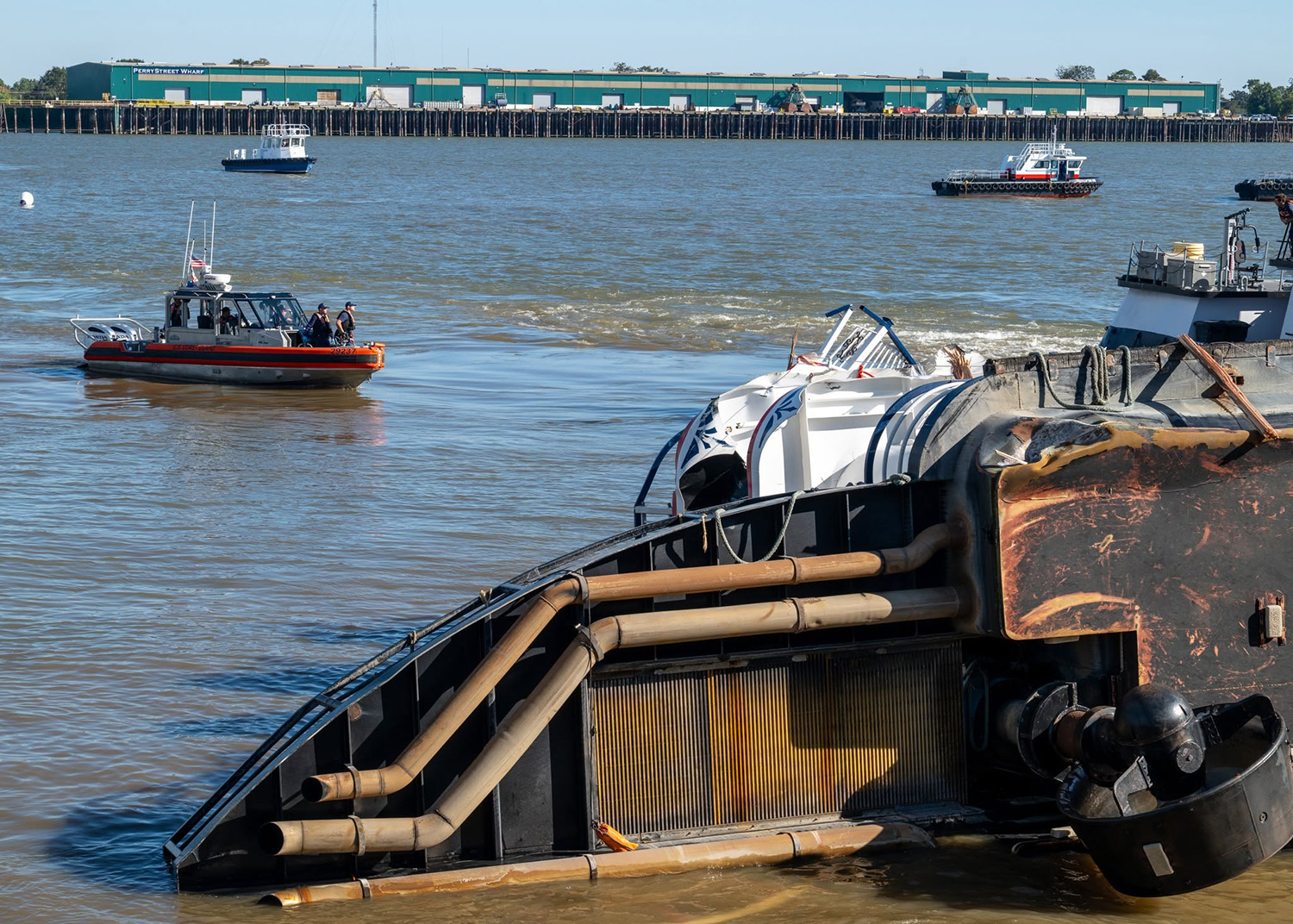
Videos from the scene captured the ship, with its anchors deployed, closing in on and then colliding with the aft section of the riverboat, which lurched from the impact and then began listing to port. Within minutes, the American Heritage began to roll onto its side. The vessel, christened in 2015, then sank, becoming partially submerged in the low-stage Mississippi River.
“When that occurred, we started to have people in the water,” said Helena Moreno, mayor of New Orleans, who spoke at an afternoon press conference. “I have to completely thank our first responders. It was an all-hands-on-deck approach with our Harbor Police responding first with tremendous bravery, going into the water to start pulling people out.”
According to Moreno, between 180 and 190 passengers and crew members were on board at the time of the collision.
The Gen. Roy S. Kelley, the Port of New Orleans’ fire boat, and other vessels swarmed to the scene to begin pulling passengers from the water and hold the tanker in place. AIS data along with local reports captured crews from Moran Towing, Crescent Towing, Cooper Mooring, John W. Stone Oil Distributor, and Canal Barge Co., among others, responding within seconds of the collision.
Once on shore, passengers were led into the Port of New Orleans administration building, where they were either directed to the auditorium or triaged in the atrium before being transported to local hospitals.
During the press conference, Moreno announced that all passengers and crew members were safe and accounted for, with 30 passengers and two Harbor Police officers taken to hospitals for non-life-threatening injuries.
Moreno called it “a miracle on the Mississippi.”
“That is a credit to all of the first responders — local, state, federal — who literally jumped right in to help,” she said.
Melanie Montroll, chief of the New Orleans Harbor Police, said 87 passengers and crew members were able to disembark prior to the American Heritage capsizing. She estimated it took about 30 to 45 minutes to pull the remaining passengers and crew members from the water.
Capt. Melanie Burnham, commander of Coast Guard Sector New Orleans, called the response “truly exceptional” and said her agency was focused on reopening the river to commercial traffic, coordinating salvage operations, and investigating the event.
Louisiana Gov. Jeff Landry echoed that praise.
“This doesn’t happen by accident,” Landry said. “The amount of work that these people do on a daily basis together — I have spoken volumes about the partnerships we have developed, local, state, and federal relationships. When those people work every day together, these are the kinds of responses.
“The mayor is absolutely right,” Landry continued, “This is a miracle. It is a literal miracle on the Mississippi when you think about the population that was on that cruise ship and the ability for us to get them off and out of the water.”
Officials said they were working with American Cruise Lines to secure housing for the night for passengers and to assist passengers who lost everything from clothes and prescriptions to car keys when the American Heritage sank. With the day of the collision coinciding with the Federal Aviation Administration grounding all flights in the country for most of the day, Landry said it might take a couple of days for people from the American Heritage to make it home.
“I couldn’t think of a better place to be than New Orleans,” Landry said. “I don’t know about you.”
At the same time the mayor, governor, and medical personnel were triaging those who had been on the American Heritage, chaplains from multiple agencies were providing trauma and pastoral care. From the Seamen’s Church Institute (SCI), the Rev. Geoffrey Davis, SCI’s lead Louisiana-based chaplain, and Capt. Joy Manthey responded. For Manthey, who has served as a trip pilot for American Cruise Lines, it was a particularly poignant assignment. Chaplains from nearby Global Maritime Ministries also met with passengers from the American Heritage. Davis said chaplains were busy coordinating meal logistics, moving people by wheelchair to ambulances, and offering trauma care using critical incident stress management (CISM) techniques.
“This was a real case of unity of purpose,” he said.
The National Transportation Safety Board, working with the Coast Guard, will conduct the investigation into the collision. The cause, officials said, remains under investigation.
American Cruise Lines released the following statement the evening after the collision.
"American Cruise Lines is grateful to the U.S. Coast Guard, our crew, and the local first responders on the ground in New Orleans for their tremendous rescue efforts.
"We are getting everyone who was aboard the ship settled into hotels and making sure they have everything they need.
