



Rising costs are impacting businesses across the board, and it’s no exception in the towboat sector.
In general, new towboats are being ordered, but only on an as-needed basis, said Tony Cibilich, president and owner of C&C Marine and Repair, Belle Chasse, La. “[Customers are] generally moving forward with newbuilds when there’s a clear operational need, and that’s largely because of the significant cost increases we’ve seen over the past five years,” he said.
“Pricing has been volatile across just about every part of the build process — steel pricing, freight costs, and now tariffs. All of that hits final vessel pricing, and it can move fast, which makes forecasting tougher than it used to be,” Cibilich continued. “A lot of operators are telling us current day rates just don’t justify what a newbuild costs today.”
In response, C&C has altered its approach by planning further ahead and building boats on speculation to accelerate delivery timelines. “Inland fleets continue to age, and replacement decisions are being deferred, but they aren’t going away,” Cibilich said. “When operators do move, they typically need vessels delivered on aggressive timelines, and shipyard capacity across the industry is tightening. By building on spec now, we’re positioning ourselves to deliver when our customers are ready, rather than asking them to wait years for a slot to open.”
Cibilich said qualities such as experience, transparency, and discipline become more important when market conditions are tight. “Our project managers are engineers by background, so they understand the build technically and they manage procurement tightly. That combination matters when conditions are moving,” he said. “The yards that succeed in this market aren’t the ones promising what they can’t deliver — they’re the ones managing complexity well and communicating honestly with their customers throughout the build.”
NEWBUILDS
Despite challenging market conditions, many operators need new vessels, and towboat builders are building.
In December, C&C began delivering a series of 2,600-hp inland towboats for Canal Barge Co., New Orleans. The first three boats — Al Sloss, Deborah H. Valentine, and Cabby H. Boone — have been handed over, and a fourth vessel is under construction.
Earlier this year, Blessey Marine Services Inc., Harahan, La., christened its first EPA Tier 4 towboat, the 2,600-hp Capt. Daniel Armstrong, built by Vessel Repair Inc., Port Arthur, Texas, as part of a four-boat newbuild series that includes a pair of retractable wheelhouse vessels and two conventional towboats. Elsewhere, the Mary Beth, a new towboat for Dupre Marine Transportation, Houma, La., is nearing its launch date at Intracoastal Ironworks, Bourg, La. Turn Services LLC, Convent, La., has ordered a series of new boats at Verret Shipyard, Plaquemine, La.
Cost is not the only thing on operators’ minds. Many are also rethinking what they want in a vessel from a design standpoint, favoring improved onboard amenities and comfort to help with crew retention, according to Cibilich. “Operators are realizing that good living quarters actually matter. They help attract and keep good crew, and that’s a real challenge in this industry right now,” he said. “Crew comfort has become a key consideration in new vessel designs, and we’re building that thinking into every project.”
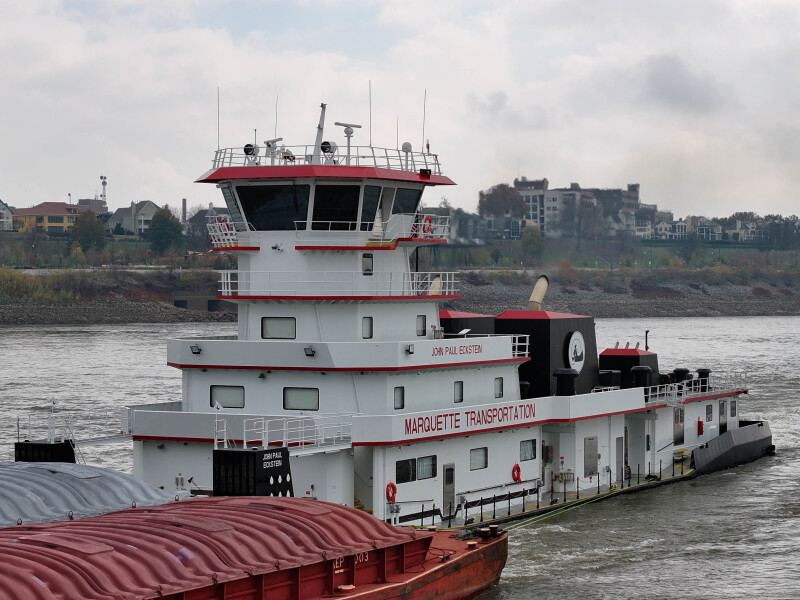
Larry Sibley, captain aboard the 10,000-hp linehaul towboat John Paul Eckstein, delivered from C&C to Marquette Transportation Co., Paducah, Ky., in December, said onboard accommodations, which include 12 berths distributed across 10 staterooms, are improved “massively” compared with those of towboats from previous generations. “The noise is so much less. Vibration is so much less,” he said. “It makes a big difference.”
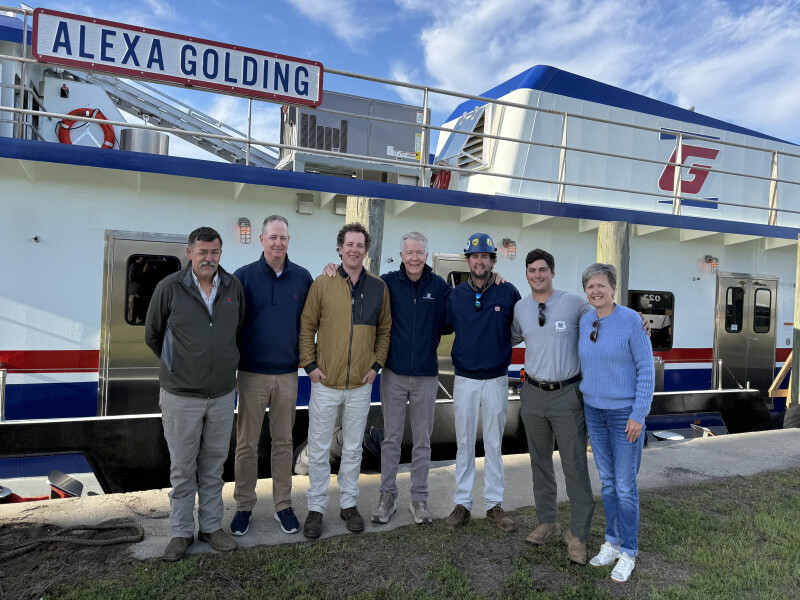
Golding Barge Line Inc., Vicksburg, Miss., has been adding vessels, too. In 2025, it took delivery of the 2,800-hp retractable pilothouse towboat Gage Golding from Steiner Shipyard, Bayou La Batre, Ala., which delivered a sistership, the Alexa Golding, to the same operator this year.
Gregory Marshall, the shipyard’s project manager, said the two Golding boats are the first retractable pilothouse vessels to be built by Steiner Shipyard under Subchapter M, noting the extra level of fitting and precision required for this type of vessel. “It definitely takes some tweaking to get that ram and pilothouse going up and down smoothly,” he said.
Steiner Shipyard is also building a pair of 130-footers for Florida Marine Transporters, Mandeville, La., including a retractable and a conventional vessel, Marshall said. Beyond that, the yard is looking to add to its backlog.
“We’d be open to signing contracts in June or July of this year and starting another vessel,” Marshall added. “We’ve seen a lot of specs come out to bid over the past three months. But with everything that’s going on in the government and overseas, prices are escalating. So, I don’t know if we’ll see contracts being signed until we get a little more clarity.”
Marshall said demand signals are present. “There’s definitely a need for more Subchapter M pushboats, and it seems like a lot of these guys are going with a bigger longline boat, so we anticipate some larger vessels in the future,” he said, noting that the yard has built boats up to 250' long and 70' wide.
MAINTENANCE & REPAIR
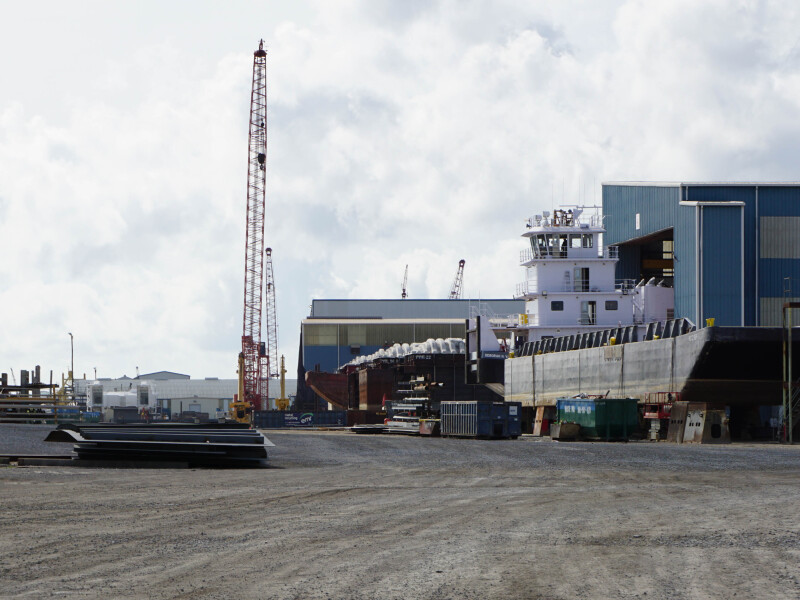
Steiner Shipyard balances openings with a steady stream of maintenance and repair work. “That’s been really big for us down here on the bayou. We’ve seen a lot of growth with the repair yard over the past few years,” Marshall said. “We’re really interested in getting more involved with Subchapter M pushboat renewal work. There are a lot of five-year checks coming up in the near future, so hopefully we can find some time to fit some of those in along with the dredging contractors, Subchapter T, and Subchapter K ferries that have been coming in and out of here.”
In general, escalating costs are pushing operators toward repair and overhaul rather than new construction, Cibilich said. “Given the substantial increase in new construction costs, a lot of operators are prioritizing extending the service life of their existing vessels through more repair and maintenance,” he explained.
Inevitably, the calculus will shift. “There are practical limits to how long a vessel can stay economically viable. Eventually, replacement becomes unavoidable,” Cibilich said.
When that moment arrives, operators may find themselves caught off guard. “What people miss in this calculation is timing risk. Replacement decisions can be deferred, but they can’t be avoided indefinitely,” Cibilich said. “When an operator finally needs to move, shipyard availability becomes the constraint, not just price.
“The yards capable of delivering quality tonnage on commercial timelines are a finite resource. If you’re planning fleet renewal, you need to be thinking about capacity access just as much as cost,” he added.
Both Marshall and Cibilich are optimistic, particularly amid increased signals of federal support toward the U.S. maritime industry, and each believes steady demand for new towboats will return.
“Look, the capacity picture is shifting in ways the market hasn’t fully caught up to yet,” Cibilich said. “The federal government is expanding its engagement with smaller shipyards, and as those contracts ramp, capacity is going to shift away from commercial work. At the same time, inland fleet aging is accelerating the need for replacement tonnage. Our approach — executing contracted work while building spec inventory — is designed for this exact environment.”
The dynamic will further separate those who are prepared from those who are not, Cibilich said: “Operators who plan ahead will have vessels available when they need them. Those who wait will be competing for slots that may not exist.”
