



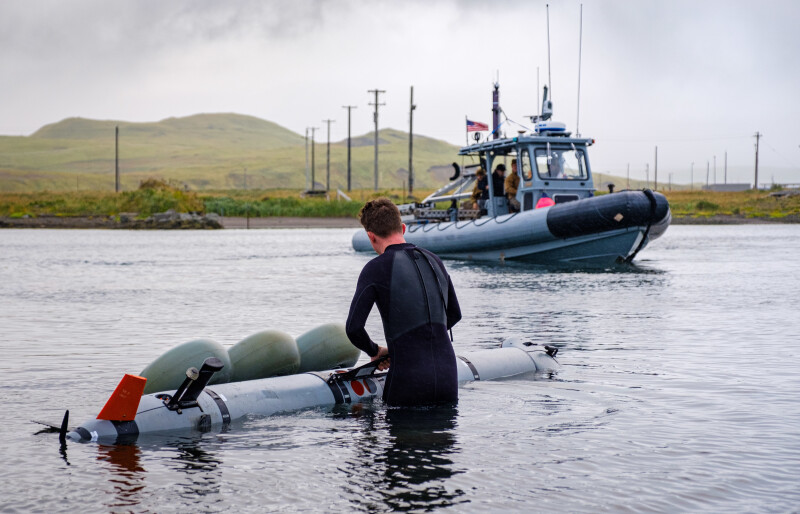
The U.S. Navy is inviting industry participants to take part in a new undersea security initiative focused on autonomous vessels, maritime surveillance, and technologies to protect strategic ports, harbors, and assets in transit.
Strategic Systems Programs (SSP) outlined 22 areas of interest for the Next Generation Undersea Security Initiative (NG-USI), a prototype development effort aimed at bringing industry and nonprofit organizations together to advance new security technologies.
Among the focus areas are counter-unmanned systems capable of detecting, tracking, identifying, and defeating threats across the aerial, surface, and underwater domains. The notice calls for scalable technologies for shore installations and afloat operations in ports, harbors, littoral areas, waterways, and open-ocean environments.
The initiative also calls for new harbor and expeditionary surveillance capabilities to provide persistent maritime domain awareness at strategic ports and harbors. Potential technologies include mobile surveillance kits, unattended surface and underwater sensors, and camera systems equipped with automated threat recognition for maritime environments.
Autonomous platforms are another area of interest. According to the notice, the Navy is looking at commercial robotic systems for persistent patrol, automated inspection, and rapid response. Unmanned surface vessels could be used for waterside patrol, while unmanned ground vehicles could support perimeter screening.
The Navy is also seeking technologies tied to strategic maritime transit and escort security. The focus area includes maritime situational awareness and technologies designed to protect strategic assets while underway.
Other areas covered by NG-USI include signal mitigation for submarines and unmanned systems, electronic security and sensor fusion, counter-autonomy and artificial intelligence capabilities, and advanced weapons and fire control technologies.
SSP said the initiative is intended to create a “sphere of technological excellence” capable of rapidly developing prototype solutions for undersea security requirements.
Projects are expected to be carried out through Other Transaction Authority agreements under the terms of a Participant Basic Agreement. Organizations interested in participating must demonstrate recent and technically relevant experience in the focus areas they intend to pursue.
