



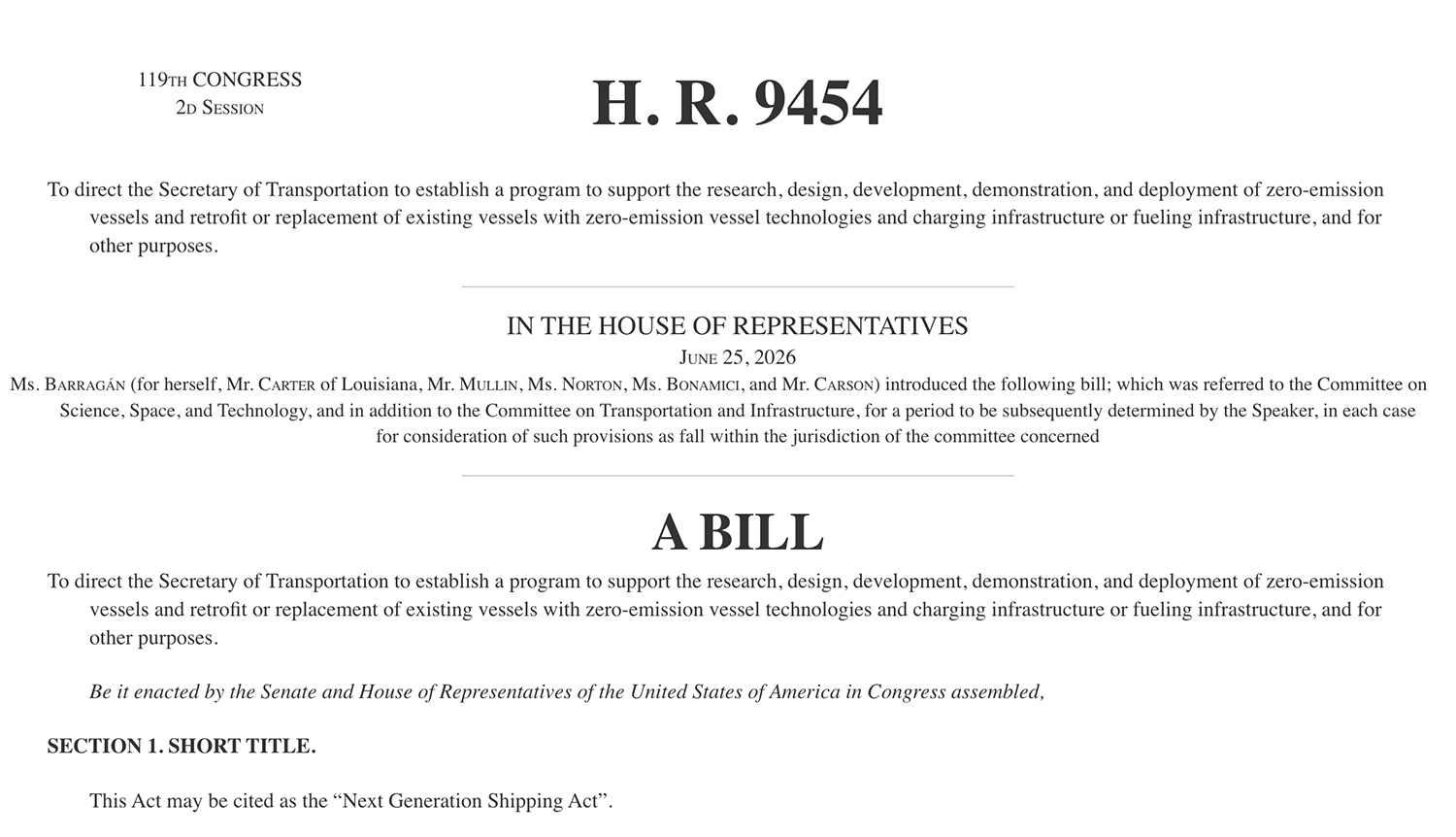
A trio of congressional Democrats has reintroduced legislation that would create a billion-dollar-per-year grant program within the Department of Transportation’s Maritime Administration to support technologies that reduce or eliminate vessel emissions. This is the second time around for the Next Generation Shipping Act, which was first introduced in November 2024 as the “Zero-Emission Vessel Innovation Act.”
“Maritime commerce is a key economic driver in our state, with the Port of Baltimore alone supporting more than 273,000 good-paying jobs in Maryland,” said Sen. Chris Van Hollen, D-Md. “That’s why we’re fighting for resources to strengthen U.S. competitiveness in the global shipping industry by modernizing our nation’s maritime economy and building the maritime workforce of the future. With this legislation, we begin to meet the clean shipping demands of today and tomorrow.”
The bill —introduced by Van Hollen with Rep. Nanette Barragán, D-Calif., and Troy Carter Sr., D-La. — would create the “Next Generation Shipping Innovation Program,” a 10-year, $10 billion Marad grant program aimed at investing in “zero-emission vessels, clean alternative fuel vessels, shore power, charging and fueling infrastructure, vessel efficiency technologies, and related maritime innovations,” while also developing domestic supply chains and workforce development and training programs. Eligible projects, as defined by the bill, would support the research, design, demonstration, development, and deployment of zero-emission vessels, clean alternative fuel vessels, “vessel energy efficiency technology (such as wind assistance and systems that minimize underwater noise emissions),” shore power and corresponding vessel technology, and infrastructure to support the deployment of zero-emission and clean alternative fuel vessels.
“Maritime innovation is essential to America’s economic and environmental future,” Carter said, “and the Next Generation Shipping Act delivers the bold, forward-looking investment needed to keep our nation competitive. By advancing zero-emission vessels, modernizing port infrastructure, and strengthening domestic shipbuilding, this legislation charts a cleaner, smarter course for the shipping industry.”
As lead sponsor in the House, Barragán placed the emphasis of the bill on community health.
“Shipping plays a vital role in our economy, and at the Ports of Los Angeles and Long Beach, but it should not come at the expense of the health of our families,” Barragán said. “The Next Generation Shipping Act is about investing in cleaner technologies, supporting American jobs, making sure the United States leads in the future of maritime innovation, all while making sure we do so in a way that preserves public health.”
Reintroduction of the Next Generation Shipping Act comes at a complicated time for maritime policy and industry in the United States, with much fanfare following the release of the Trump administration’s Maritime Action Plan earlier this year and outspoken criticism over the ongoing waiver to the Jones Act. The bill also faces competition from the bipartisan SHIPS for America Act, reintroduced a year ago.
While the Next Generation Shipping Act has garnered support from a wide range of environmental and community organizations, the bill also has backers in the maritime industry, including ABB and Elliott Bay Design Group.
