


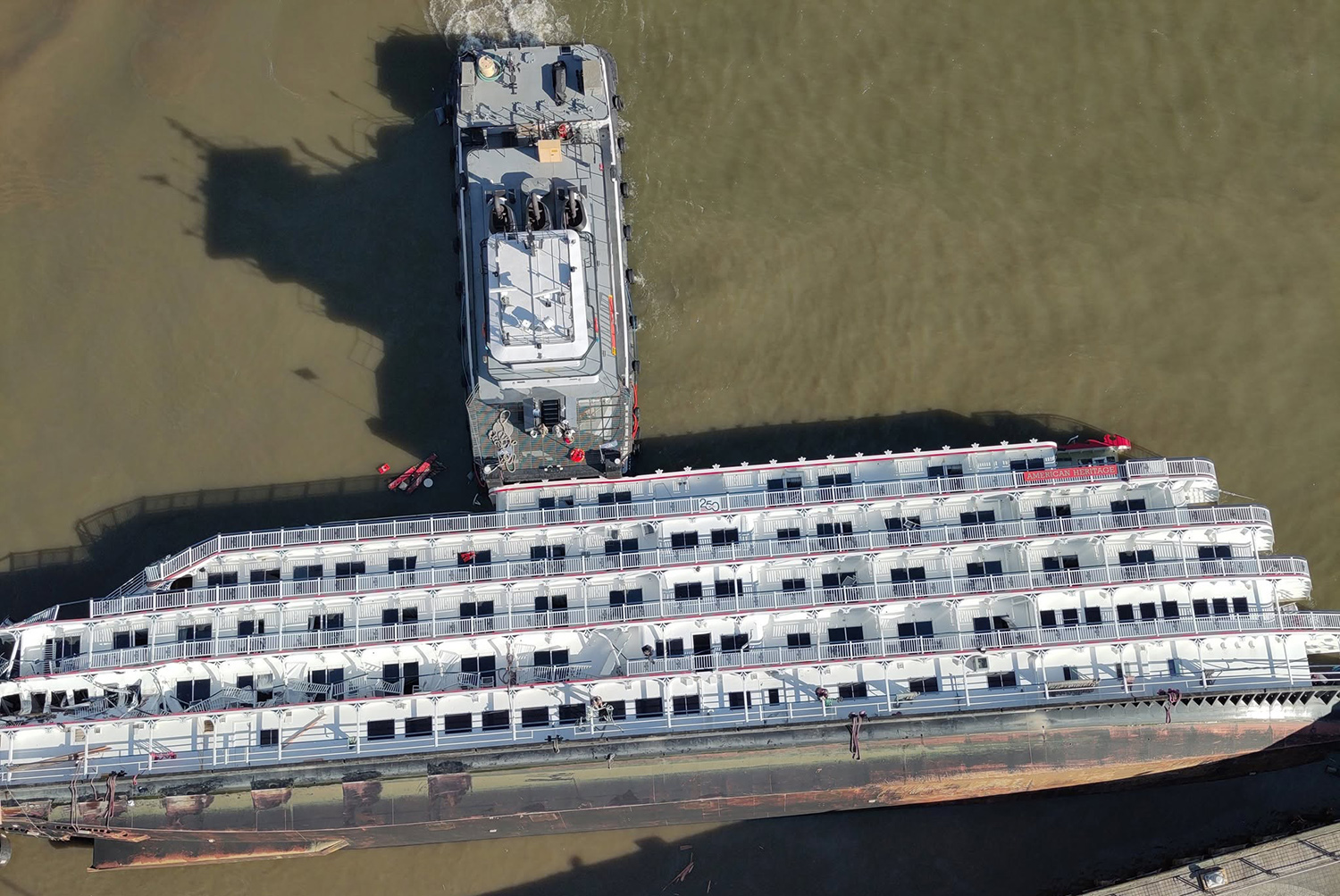
The replay from AIS of the “Miracle on the Mississippi” in New Orleans Nov. 13 is nothing short of amazing.
About 12:30 p.m. that day, the tanker Atlantic Asphalt experienced a steering failure and allided with the docked riverboat American Heritage, causing the riverboat to capsize and sending about 100 of its 190 passengers and crew into the water.
Still images from the scene and dockside videos captured the moment the ship struck the American Heritage broadside and the dramatic scenes from the rescue that followed. The replay from AIS, though, records an aspect of the Miracle on the Mississippi that still images and video reels cannot — the speed at which vessels of all sizes and sorts from the New Orleans harbor swarmed to scene in response to calls for help. The fleet of responding vessels included the Port of New Orleans fireboat Gen. Roy S. Kelley, the RTA1 ferry, a Coast Guard fast response boat, and more than a dozen commercial vessels.
“When something goes wrong on the river, the first boats you usually see on scene are towboats and tugs,” said Kenny Brown, a seasoned towboat captain and founder of Maritime Throwdown. “Nobody calls them in. They’re already there, and they turn toward the trouble.”
Stone Oil response
Among the closest vessels to the allision was the fleet of John W. Stone Oil Distributor, located almost directly across the river from the Port of New Orleans, where the American Heritage was docked. Among that fleet was the Madison Stone, which was shifting a barge when the allision occurred.
“One of our other boats that was a little bit closer came and shoved alongside [the American Heritage] as soon as the collision happened to try to keep it upright,” Capt. Ryan Williams, a captain aboard the Madison Stone, said of the Stone Power.
As the tanker came off the American Heritage, though, and as the riverboat began to list and capsize, the Stone Power had to back away to a safe distance. Then, once the American Heritage rolled onto its side, the Madison Stone moved into position, push knees faced up against the roof of the riverboat. Williams said his crew’s familiarity with the contours of the river at that location led them to take that action.
“We’ve fueled them up quite often, so we knew the depths,” Williams said. “We knew it’s 20 feet or 25 feet on a low river, and we knew where it falls off. We knew, if the ship moved, it could essentially slide off that shelf into deeper water. With us being on the roof, pinning it back up against the riverwalk, we had pretty good confidence it would stick in the mud.”
With Capt. William “Woody” Brunner at the helm, Williams and the rest of the Madison Stone crew went out on deck to assist the riverboat’s passengers and crew members who were either in the water or clinging to the starboard side of the vessel, which was now pointing skyward.
“People were just popping out of holes [windows] if they could, and we were there assisting the older people that couldn’t get out,” Williams said. “We were assisting everybody to get on our boat, grabbing life jackets, and making sure everybody was safe. There was one room where the windows did not open, and they had four individuals in it. We broke the window with a cheater pipe, and I jumped in with them, because they had two older women who were pretty frightened and panicking quite a bit.”
In all, 27 passengers and crew members from the American Heritage made it onto the Madison Stone before being transferring to the dock via other vessels. After that, the Madison Stone crew walked out on the American Heritage to catch lines to secure it to the dock.
“Fortunately, there was a guy who worked for Associated Terminals walking up and down the riverwalk, and he was able to catch our heaving line and throw it around the timberheads there on the dock,” Williams said.
In all, four towboats from Stone Oil’s fleet responded to the allision.
Canal Barge’s Elly Lane
When the call for help went out on VHF, Canal Barge Company’s Elly Lane was just upriver in Harvey, La., with pilot Miles Smith on watch in the wheelhouse.
“I was actually looking at our Rose Point system and heard the initial call from the pilot on the tanker about a potential loss of steering underneath the GNO [bridge],” Smith said. “I immediately alerted Capt. Clyde [Bowen] that there was potential for a situation just below us downriver.”
Bowen and Smith made the immediate decision to get underway.
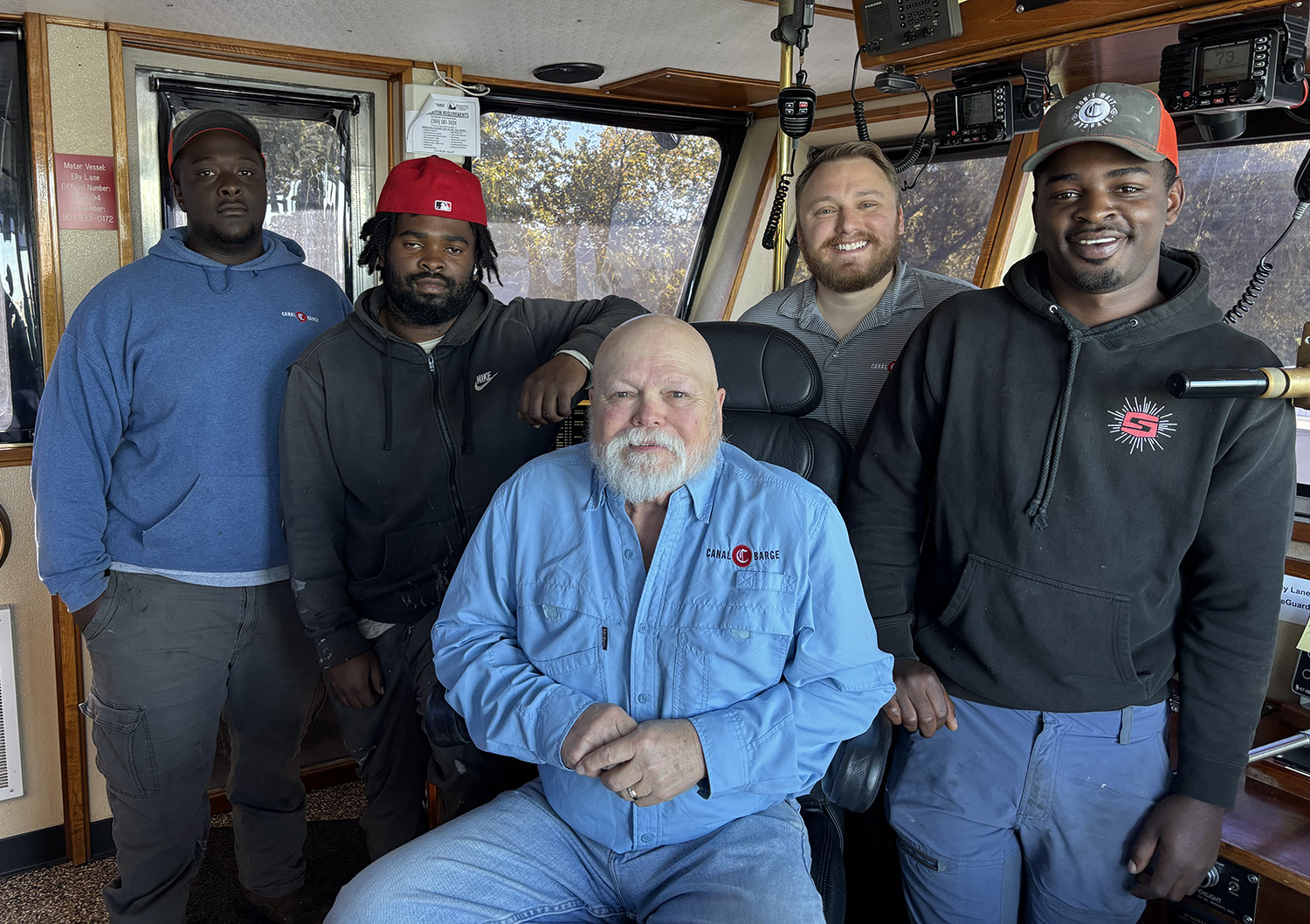
“As we were arriving, multiple boats were already on scene, and there was already an attempt at that point to try to stabilize the Heritage,” Smith said. “Capt. Clyde was at the sticks, and he made the decision at that point, after seeing the individuals in the water, to go downriver of their location.”
Smith explained that the design of the Elly Lane, which sits low in the water and has no bulwarks, was advantageous for water rescues.
“There was a good, cooperative agreement to let us up in there, so that we could hopefully get people alongside and onto the deck of the Elly a little bit easier,” Smith said.
The boat’s design also made it easier for smaller vessels to come alongside and transfer passengers from the Heritage on board. With Bowen at the sticks, Smith and the Elly’s two deckhands were able to rescue 14 passengers and crew members from the riverboat.
“I want to commend the crew of the Cooper Mooring vessel that was already pulling people out of the water,” Smith said. “We were able to secure them to the side of the Elly and then aid in helping them pull those remain individuals out.”
Once on the people were board, the crew of the Elly Lane began giving out blankets to help ward off hypothermia in the chilly November water.
Training for a miracle
The accounts of the Madison Stone and Elly Lane are just two of the stories of heroism and service that have emerged since the Nov. 13 allision and sinking of the American Heritage. Another example is New Orleans Harbor Police Chief Melanie Montroll sending a pair of officers aboard the American Heritage to help coordinate the evacuation. Those officers were on board when the vessel went down, and they were among the 32 who were hospitalized with non-life-threatening injuries.
And then there was Capt. Leonard Stewart, captain of the American Heritage, who also stayed on board as the riverboat went down.
“We would like to recognize Capt. Leonard Stewart,” vessel owner American Cruise Lines said in a statement after the event, “whose immediate and decisive actions with the crew allowed for the rapid evacuation of the vessel. Capt. Stewart remained on the bridge as the vessel capsized, calling for aid and keeping the ship alongside the dock for as long as possible.”
The response and the fact that all of the roughly 190 passengers and crew members survived the allision has been called a miracle. For the crews aboard the Elly Lane and the Madison Stone, an integral part of that miracle was the safety training and selfless response of all the commercial mariners that responded.
“If it had been in high water, it might have been a totally different incident,” said Bowen, who later added, “When something happens in the marine industry, especially in private industry, if there’s something going wrong and there’s a mayday, the response is great.”
“It was truly a collaborative effort, and we’re so thankful that we could’ve been a part of it in the way that we were,” Miles said.
Miles also said he wishes everyone involved a speedy mental and physical recovery.
“We know that both of those will be a considerable uphill battle,” he said. “Our heart is truly with the victims.”
Williams concurred.
“By the time the ship had blown us five whistles, dropped the anchors, and was already turned, you’re looking at less than two minutes,” Williams said. “And again, on that cruise ship, it’s essentially all people 55 and older. To get everybody out, safely away from the crash site, I would go with ‘Miracle on the Mississippi.’
“We were there,” Williams added. “God put us there. That situation happened there. Everybody was there for a reason. The people who showed up — the Gen. Roy S. Kelley, the Coast Guard, the fire department — everybody was there within minutes. It took no time for everybody to get there and start doing what they were trained to do.”
Williams said that’s why mariners do weekly and monthly training exercises — to be ready when needed.
“These drills are done seriously,” he said. “We do them for a reason.”
Investigation update
Salvage efforts at the American Heritage are underway, and the investigation by the National Transportation Safety Board (NTSB) is ongoing. NTSB officials have recovered the voyage data recorder (VDR) from aboard the Atlantic Asphalt. A preliminary review of that data confirmed the ship experienced “a steering casualty that resulted in the rudder remaining to starboard,” said Bart Barnum, senior marine accident investigator with the NTSB.
The VDR also recorded the sounding of the ship’s whistle, a mayday over the ship’s marine radio, deployment of the ship’s anchors, and emergency maneuvering orders.
The allision with the American Heritage occurred at about 12:28 p.m., and the riverboat capsized about 22 minutes later, according to NTSB officials. The NTSB is expected to release a preliminary report by mid-December.
