



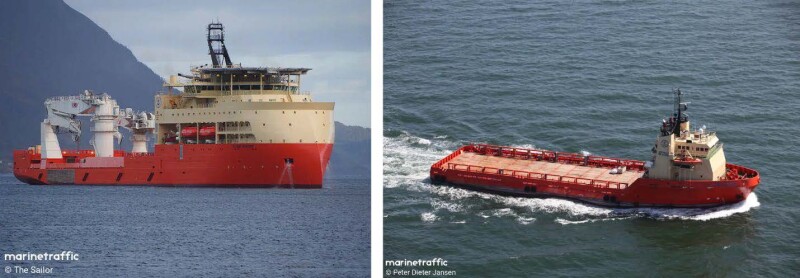
An offshore construction vessel’s crane cable parted as it was lifting a wire reel from the aft deck of an offshore supply vessel at Port Fourchon, La., in April 2025, apparently due to internal corrosion of the cable after eight years of use in subsea work, the National Transportation Safety Board reported Wednesday.
The 524’ offshore construction vessel Island Venture's crane was being used in Bayou Lafourche for the lift around 9:45 p.m. April 3, 2025, when the crane cable parted and dropped the reel onto the deck of the 240’ OSV C-Enforcer.
Both vessels were operated by Galliano Marine Service LLC and owned by affiliates of the Edison Chouest Offshore group. There were no injuries and no pollution; damages to the C-Enforcer and Island Venture were estimated at $3.8 million.
The subsea crane was a knuckle-boom-style crane, with the hoisting winch located below deck, and the crane was specifically designed for load-handling toward the seabed, underwater installations, or other fixed targets. As built, the crane’s safe working load was 400 metric tons; on the day of the casualty it was rated for 320 MT.
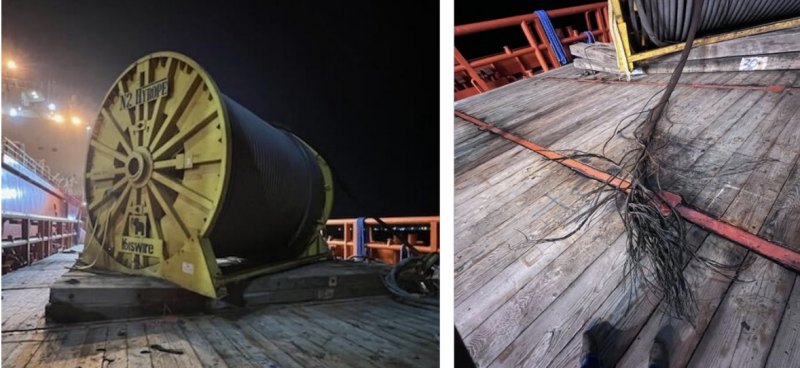
The C-Enforcer had docked at Port Fourchon, where shoreside personnel had loaded a 338-MT wire reel via a shoreside crane onto the main deck. The reel was comprised of spooled wire 5” (128 millimeters) in nominal diameter and 13,451’ (4,100 meters) in length; was intended as a replacement hoisting wire rope for the Island Venture’s subsea crane.
The Island Venture was moored at the C-Innovation dock, where the C-Enforcer positioned alongside the Island Venture’s starboard side so that the wire reel could be offloaded by the Island Venture’s crane.
A lift team that included two riggers and a crane operator completed a lifting and hoisting plan according to the operating company’s safety management system. This involved completing a pre-job checklist, which included a risk assessment and job assignments; holding a meeting for the lift team to discuss the plan; and completing a pre-use checklist for the crane, which included a visual inspection of the crane’s machinery and components.
“No abnormalities were noted,” according to an NTSB narrative. At 8 p.m. the two riggers “boarded the C-Enforcer to rig the wire reel for the lift and to communicate with the crane operator. Around 9 p.m. the crane operator proceeded with lifting the wire reel off the main deck of C-Enforcer. The crane operator first completed a safety check, using the crane to raise the wire reel a few feet, then lowering the wire reel back onto the deck (the crane operator had to activate the override function to complete the lift.”
“Once the crane operator had confirmation from the riggers that everything looked good, they proceeded with the lift. The crane operator and one rigger stated that, as the lift began, the wire reel was free of obstruction, and the reel was rising smoothly.”
After about 15 minutes, the crane operator stopped the lift to allow the ballast system aboard the Island Venture to even the trim. About 5 minutes after that, once he had ensured the load was straight, the crane operator proceeded with lifting the wire reel.
When the reel was 5’ to 10’ above the deck, the main hoisting wire parted about 70’ from the base of the crane block socket, causing the wire reel to fall onto the main deck of C-Enforcer.
After the wire parted, its recoil damaged a hydraulic line on the upper crane pedestal on the Island Venture. Sensing the drop in hydraulic pressure, the crane’s safety system stopped hydraulic fluid flow. The rigging crew on the C-Enforcer and the crane operator on Island Venture were uninjured. The following day, the casualty was reported to the US Coast Guard. The C-Enforcer transited back to the Fourchon Heavy Lift yard with the wire reel aboard; the reel was offloaded using a shoreside crane.
After the casualty, Coast Guard and National Transportation Safety Board investigators visually examined the parted hoisting wire and the remaining wire on board Island Venture (see figure 6). The hoisting wire showed internal and external oxidation (rust). The outside diameter of the wire had minimum and intermittent aged lubrication grease coverage throughout the length.
The Island Venture’s crane had been installed on the vessel in 2017 and was used primarily for subsea work. At the time of the casualty, the crane’s hoisting wire was 10 years old and had been in service for 8 years. The crane operator stated that when the crane was used for subsea work, the wire could be submerged to depths ranging from 1,800 meters (5,905’) and up to 2200 meters (7,217’) and stay submerged for up to 24 hours as part of operations.
Coast Guard and NTSB investigators analyzing the cable reported that “the outer layer of the remaining hoisting wire on board that was examined had minimum and intermittent aged grease coverage. The hoisting wire had been in service for 8 years, and during its service life, the wire was used in subsea operations and exposed to salt water, salt air, and humid conditions.”
The last high-pressure lubrication process on the cable was conducted in April 2023, according to the report. “To reduce the effects of salt water, the crew typically completed a freshwater rinse of the crane’s hoisting wire whenever they retrieved it from subsea operations. The most recent freshwater rinse had been completed about a month and a half before the casualty.”
In its summary, the NTSB concluded “the probable cause of the failure of the hoisting wire on the offshore construction vessel Island Venture’s crane was internal corrosion of the crane’s hoisting wire.”
