



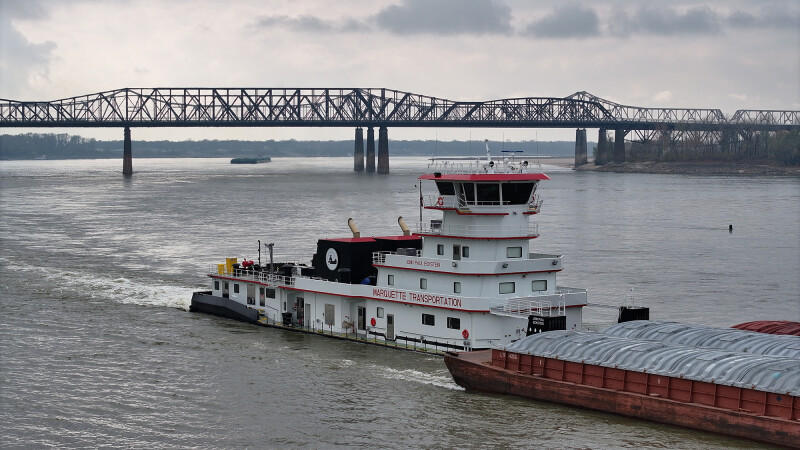
It’s only fitting that the new flagship of the Marquette Transportation Co. fleet bears the name of the person who led the company as it scaled to become one of the leading operators on the U.S. river system.
The John Paul Eckstein, named after the company’s longtime president — now executive chairman — was christened during a January ceremony in New Orleans.
Eckstein joined Marquette in 1990 and became president a year later. He led the company for nearly three decades before transitioning to executive chairman in 2020. Under his leadership, Marquette grew from five towboats to more than 130 vessels. Today, alongside sister company Canal Barge Co., New Orleans, the pair operates nearly 200 boats.
“John’s success, in my mind, has been driven by his relentless competitive drive, creative and innovative thinking, the sacred way he treats the trust of our customer partners, and most importantly, his phenomenal capabilities as a leader,” said Marquette CEO Damon Judd.
“Towboats are in my blood. I’ve been around the [Mississippi] river my whole life, and it’s a real honor to have this vessel named after me.” Eckstein said.
The new 189'x50' towboat, designed by CT Marine, Portland, Maine, and built by C&C Marine and Repair, Belle Chasse, La., entered service in October, operating between St. Louis and New Orleans. The vessel is notable not only for its namesake but also for its power and innovative design.
The 10,000-hp vessel features twin Caterpillar C280-12 main engines supplied by Louisiana CAT. Each engine is connected to Reintjes WAF 6755H reduction gears with a 5.05:1 ratio, provided by Karl Senner LLC. Large 122"-diameter Hung Shen propellers operate inside Kort nozzles and are maneuvered using TwinDIFF steering from CT Marine.
Jerry Jarrett, Marquette’s senior vice president of engineering, worked with the naval architect and the shipyard to make several impactful changes to a previous design, including reducing the length and draft and developing a unique steering system.
The John Paul Eckstein is the only towboat running a high-lift steering rudder system, Jarrett said. “The vessel absolutely does not slide. By having that rudder design, it changes the water flow,” he said. “You have the advantage of having a low-pressure/high-pressure side on a rudder, which helps you to maneuver.”
Electrical power is supplied by three Caterpillar C9.3 gensets rated at 250 kW each, also furnished by Louisiana CAT.
The vessel’s tank capacities include 120,000 gals. of fuel, 16,000 gals. fresh water, 2,000 gals. lubricating oil, and 1,000 gals. gear oil. Propulsion shafts were built by J&S Machine, with Duramax seals and Thordon bearings. Duramax also provided the engine cooling package. Engine monitoring and alarm systems, along with the steering controls, were supplied by Eagle Control Systems.
Deck equipment includes six 65-ton electric winches from Patterson, supplemented by two 40-ton manual winches and a dozen 65-ton roller buttons. A Wintech capstan completes the deck machinery outfit.
For navigation and communications, Gmeni Marine Electronics installed Furuno systems, while Hiller delivered the smoke and heat detection equipment as well as the fire suppression system. Fendering was supplied by Schuyler Maritime.
Beyond the technical specifications, crew comfort was a major design priority. Onboard accommodations, which include 12 berths distributed across 10 staterooms, are improved “massively” compared with those of towboats from previous generations, said Capt. Larry Sibley, captain aboard the John Paul Eckstein. “The noise is so much less. Vibration is so much less… It makes a big difference.”
