



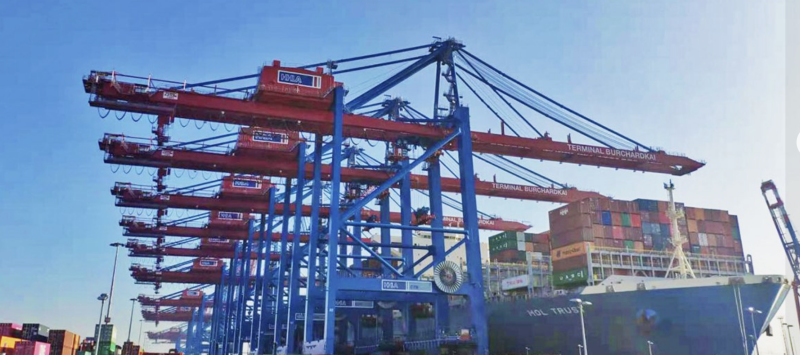
U.S. ports need more than 100 new or replacement ship-to-shore cranes to accommodate larger container vessels, part of an estimated $6.7 billion in near-term capital “to maintain efficiency and global competitiveness,” according to a survey by the National Association of Waterfront Employers (NAWE).
The report issued May 19 was based on information from 25 senior port and terminal executives. The findings stressed that ship-to-shore (STS) cranes and cargo handling equipment are foremostly the big-ticket costs.
Over the next five years executives foresee needs for:
- $2.74 billion for new STS crane purchases
- $2.4 billion for large yard cargo handling equipment and additional STS cranes
- $917 million to acquire rail-mounted large yard cargo handling equipment
- $790 million for repairing to existing STS cranes and cargo handling equipment at marine terminals
“These findings underscore the scale and urgency of the investment challenge facing U.S. ports,” said NAWE president Carl Bentzel. “Modern cargo handling equipment is essential to ensuring terminal productivity, supply chain resilience, and the ability of U.S. ports to compete with international gateways.”
“To invest in this equipment is an investment in securing America’s future and supply chain and will be the linchpin to unlock tens of billions of private sector investment in related intermodal infrastructure.”
The findings arrived amid continuing uncertainty over Trump administration tariff policies affecting STS cranes and cargo handling equipment. In a May 18 letter to the U.S. Trade Representative Ambassador Jamieson Greer, the association described in detail their concerns over the possible outcome of the present one-year pause on Chinese imports of ship-to-shore cranes.
The letter questions about the implementation of the one-year pause on tariffs, “including how the policy applies to equipment orders, deliveries, and parts,” according to the association. The group is also concerned “about the gap between current U.S. manufacturing capacity and immediate port infrastructure needs, noting that a lack of clarity could delay critical equipment purchases.”
“Having clarity on tariff policy is essential for terminal operators making long-term investment decisions in our nation’s ports,” said Bentzel. “Uncertainty risks delaying projects that are vital to maintaining the efficiency of the U.S. supply chain.”
