



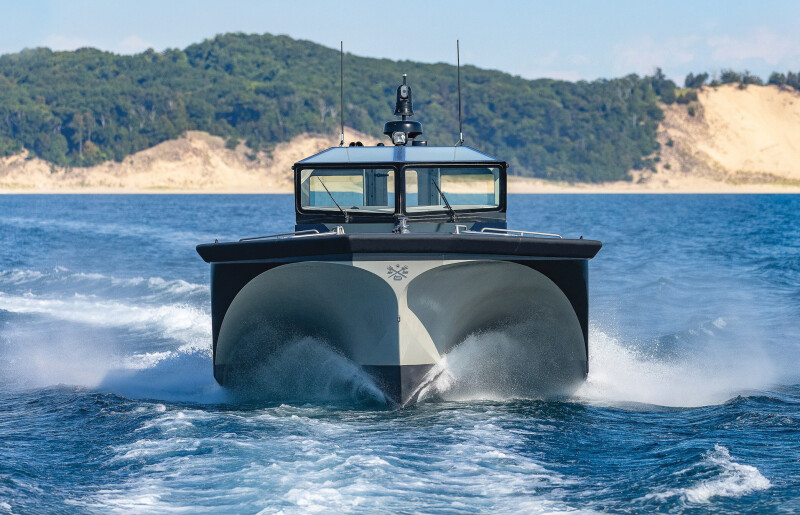
Ghostworks Marine, Holland, Mich., has introduced a remote-piloting and autonomy system intended to expand the range of missions that can be carried out by its unmanned vessels.
The Multirole Remote Littoral Node, known as MRLN, was unveiled July 14 at the Pennsylvania Defense and Innovation Summit at the U.S. Army War College in Carlisle, Pa.
Developed with General Atomics Aeronautical Systems Inc. and Mercury Marine, the system combines remote vessel control, autonomous operation, sensors, and propulsion controls. Ghostworks plans to use it across its M-Hull and powercat vessel designs.
The first installation is aboard Minerva, a 40' carbon-fiber M-Hull built by Ghostworks. The company said the vessel can carry 17,500 lbs. while cruising at 30 knots and operate in Sea State 4.
MRLN is designed for intelligence and surveillance, littoral resupply, mine countermeasures, communications relay, and logistics support. Operators can change mission configurations in the field without modifying the vessel for each assignment.
A remote operator can monitor the vessel and take control when necessary, even when it is running autonomously.
Ghostworks designed and built the Minerva platform. General Atomics adapted autonomy and sensor technology developed for remotely piloted aircraft, and Mercury Marine provided drive-by-wire propulsion controls and its Command Gateway system.
“For decades, naval planners have had to accept that speed, range, and payload pull against each other,” said Brooke Kerschbaumer, CEO of Ghostworks. “MRLN gives operators human-in-the-loop command and control over that tradeoff space, mission to mission, without changing platforms.”
Carl Greiner, Mercury Marine’s director of government and advanced maritime systems, said the company focused on the control and reliability requirements of extended surface operations.
“This integration expands what’s achievable in a remote-piloted maritime system,” Greiner said.
