


.jpeg.author-image.300x300.jpg)
The last six weeks have made one thing clear: maritime autonomy is no longer a future-state defense concept. It is now part of the operating reality of modern conflict.
The Strait of Hormuz has reminded the world how quickly a narrow body of water can become a global strategic pressure point. Energy markets, shipping lanes, military posture, commercial risk, and geopolitical signaling can all be shaped by what happens in a contested maritime chokepoint.
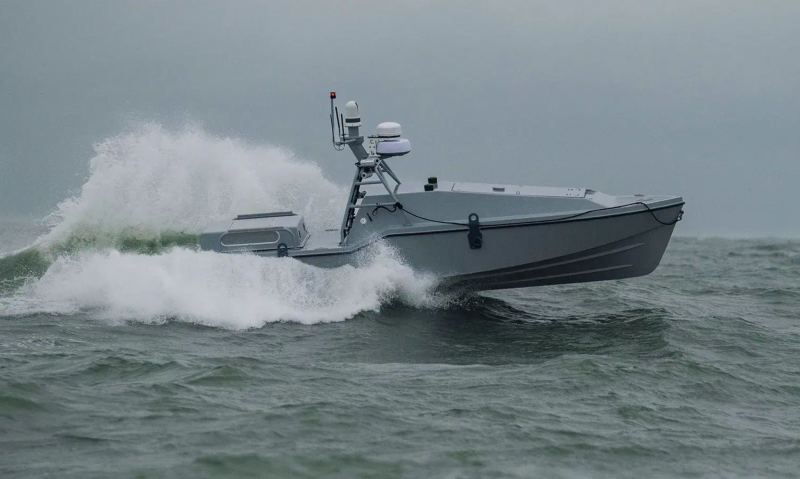
This week, that reality became even clearer. In what U.S. Central Command described as the first operational employment of U.S. autonomous surface vessels in combat, three autonomous Corsair uncrewed surface vessels (USV) manufactured by Saronic were used to strike an Iranian naval facility near the Strait of Hormuz. The operation demonstrated that USVs have moved beyond experimentation and into operational warfare, providing a real-world example of how autonomous maritime systems can deliver combat effects while reducing risk to personnel.
The previously reported rescue of a downed two-person Apache crew using a USV showed something equally important. USVs are not just theoretical tools for future fleets. They can extend reach, reduce risk to personnel, and perform critical missions in environments where speed, persistence, and distributed presence matter.
That is the new maritime lesson.
The future of naval power will not be defined only by larger ships, longer-range missiles, or more exquisite platforms. It will be defined by the ability to deploy autonomous systems at speed, connect them across domains, manufacture them at scale, and adapt them as missions change.
We are now in the era of precise mass in war, driven by the use of low-cost autonomous systems with high-accuracy guidance. Earlier this year, the Pentagon requested a budget that earmarked $75 billion for drones and technologies to counter them, including $54.6 billion for the Defense Autonomous Working Group, up from just $225.9 million in 2025 and potentially the largest single year-over-year boost of any defense program.
These staggering figures remind us of the vast scope of contemporary battlespaces, with contested environments spread across air, land, cyber, and sea. But the events around Hormuz explain why the maritime domain has moved to the center of the conversation. Our planet is 70% water, and maritime power underpins global trade, military force projection, and geopolitical competition. In a crisis, the water's edge can quickly become the point where economic security, national security, and military readiness converge.
For the U.S. Navy and allied forces, this reality is colliding with contested logistics, shipbuilding bottlenecks, and increasingly distributed threats. The evaluation criteria for maritime capability are changing in real time. The central question is no longer whether autonomous USVs belong in the future fleet. The question is whether they can be made modular, interoperable, attritable, and scalable quickly enough to meet the pace of modern conflict.
The Hormuz Lesson: Low-Cost Systems Are Reshaping Maritime Risk
First-person-view drones have transformed conflict economics. A $500 drone can now destroy a $10 million asset, forever changing how risk is calculated, how missions are planned, and how resources are deployed. Those considerations have now moved decisively into the maritime domain, with potentially greater implications.
A distributed network of lower-cost autonomous vessels introduces new capabilities, including persistent intelligence, surveillance, and reconnaissance, operational ambiguity, area denial, personnel recovery, fleet-level disruption, logistics support, and electronic warfare. Instead of concentrating maritime power in a small number of highly expensive assets, naval forces can disperse a wider array of crewed and uncrewed systems across a large operating area, complicating an adversary's defensive strategy and increasing the number of problems they must solve at once.
The recent combat use of autonomous surface vessels in the Strait of Hormuz fundamentally changes the discussion around maritime autonomy. Until now, much of the conversation has been focused on future potential. Combat employment changes that equation. It validates that autonomous surface vessels are no longer simply developmental technologies. They are operational assets capable of contributing directly to modern military campaigns.
The reported use of a USV in a rescue operation near one of the world's most strategically sensitive waterways adds another dimension to this shift. Maritime autonomy is not only about strike, surveillance, or deterrence. It is also about survivability. In contested waters, the ability to send an uncrewed system into a dangerous operating area can compress response time, protect personnel, and create options that traditional platforms may not be able to provide without unacceptable risk.
Modern warfare is no longer defined by platform superiority alone, but by four variables: scale, speed, adaptability, and manufacturing agility. These core pillars define how quickly a force can respond, how long it can sustain operations, and how much pressure it can impose across distributed environments.
The U.S. Navy's Challenge: Organizational Adaptability
Traditional naval systems reflect decades of engineering excellence, but they also come with structural constraints. They are expensive, highly specialized, slow to field, difficult to upgrade, and dependent on long acquisition cycles. That model aligned with an earlier era of more predictable threats and stable development timelines, but modern conflicts evolve in the blink of an eye. Software updates, sensor requirements, communications needs, and mission profiles can all change in real time.
Under these conditions, adaptability becomes a primary performance metric.
This puts modularity and open architecture, often referred to as MOSA, or Modular Open Systems Approach, at the center of naval strategy. Autonomous systems must operate as flexible platforms rather than fixed configurations. They must be able to integrate sensors, AI software, communications systems, aerial assets, payloads, and future capabilities without requiring a complete redesign.
The future maritime environment will depend on seamless communication across air, land, sea, space, and cyber. Interoperability has become a primary concern because systems designed as part of an ecosystem will almost always outperform those designed as standalone assets. The battlespace is becoming too fast, too distributed, and too data-dependent for isolated platforms to create decisive advantage on their own.
Manufacturing Speed as a Strategic Differentiator
Recent global conflicts have reinforced an age-old lesson: manufacturing speed shapes battlefield outcomes. The ability to quickly produce, adapt, replace, and scale systems will determine operational resilience as well as strategic staying power.
Advanced manufacturing methods, including additive manufacturing, modular assembly, and digital engineering, are redefining how defense systems are built. They enable faster iteration cycles, reduced costs, and more scalable deployment. In a world where mission requirements can shift rapidly, the ability to modify a platform quickly may be just as important as the platform's initial performance specifications.
Manufacturing speed carries direct consequences for deterrence, readiness, and force design. Domestic manufacturing resilience has moved to the center of policy discussions, and supply chain independence, production capacity, and workforce readiness now influence national security outcomes as directly as platform performance.
Attritable systems are part of this conversation. These lower-cost systems are designed for repeated deployment at scale, enabling persistence and flexibility without placing the same level of financial or human risk on each mission. In maritime environments, they significantly expand operational options, supporting distributed sensing, surveillance, logistics, electronic warfare, ISR, rescue, and tactical strike in contested zones.
The result is a force that can absorb pressure, adapt quickly, and sustain operations over time.
Multi-Domain Operations Will Expose Integration Gaps
The future battlespace will be fully connected. Aerial systems will identify maritime activity. Autonomous surface vessels will extend tracking, persistence, and response. Command systems will fuse data into a unified operational picture that enhances decision-making with greater speed and clarity.
The recent strike against an Iranian naval facility illustrates exactly what this convergence looks like. Autonomous surface vessels did not operate in isolation; they formed part of a broader military operation, demonstrating how maritime autonomy is becoming an integrated component of multi-domain warfare. The significance is not simply that autonomous boats can carry out missions. It is that they can work as part of a connected operational architecture spanning multiple domains.
This is where the water's edge becomes so important. Maritime operations increasingly sit at the intersection of air, land, cyber, space, and sea. A threat that begins in the air may require a maritime response. A crisis at sea may reshape land-based military posture. A disruption to shipping lanes may trigger economic, diplomatic, and operational consequences at once.
In that environment, value is calculated by how well systems connect, share data, and operate together. Any gaps in interoperability become immediately visible and costly. Organizations that prioritize open architecture, shared interfaces, software-defined systems, and cross-domain integration will move faster and operate more effectively. Those that do not will encounter interruptions at the exact moment when speed matters most.
The lesson is clear: future maritime advantage will belong to the force that can connect more sensors, more platforms, more operators, and more data streams into a coordinated system of action.
The Maritime Industrial Base Must Evolve
America's maritime industrial base faces well-documented challenges: long production timelines, workforce shortages, supply chain dependencies, and rising costs. These issues are structural, and they intersect directly with strategic competition.
But autonomous systems offer a path forward. They extend reach, distribute risk, and increase maritime coverage without relying exclusively on traditional shipbuilding models. They do not replace the need for larger naval platforms, but they can augment them, protect them, support them, and expand their operational reach.
At the policy level, momentum is building. Federal initiatives focused on reshoring manufacturing, securing supply chains, and accelerating autonomous deployment are reshaping the industrial landscape. Public and private sectors are aligning around scalability, resilience, and speed, and industrial capacity is becoming directly proportional to operational capability.
The future fleet will be more distributed, more autonomous, and more software-defined. Crewed and uncrewed systems will operate together, extending reach and increasing decisive advantage across the force. The question is not whether maritime autonomy will matter. The question is how quickly the defense ecosystem can build, field, integrate, and scale the systems required for the next phase of conflict.
Turning the Tide
The global autonomous ships market is projected to reach $13.85 billion by 2034, driven in the U.S. by the Navy's ongoing large-scale investments in USVs. But the real story is no longer just market growth. It is operational urgency.
Withing the span of only two months, the Strait of Hormuz produced two defining demonstrations of maritime autonomy. One showed how autonomous surface vessels can save lives through personnel recovery. The other showed how they can deliver combat effects against strategic military targets. Together, they demonstrate that maritime autonomy has entered a new phase of operational maturity.
That is the larger shift now underway.
The leaders of the future will not be defined only by who owns the largest platforms or spends the most money. They will be defined by who can build integrated, scalable systems designed for the speed, complexity, and interconnected nature of modern conflict.
The future maritime force will need systems that can sense, move, connect, adapt, and scale. It will need platforms that reduce risk to personnel while extending operational reach. It will need manufacturing models that can keep pace with conflict, not acquisition cycles built for a slower era.
Because in a world that is 70% water, power is not only projected at sea. It is increasingly projected, protected, and multiplied by autonomous systems operating at the water's edge.
