



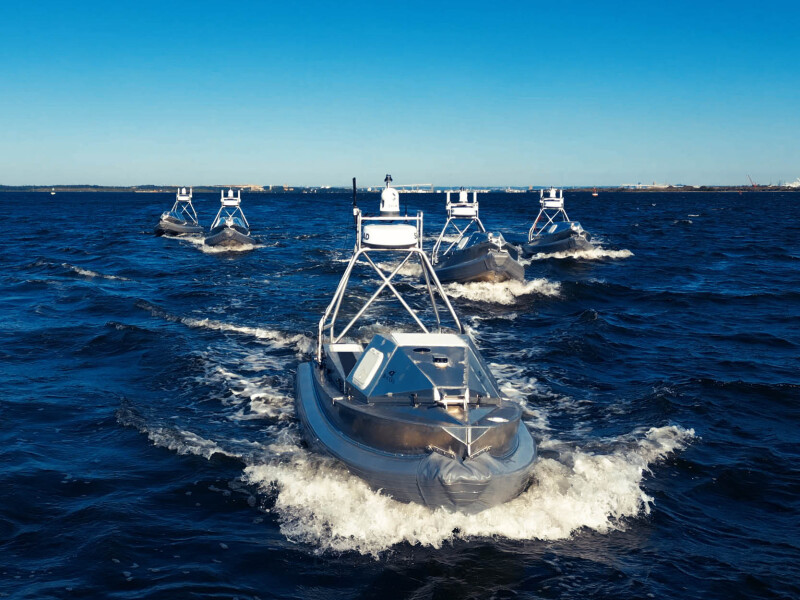
Convinced by lessons from the war in Ukraine — where small kamikaze uncrewed surface vessels (USVs) crippled or sank much larger Russian warships — and by the development of indigenous USVs by powerful rival nations such as China, the U.S. Navy is rapidly advancing plans to build out its own USV fleets. These plans span a range of platforms, including small, medium, and large vessels, as well as fully autonomous systems.
THE NAVY’S WANTS
When contacted for comment, the Navy’s Chief of Information Office declined to answer WorkBoat’s questions on the service’s USV programs, instead directing WorkBoat to separate testimonies made by Navy Secretary John C. Phelan and Chief of Naval Operations (CNO) Adm. Daryl L. Caudle to the Senate Armed Services Committee.
“If the last few years of conflict have taught us anything, it is that we will not win the wars of the future with the platforms of the past,” Phelan said during the June 10 hearing. “Success in modern warfare will require the rapid, scalable production and integration of air, surface, and subsurface unmanned systems (UxS). Recent warfighting in Ukraine and the Middle East demonstrates that while UxS have not replaced manned systems, they effectively serve as force multipliers, amplifying intelligence and lethal capabilities at significantly lower cost and reduced risk.”
“Unmanned systems are a force multiplier and provide options to manage risk to force and risk to mission across the spectrum of conflict,” said Caudle during his July 24 nomination hearing for CNO. “When paired with manned platforms, unmanned systems expand capacity and provide increased flexibility that is central to the success of Distributed Maritime Operations. The Navy is building a mix of high-end warfighting systems and affordable, attritable, and attainable systems that provide mass and scale to challenge our adversaries.”
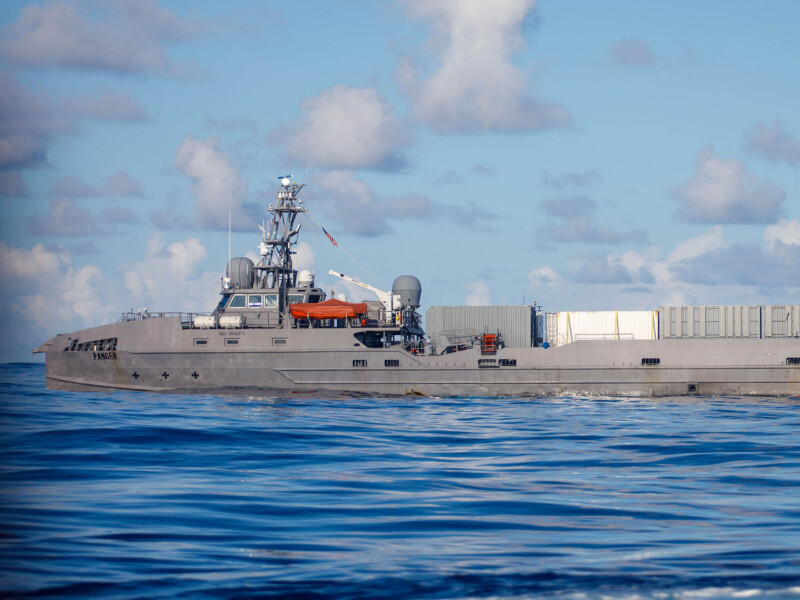
Brent Sadler, a senior research fellow for naval warfare at the Washington, D.C.–based think tank The Heritage Foundation, described to WorkBoat the 2021 launch of a Standard SM-6 surface-to-air missile — successfully intercepting an aerial target — from the Navy USV Ranger as a signal of the technology’s maturity.
The Navy will need USVs that are able to operate in the Philippine Sea and are armed with long-range strike weapons such as Tomahawk missiles and air/missile defense weapons such as Standard SM-6s, Sadler said.
Sadler said the Navy will also need smaller USVs for swarming tactics within the so-called first island chain of archipelagos off Asia in the western Pacific, which includes Taiwan. “These [USV] platforms provide the only viable option to get firepower to sea within the next 12 to 18 months in any meaningful scale in the Pacific. This is not [an] either/or proposition as these new platforms, along with recommitted shipbuilding of destroyers, submarines, [and] aircraft carriers, are urgently needed,” Sadler said.
“Reliability of systems, supply chain needs to sustain these platforms, and the tactics they will be used to execute” are the three key points that need to be understood about USVs for the Navy, he added.
The maritime industrial base has taken notice and is answering the call.
ENTER THE MANUFACTURERS
USV technology traces its origins to the late 19th century, beginning with Nikola Tesla’s demonstration of a radio-controlled boat at the 1898 Electrical Exhibition in New York’s Madison Square. Since then, uncrewed vessels have progressed substantially, especially in recent decades, with the arrival of semiautonomous and fully autonomous capabilities.
“Today’s USV technologies are maturing fast, but from BMT’s perspective, there is still work to do before they are fully adequate for the scale, complexity, and tempo that navies and operators are aiming for,” said William Champagne, business development manager at BMT Group Ltd., London.
In September, BMT unveiled a flexible, scalable family of USV designs called MODUS, for modular uncrewed surface vessels. These include pre-concept designs for a 131.2' medium USV (MUSV) and a 246' large USV (LUSV). The MODUS concept targets rapid production, cost effectiveness, and high availability.
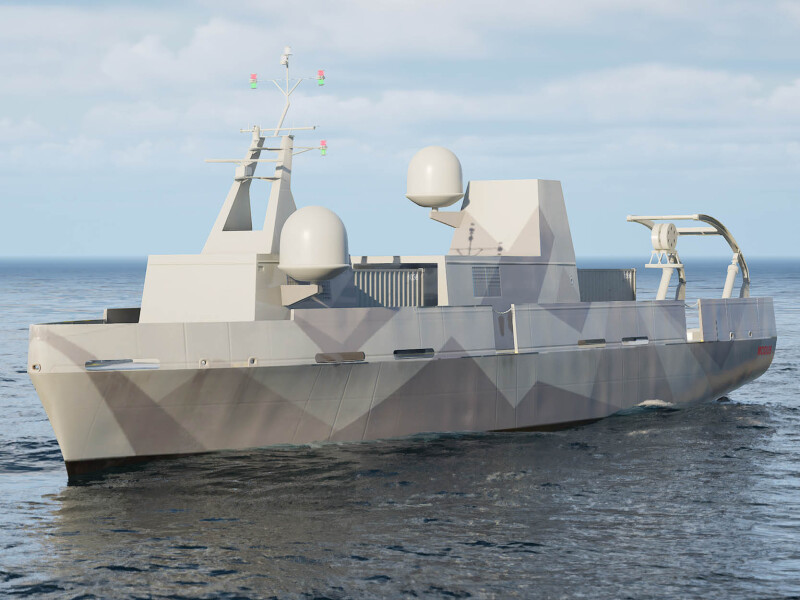
“NATO navies — including the U.K. Royal Navy and the U.S. Navy — are all driving towards more modular, more autonomous, and more adaptable USVs that can be rapidly re-rolled across mine warfare, ASW, surveillance, logistics, and force protection missions,” Champagne said.
Blue Water Autonomy Inc., Boston, is another company focused on building ship-sized USVs for the Navy. Its cofounder and chief strategy officer, Austin Gray, told WorkBoat that the company is the only “pure-play on autonomous ships,” noting it can produce upward of 10 autonomous MUSVs annually through its partnership with Conrad Shipyard, Morgan City, La. “With investment, we can achieve a rate of 20-plus per year,” Gray added.
However, Gray said he couldn’t comment on Navy contracts, costs, or USV quantities.
Cory Emmons, general manager of maritime surface programs at Anduril Industries Inc., Costa Mesa, Calif., told WorkBoat that the company is developing a new dual-use class of surface vessels that are fully autonomous and modular in hardware and software for the U.S. Navy’s Modular Attack Surface Craft (MASC) program. “It provides a mission-focused solution for the Navy that, from its first concept drawing, is focused on mass production, maintenance in austere locations, and continuous modernization,” Emmons said. “By pairing advanced autonomy software with proven shipbuilding expertise, we’re giving the Navy affordable, flexible platforms built for contested maritime environments.”
“What sets Anduril apart is our proven ability to connect mission, design, and build into a cohesive system of engineering and production,” said Emmons. “Anduril has clearly demonstrated this, particularly with the Royal Australian Navy on Ghost Shark, showing how rapid iteration and close industry-government partnership can deliver capability fast. We’re now bringing that approach to the surface domain and pairing it with HD Hyundai Heavy Industries, one of the world’s leading shipbuilders, to not only deliver USVs but also bolster and sustain the dual-use shipbuilding supplier base.”
The Navy needs autonomous, modular vessels that can be built quickly, produced in quantity, and continuously modernized, Emmons emphasized. “Traditional acquisition timelines won’t keep pace with global shipbuilding competition,” he said. “Prioritizing software-driven platforms that can be produced at scale and modular in architecture will be key for the Navy’s acquisition offices. Trustworthy software at sea and partners that provide modular mission capabilities are important for the operators and essential to restoring maritime advantage.”
BlackSea Technologies, Baltimore, is an active supplier and partner in the Navy’s small USV (SUSV) program, the company’s president, Bob Pudney, told WorkBoat. “Our Global Autonomous Reconnaissance Craft (GARC) was built at the Navy’s request for a fast, rugged, and operationally relevant SUSV that could move beyond experimentation and into active fleet use. BlackSea rapidly scaled to high-rate production and has delivered many hundreds of GARCs to the fleet on time and on budget.”
Powered by a 200-hp diesel engine, the 15'8"x5'8" GARC reaches speeds up to 40 knots with a range exceeding 680 nautical miles, according to BlackSea. Its aluminum hull supports a 1,000-lb. payload and an open architecture that has successfully integrated seven different autonomy software stacks. “With more than 15,000 operational hours on the water with the Navy, GARC stands apart as a flexible and combat-relevant platform that demonstrates how a company can mobilize to scale autonomous platforms for the Navy,” Pudney said.
“We designed GARC to be a true workhorse, a platform shaped by Navy operators with clear mission focus, said Pudney, noting that GARC is being integrated into day-to-day maritime operations in several Navy operational fleets.
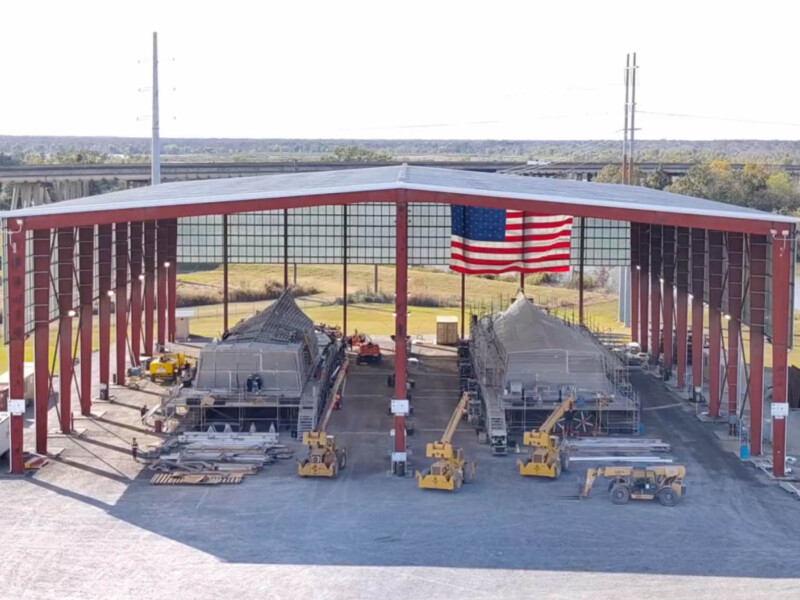
Saronic Technologies, Austin, Texas, offers six different types of USVs, ranging from small to large. A Saronic spokesperson said a $392 million Navy production contract has allowed the company “to move our 24-foot Corsair from prototype to fielded capability in high-rate production in under a year.”
Last year, Saronic acquired the Gulf Craft shipyard in Franklin, La., to immediately expand its shipbuilding capabilities. “We are currently constructing two 150-foot Marauder vessels, having progressed from initial design to full vessel development in just six months, and recently announced a $300 million investment into expanding the shipyard while adding 1,500 new jobs at the site,” the spokesperson said.
“We are also planning to build Port Alpha, the most advanced shipyard in the U.S., designed to produce large autonomous ships at speed and scale and create thousands of jobs in the process.”
