



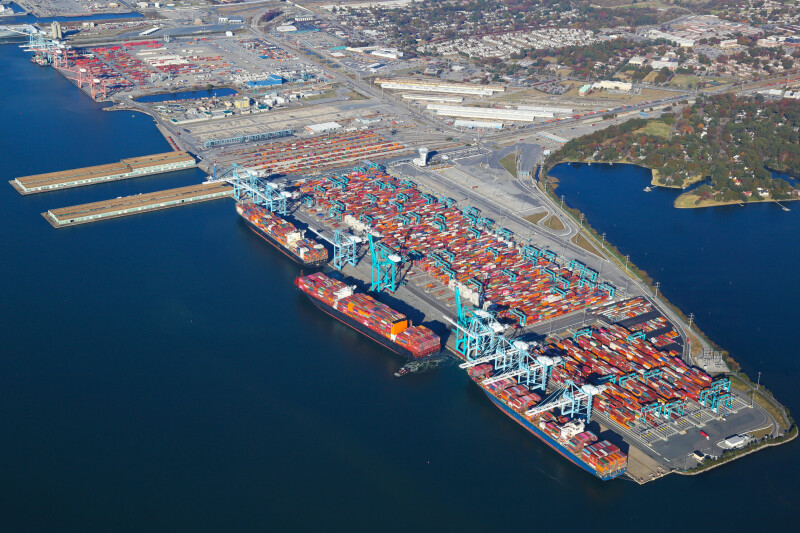
The Port of Virginia has expanded its ability to handle ultra-large container vessels (ULCVs) with the addition of four new ship-to-shore cranes at Norfolk International Terminals.
WorkCargo News reported that the all-electric, Suez-class cranes were delivered by Shanghai Zhenhua Heavy Industries Co. (ZPMC) and placed into service in late January, increasing the terminal’s capacity to work up to four ULCVs simultaneously.
With the new additions, the port said it now operates 29 ship-to-shore cranes along deep-water berths capable of serving the largest container vessels in the Atlantic trade.
According to the Virginia Port Authority, the crane expansion is part of a broader infrastructure program aimed at accommodating continued growth in vessel size and cargo volumes. The improvements include berth upgrades, yard expansion, gate enhancements, and on-dock rail capacity.
Sarah J. McCoy, interim CEO and executive director of the Virginia Port Authority, said berth capacity is increasing in parallel with channel improvements.
"This is the kind infrastructure investment that lets ocean carriers and cargo owners using The Port of Virginia know they can grow their volumes here,” McCoy said. “Our berth capability is growing. We now have four ULCV berths and we are quickly heading toward having the berth capacity to handle five ultra-large container vessels at once.”
The berth expansion aligns with the ongoing deepening of the port’s commercial shipping channels and Norfolk Harbor to 55'. Once complete, the project will make the Port of Virginia the deepest port on the U.S. East Coast. Port officials expect dredging work on the 55' channel to be completed by the end of the month.
When the deepening project is finished, the port will be able to accommodate fully laden ULCVs without tidal restrictions, while also supporting two-way traffic for large vessels in its approach channels.
Separate from the infrastructure upgrades, members of Congress in recent years have raised security and trade concerns tied to the widespread use of ZPMC-built container cranes at U.S. ports. During a House Transportation and Maritime Security subcommittee hearing in May 2023, lawmakers questioned whether sophisticated sensors and data systems embedded in some Chinese-manufactured ship-to-shore cranes could present cybersecurity vulnerabilities within the marine transportation system.
Federal officials from the U.S. Coast Guard, the Cybersecurity and Infrastructure Security Agency, and the Transportation Security Administration testified about ongoing efforts to assess and reduce cyber risk across port facilities, including closer scrutiny of networked industrial equipment and expanded use of cyber protection teams.
Port officials said the combined investments in cranes, berth capacity, and channel depth are intended to ensure long-term operational flexibility as container ships continue to increase in size.
