



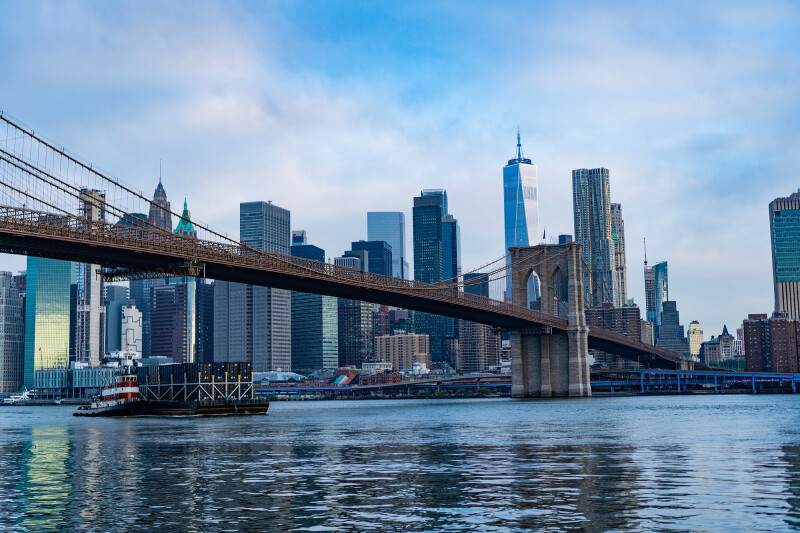
New York City is seeking maritime operators, vessel designers, logistics firms, and technology partners to launch an all-electric and/or zero-emissions container-on-barge and tug service between the Brooklyn Marine Terminal in Red Hook and a new marine terminal under development at Hunts Point in the South Bronx, part of the city's broader push to shift freight off congested highways and onto its waterways.
A request for expressions of interest (RFEI) posted Thursday on the New York City Economic Development Corporation's (NYCEDC) website calls for operators capable of running a service carrying at least 100 40' refrigerated containers — known as reefers — per sailing, with sufficient onboard electrical capacity to maintain continuous refrigeration of all containers during transit. The future Hunts Point Marine Terminal has been designed to accommodate 150 40' containers moving in each direction simultaneously. The route would connect imported food commodities arriving at the Brooklyn Marine Terminal — primarily goods from the Caribbean and Latin America — directly to distribution hubs at the Hunts Point Food Distribution Center, which supplies roughly 12% of New York City's food.
Currently, that cargo moves by truck after arriving at Port Newark or the Brooklyn Marine Terminal, adding to the tens of thousands of heavy vehicles that cross the George Washington and Verrazzano-Narrows bridges daily — more than 25,000 trucks per day through those two crossings alone. Congestion already costs the New York City economy more than $20 billion annually, according to the NYCEDC, and the agency projects freight volumes will grow approximately 67% by 2045.
The proposed Hunts Point Marine Terminal, an approximately 8-acre fully electrified facility, is slated to open in the second quarter of 2030, with the barge operation expected to come online at roughly the same time. The terminal will be built on the former site of the Vernon C. Bain Correctional Center, a floating jail barge that was decommissioned in 2023 and scrapped. Once operational, city officials have estimated the new barge link could eliminate roughly 9,000 truck trips per month from city streets, with a projected $3.9 billion in economic impact over 30 years and the creation of 400 construction jobs and 100 permanent positions.
The RFEI asks respondents to address a broad range of technical and operational questions, including battery capacity requirements for a round trip under various load conditions, shore power infrastructure needs at both terminals, vessel and barge dimensions, tug bollard pull estimates, loading and unloading sequencing, crewing and labor structure, contracting approaches, and domestic procurement considerations under Build America/Buy America standards. The NYCEDC notes it is open to non-battery zero-emissions propulsion alternatives, such as hydrogen, in addition to battery-electric solutions.
The barge service is a centerpiece of the NYCEDC's Blue Highways initiative, a joint program with the New York City Department of Transportation aimed at activating the city's approximately 520 miles of navigable waterways for cargo movement. The NYCEDC says the service is also intended to catalyze broader investment in zero-emissions maritime technology in New York Harbor.
The initiative fits within the larger Harbor of the Future strategy that includes the redevelopment of the 122-acre Brooklyn Marine Terminal into an all-electric port — a project backed by $418 million in city, state, and federal funding, including a $164 million federal grant. The NYCEDC has already committed $18 million in immediate BMT improvements, including $15 million for a new electric ship-to-shore crane and $2 million in pier fender repairs. A separate waterside transloading facility in Hunts Point, operated in partnership with Con Agg Global adjacent to the Fulton Fish Market, is already handling aggregate cargo and is projected to remove around 1,000 truck trips per month from South Bronx streets.
