



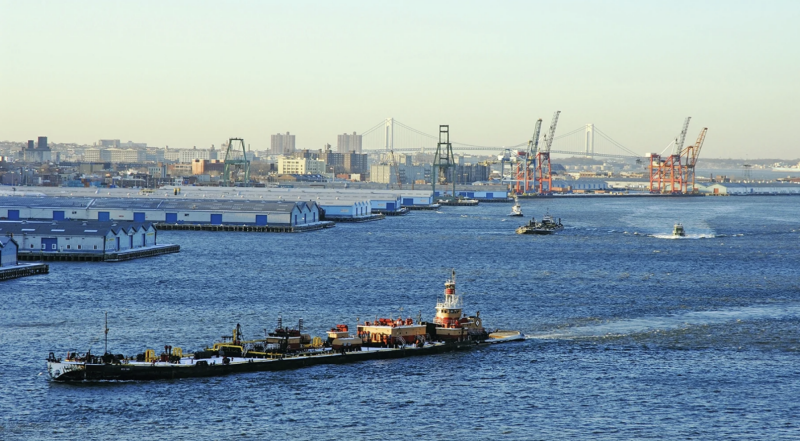
New York City officials issued an updated ‘Blue Highways Action Plan,’ a report focused on new steps toward reviving short sea shipping and maritime freight movement throughout the city’s waterways.
The New York City Economic Development Corporation (NYCEDC) and city Department of Transportation announced the Nov. 5 launch of the plan, described as “actionable steps to revive short sea shipping and maritime freight movement throughout New York City waterways.”
“This plan marks a major milestone in reimagining the city’s waterfront, reducing truck congestion, and creating new pathways for economic opportunity and sustainability through investments in maritime freight infrastructure,” according to an EDC statement. “The Blue Highways Action Plan is also a major step forward in the effort to build the Harbor of the Future – a reimagined network of innovation and growth across New York City’s waterways.”
A recent workforce development report, NYC’s Working Waterfront: A Blueprint for Blue Highways, projects that the maritime sector can support 117,000 jobs in the city by 2035, expanding in port operations, shipbuilding, logistics, and last-mile delivery services.
City planners project freight volumes could grow by 67% through 2045, with increased congestion and emissions from truck traffic. Today more than 44,000 trucks daily cross chokepoints like the George Washington and Verrazano bridges, with traffic delays “costing the city an estimated $20 billion annually in lost productivity, increased maintenance, and environmental impacts,” according to the EDC.
Short sea shipping, or coastal trade (as distinct from bluewater shipping) has been a project of maritime and urban transportation advocates around New York City for decades. As the metropolitan region is increasingly unable to build its way out of traffic jams, New York’s tidewater highway is attractive.
“The capacity lies back on the water. That’s where it all began. Before we had a rail and road system, that’s how we did it,” Rear Adm. Mark Buzby, then-administrator of the Maritime Administration, said at a 2018 marine highway conference at the State University of New York Maritime College.
“We have this great resource, we need to learn to use it again,” Buzby said then. “It’s the only existing surface mode that has capacity.”
The EDC led New York’s maritime passenger revival with the NYC Ferry system in the mid-2010s, and touts a new run at solving the city’s troubles with moving material needs around the five boroughs.
The agency’s Blue Highways plan proposes to shift “a significant portion of freight deliveries off crowded streets and onto the city’s navigable waterways, taking advantage of 520 miles of waterfront and last mile microdelivery by commercial cargo bike. By leveraging publicly controlled waterfront assets, partnering with private industry, and investing in supportive infrastructure for last mile microdeliveries, the plan aims to reduce congestion, pollution, and roadway wear—while catalyzing economic growth and job creation.”
“The Blue Highways Action Plan is our citywide commitment to innovation, sustainability, and equity—leveraging our storied waterfronts to get trucks off our streets and goods back on the water,” said Andrew Kimball, the EDC’s president and CEO.
EDC officials assert progress on the Blue Highways program has accelerated in the past two years, including announcements of a new Hunts Point Marine Terminal, a micro-freight facility at Downtown Skyport, as well as the recently approved and historic Brooklyn Marine Terminal (BMT) redevelopment project.
The Blue Highways plan agenda includes:
- Mapping and assessment of 25-plus Blue Highways “opportunity sites” for activation, ranging from old piers to ferry landings to container terminals, matching site characteristics to potential services.
- Tangible maritime infrastructure projects for short-term, medium-term, and long-term activation.
- Engagement with industry partners such as DutchX, U.S. Coastal Service, and Sixth Borough Marine, who are investing in new vessels, logistics hubs, and innovative delivery models.
- Creation of a Blue Highways Advisory Council in early 2026, ensuring continued dialogue and collaboration between public and private stakeholders.
