



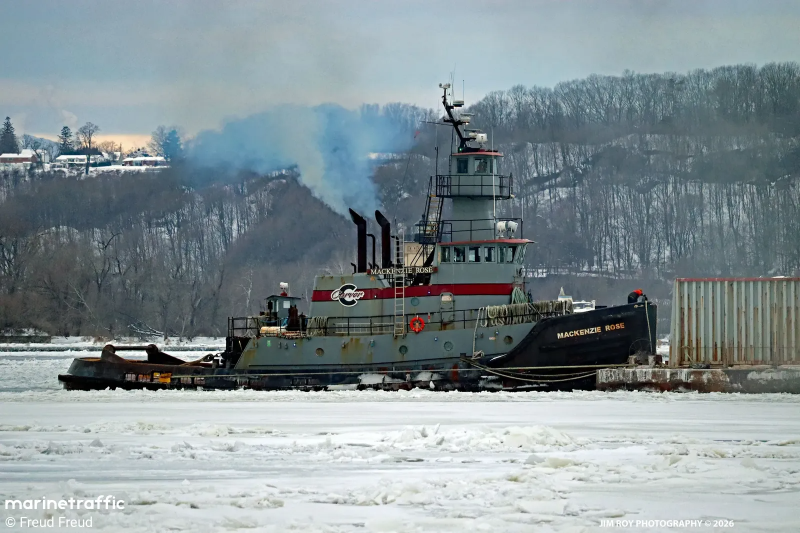
A barge struck a rail bridge on the Elizabeth River in Chesapeake, Va., when the mate at the helm lost control of the tow, “possibly due to his error in switching from autopilot to hand steering or impairment by fatigue,” according to a National Transportation Safety Board report on the June 15, 2024 accident.
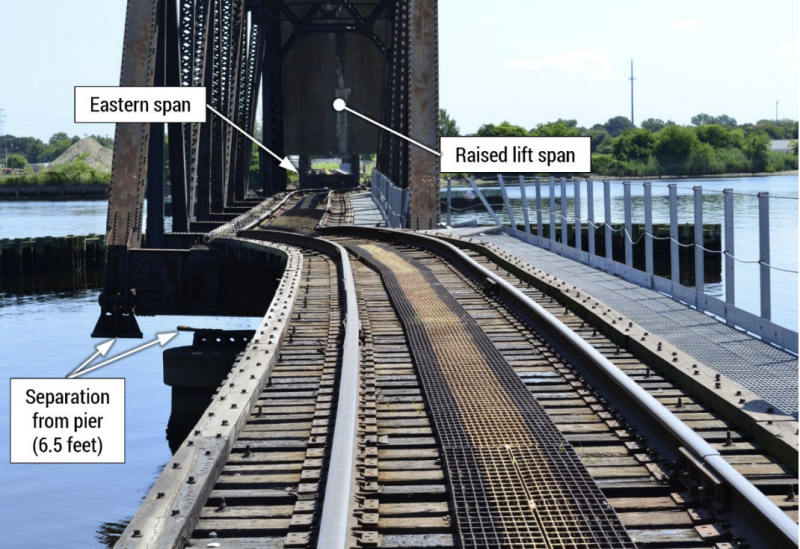
The contact of the 191’ deck barge Weeks 281, loaded with precast concrete materials and pushed by the 96.4’ Mackenzie Rose, left the Norfolk and Portsmouth Belt Line Railroad Bridge displaced over 6’ at its the western end. The tow was transiting the southern branch of the Elizabeth River in Chesapeake, Virginia just before 4:30 p.m. when the barge’s raked bow struck the bridge.
The extent of damage was discovered two days later “when a train crew stopped at the bridge…it was evident they would not be able to lower the lift span and cross the bridge,” NTSB investigators wrote. “The railroad bridge was severely damaged; total damages were $15.8 million.”
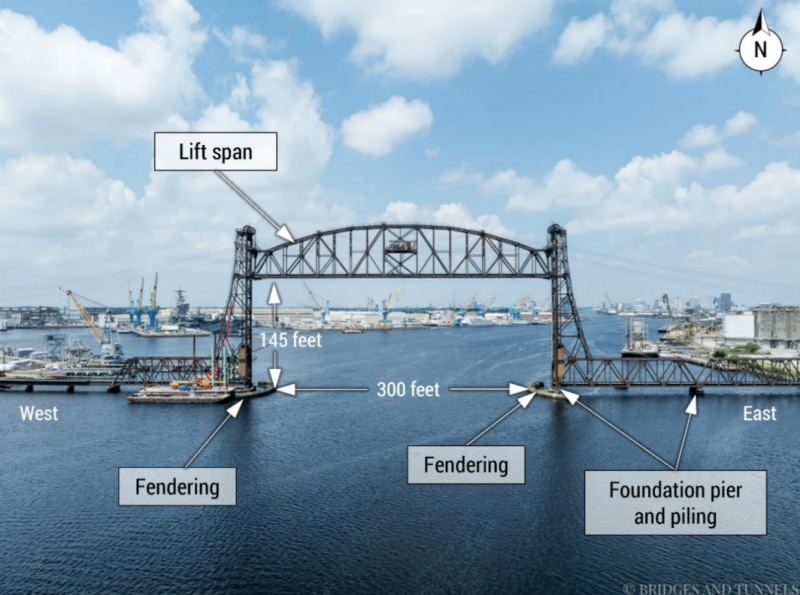
Also known as the Elizabeth River Lift Bridge, it connects the cities of Portsmouth and Chesapeake, Va. When lifted, the bridge’s 378’ lift span provides 300’ horizontal clearance and 145’ vertical clearance for vessel traffic through the navigational channel.
The Mackenzie Rose, operated by Coeymans Marine Towing LLC, Coeymans, N.Y., had five crewmembers aboard: a captain, mate, lead deckhand, junior deckhand, and engineer. They were en route to New York Harbor, with the mate at the helm in the upper wheelhouse. The mate was a senior permanent captain for the Mackenzie Rose’s other crew and had 14 months’ experience on the vessel, and had been a towing vessel captain for 28 years and a mariner for 40 years.
“The mate used autopilot while transiting outbound (north) in the Elizabeth River toward the Atlantic Ocean,” according to the NTSB report narrative. “The mate said he started using the autopilot between Money Point and Paradise Creek. The mate told investigators that he typically would not use autopilot while navigating inland, but he used it for this transit because the barge was ‘smaller’ and ‘handling really well.’”
At about 4:25 p.m. the vessel and tow passed successfully through the South Norfolk Jordan Bridge. After passing under that bridge, he was still steering on autopilot, squaring up the tow for the approach to the Norfolk and Portsmouth Belt Line Railroad Bridge, the mate told NTSB investigators.
The tow continued to approach the bridge, “and about 1625:25, the vessel’s heading began swinging to port, with a rate of turn at 12° per minute…The mate told investigators that within a couple of minutes, when the tow was ‘getting too close to the bridge,’ he realized the autopilot ‘had switched’ (turned off) without alarming,” the report states.
The mate stated that he took control by switching from autopilot to non-follow-up (NFU) hand steering about two barge lengths from the bridge. He then pulled back on the two throttles to neutral (8 seconds) and engaged the throttles in reverse (another 8 seconds) to back the vessel.
However, he stated he was unable to do so without “touching up on the bridge.” He told investigators, “Before I hit the bridge, I was already in reverse. I had clutched in earlier and then I backed, as soon as I could back full, I backed full.”
At 1626:41, the bow of the Weeks 281 contacted the western portion of the Warren through-truss approach span of the Norfolk and Portsmouth Belt Line Railroad Bridge, with tow’s speed over ground at 4.8 knots.
“When the contact occurred, the captain was sleeping in his stateroom, and the engineer was in his stateroom completing daily logbook entries,” the NTSB report notes. “The engineer stated that the contact was ‘noticeable’ but ‘it wasn't a very hard impact.’ None of the crew recalled hearing any audible alarms at the time of or after the contact.
The engineer told investigators that, when he arrived in the wheelhouse, the mate was in the process of backing away from the railroad bridge, which was about 20 feet from the bow of the tow when he arrived.
“The mate did not provide any instructions to the engineer. The engineer stated that because the mate was busy, he proceeded to the engine room to check on main propulsion, steering, and auxiliary systems. He did not find any damage, flooding, or issues with propulsion or steering.”
The vessel continued outbound with the mate navigating in NFU hand steering. The captain contacted the Coeymans port captain to inform him of the bridge contact and that he wanted to call the Coast Guard. The crew also told the port captain that there was no visible damage to the bridge, Mackenzie Rose, or barge, and sent photos of the barge and bridge to the port captain to review.
However, “none of the crew or the port captain notified the local Coast Guard of the incident nor did they contact the Norfolk and Portsmouth Belt Line Railroad,” the NTSB report states. “On the afternoon of June 17, a CSX train crew arrived at the Portsmouth (western) side of the bridge for a crossing, discovered damage to the bridge, and informed the Belt Line operations supervisor. The train was unable to cross, and the bridge was immediately taken out of service.
NTSB and Coast Guard investigators “examined the autopilot system and could not replicate the issue described by the mate or find any technical issues with the system,” nor could technicians from the autopilot manufacturer, the report states.
The Coeymans’ port captain filed an incident report that stated: “When changing over from auto pilot to hand steering it is critical that the knob for the auto pilot be clicked into the ‘off’ position and that in this instance it was not.” The report also indicated there was a discussion with both the captain and mate on watch at the time of the incident that, “…in accordance with both company policy and CFR [Code of Federal Regulations] 40.670 the auto pilot should not be used in areas of high traffic density, conditions of restricted visibility, or any other hazardous navigational situations.”
The NTSB concluded that the probable cause “was a loss of control of the tow by the mate at the helm, possibly due to his error in switching from autopilot to hand steering or impairment by fatigue.”
In its customary “lessons learned” postscript, the safety board advised that “navigating in channels and harbors requires quicker reaction times due to traffic, currents encountered, and frequent course changes, and more rudder due to slower speeds. Therefore, autopilot use is often discouraged or prohibited in a harbor entrance or narrow channel.”
“If autopilot must be used, it is critical that vessel operators be fully trained in all features and functions of a vessel’s systems so that they can quickly adjust the modes of the autopilot system or disengage the autopilot to return to hand steering as needed.”
