



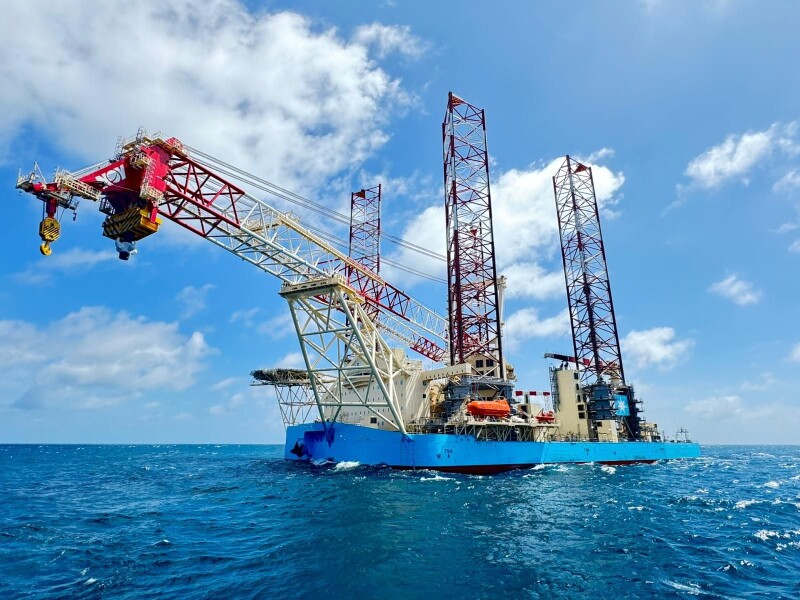
Maersk Offshore Wind A/S, Copenhagen, has taken delivery of its first wind turbine installation vessel (WTIV) from Seatrium Ltd., Singapore, the companies announced.
The to-be-named vessel was handed over on Feb. 26 following completion of sea trials and final readiness evaluations at Seatrium's Tuas Boulevard Yard in Singapore.
Maersk terminated the original $475 million construction contract in October over construction delays. The companies reached a settlement in December that called for Maersk to pay the remaining $360 million balance. Both parties withdrew all legal proceedings as part of the settlement.
The Danish-flagged, ABS-classed vessel, which will first be used to install turbines at Equinor's Empire Wind project offshore New York, measures 496'x273'. It features a 1,900-metric-ton NOV main crane with a 590' hook height, supporting installation of 15+ MW-class turbines.
The DP2 WTIV is equipped with six 4,300-kW HiMSEN diesel-electric generators, six 5,500-kW azimuth thrusters, and two 900-kW tunnel thrusters. It features a helideck, 100 cabins, and a 131' walk-to-work gangway system.
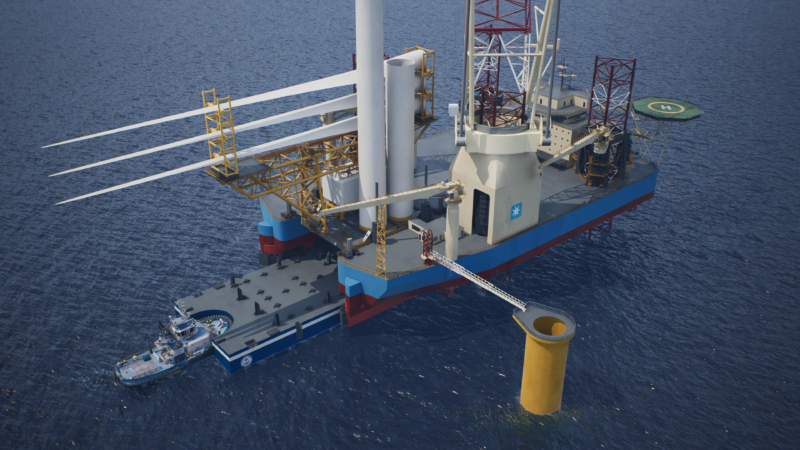
The vessel's defining feature is its feeder-based installation design, which allows the WTIV to remain on location conducting continuous installations while feeder vessels transport turbine components from port to the installation site. The system includes a stabilizing technology that enables purpose-built feedering articulated tug-barges (ATB) to dock and lock securely onto the WTIV for component transfer, even in high sea states.
The locking system "pushes down" the barge into the water to fully stabilize it, enabling what Maersk describes as a "fixed-to-fixed" component lift from feeder to WTIV rather than relying on a floating crane and barge. Once locked in place, a cargo frame is elevated to the WTIV deck for load-out of turbine components. The system can operate in waves up to 8'.
The solution improves installation efficiency by extending the operational weather window, allowing installations to continue in conditions that would halt traditional methods, according to Maersk Offshore Wind.
The company has partnered with Edison Chouest Offshore LLC, Cut Off, La., for the purpose-built windfarm feeder spread, which includes two sets of ABS-classed ATBs. The 142'x44' tugs and 223'3"x118' barges are designed by Guarino & Cox LLC, Covington, La., and are being built by Bollinger Shipyards Inc., Lockport, La., for delivery later this year. Each ATB unit will be U.S.-flagged and owned and operated by Edison Chouest, making the feeder solution Jones Act-compliant.
The feeder-based approach also enables broader port access, allowing turbine components to be marshalled at smaller, shallower ports or ports behind bridges, locks, or hurricane gates that larger installation vessels cannot access.
"This state-of-the-art WTIV represents a major step forward in pushing the possibilities for global offshore wind," said William Gu, executive vice president, Seatrium Energy (Marketing). "This achievement not only underscores Seatrium's engineering capabilities, it also reinforces the critical role we play in building the backbone to global offshore wind systems."
Wholly owned by A.P. Møller Holding, Maersk Offshore Wind is a division of A.P. Møller – Maersk A/S, focused on developing and operating offshore wind installation capabilities. The new WTIV, ordered in 2022, is the company's first wind installation vessel.
"This milestone marks an early but momentous step on our journey towards growing a future-ready fleet, fit to support the world's ambitions for clean, secure energy," said Michael Reimer Mortensen, CEO of Maersk Offshore Wind. "And for many of our team at Maersk Offshore Wind, it is the realisation of many years of dedication, technical creativity, and personal drive to make a difference to the industry."
The vessel is scheduled to sail in March for the Empire Wind project offshore New York, where it will install turbines to deliver power to 500,000 homes.
The Trump administration issued stop-work orders in late December for five East Coast offshore wind projects, including Empire Wind, citing national security concerns. U.S. District Court Judge Carl J. Nichols granted a preliminary injunction in mid-January allowing Empire Wind to resume construction. Federal judges issued similar rulings for four other paused projects: Revolution Wind, Sunrise Wind, Coastal Virginia Offshore Wind, and Vineyard Wind. Empire Wind is approximately 60% complete.
