



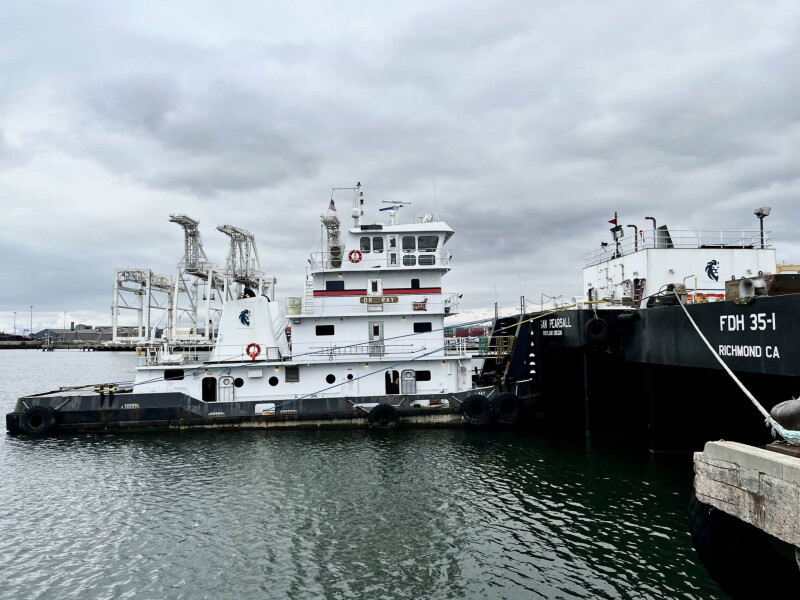
Over the past 18 months, the U.S.-flagged vessel market has witnessed a flurry of investments, mergers, and acquisitions.
Throughout the Jones Act sector and across the nation, banks, venture capital firms, and large owner-operators have made deals to fund new vessels, update fleets, and acquire assets to expand their existing services.
This activity is being driven by a timely alignment of factors. Renewed federal support, bipartisan legislative activity, and generational business turnover have converged, opening the door to new opportunities for buyers and lenders in a long, attractive market.
“The market is currently fundamentally sound and exhibits growth potential thanks to the twin controls of manageable supply and generally positive outlook,” said Andy Longhurst, managing director of shipping at CSG Investments Inc.
However strong these signals, investors say it’s just a start. Time, money, tax subsidies, regulatory change, and continued strong fundamentals are required for the industry to achieve the level of revitalization desired. Meanwhile, other pressing economic and geopolitical challenges remain at odds with this goal.
“There is a general mood of confidence and positive outlook in the sector, but we need to understand the implementation details before we see the real impacts in the bottom line of shipowners and shipping investors,” Longhurst said. “As lenders, it’s always important to understand the longevity of federal or state support and whether it would endure across political cycles.”
A MARKET DIVIDED
CSG Investments — an affiliate of Beal Bank USA, Plano, Texas — has been involved in maritime lending for 35 years, recognizing the domestic sector as attractive for its insulation from the boom-and-bust economics commonly associated with international shipping. The company focuses on underwriting deals between $100 million and $750 million and prioritizes “asset quality, structural protections, and sponsor alignment,” Longhurst said.
Most recently, that included lending Otto Candies LLC $450 million for the Des Allemands, La., shipowner’s acquisition of four multipurpose support vessels last fall.
Otto Candies offers an example of the companies currently able to make these types of “transformative transactions” thanks to their access to a small pool of attractive capital sources, Longhurst said.
It’s part of a bifurcation of the market he has been observing.
On one side, smaller companies are actively underwriting deals with equipment financiers in the range of $50 million and below, potentially preventing consolidation within the sector. Alternatively, larger companies are harnessing limited available capital either to fund sale, purchase, and merger activity or to pursue consolidation and scale.
Maritime Partners LLC, New Orleans, offers an example of the consolidation trend, having acquired both West Gulf Marine and Centerline Logistics Corp. last fall.
The activity from small and large players, combined with the longstanding attractiveness of the Jones Act market, is appealing to both asset and infrastructure investors, Longhurst said.
In many cases lately, the assets of longstanding companies have become even more valuable as their equity has grown, said Mark Thomas, senior vice president, West region and large corporate director of sales at Key Equipment Finance, a division of Key Bank and one of the largest bank-owned equipment finance providers in the U.S.
As costs have risen over the years, purchasing new equipment has become significantly more expensive than purchasing existing equipment. As a result, existing marine assets in high demand have appreciated considerably in value.
“A lot of the M&A activity we’re seeing is an owner’s ability to monetize their current vessels and sell a business,” Thomas said. “And it makes it easy for an investor, be it a private equity firm or a family office, to borrow against those assets to buy out the current owners.”
MOVING THE NEEDLE
Another factor driving deal activity among small- to mid-sized family-owned businesses is that, as owners age into retirement, many are choosing to sell as opposed to passing down the business to the next generation.
“Many of those companies were self-funded, but with new ownership, we anticipate additional financing transactions in the market,” said Rachel Telles, vice president of equipment finance, business development for Wintrust Commercial Finance.
Private equity firms have been quick to respond to this generational shift, she said. They see the marine business as one with good assets that have a very long life, hold their value, and offer great potential for consolidation and financial optimization.
Wintrust Commercial Finance, which was established in 2015 as part of Illinois financial services company Wintrust Financial, Rosemont, Ill., is an active player in the market, serving as a cash flow lender. The company has forged close relationships with key players in the Jones Act space, which has been critical for gathering boots-on-the-ground knowledge and informing how the company goes to market.
Lately, Telles said, all eyes in the industry have been on the positive signals coming out of Washington.
She points specifically to the proposed Shipbuilding and Harbor Infrastructure for Prosperity and Security for America Act (SHIPS Act). The bill is still making its way through Congress, but has already increased investor confidence and demand for U.S.-built vessels, Telles said. Other factors, such as investments in infrastructure, shipyard modernization, fleet revitalization, decarbonization, and offshore wind development, will “continue to drive demand in the industry, and ultimately, the need to transact,” she said.
Above all, the renewed federal focus on domestic shipbuilding and strengthening the broader maritime sector is the biggest driving force.
“Federal and legislative support, combined with adequate capital deployment in the space, is keeping things interesting,” Telles said. “We’re seeing good activity.”
Longhurst described the consistent and positive messaging from the U.S. government for the Jones Act sector as both “surprising and welcome.” However, he cautioned that support doesn’t directly translate into concrete policy measures. New laws for tax and subsidy benefits are needed to spur investment.
“A Maritime Action Plan alone is not something I can take to my executive loan committee,” Longhurst said, referring to the federal roadmap released by the White House in February designed to support the 2025 executive order on “Restoring America’s Maritime Dominance.”
Telles offered a similar take, suggesting that investment alone isn’t enough. “There has to be some incentive for these investors and banks and lenders to continue deploying capital here,” she said. “There has to be a good pathway for this growth and revitalization to actually occur.”
She said the investors her team speaks with are focused on incentives such as tax-deferred accounts for shipyard capital improvements and Title XI financing for new construction.
CHALLENGES PERSIST
Despite the well-timed convergence of federal support and private capital, the Jones Act market — and the maritime industry broadly — faces considerable challenges and a long road to achieve global dominance.
Aging infrastructure and assets, as well as a shrinking workforce, are well-documented hurdles the industry has long worked to overcome. Other barriers include a lack of shipbuilding capacity and ongoing geopolitical instability.
Limited build capacity in the U.S. is a major constraint on the growth of the sector because of its impact on the cost and lead time to build a vessel, said Robert Harris, vice president and West region manager at Wintrust Commercial Finance.
“Build cycles are taking a lot longer than they have in the past,” Harris said. “So, it does put the U.S. at a competitive disadvantage when you think about how long it takes a Jones Act vessel to be built versus say a non-domestic or international competitor.”
Geopolitical instability, as well as recent tariffs, have also fueled cost increases due to higher insurance premiums, safety risks, and supply chain delays. Shipyards are feeling the effects of these pressures, especially those in the Jones Act sector.
“There’s an awful lot of energy spent on determining what’s purchased from where and how it’s integrated to make sure it qualifies as a Jones Act vessel,” Thomas said. “They have to be very strategic to align with policies that are constantly changing.”
As an example, Thomas said one of his clients recently told him that a tugboat he paid $15 million for in 2019, could cost as much as $35 million to build in the U.S. today.
THE BOOM CONTINUES
Looking ahead, CSG, Wintrust, and Key all anticipate that the pace of deals will hold steady, with some potential to increase. The companies also plan to continue seeking opportunities to participate in the market throughout 2026 and beyond.
Many are keeping an eye on the federal money flowing into the Navy and defense sector — hopeful that the resulting synergies, new technologies, and capacity upgrades will trickle into the commercial side and throughout the supply chain.
It’s a positive sign, Longhurst said, to see discussions about maritime revitalization, and even the Jones Act itself, making it to the front pages of newspapers as part of a larger discussion on national and international security.
But while indicators and external forces may shift, above all, “fundamentals still matter.”
“Being successful depends on finding the right sponsor, the right collateral, and the right structure,” Longhurst said. “Sound underwriting remains very important and is key in every deal.”
