



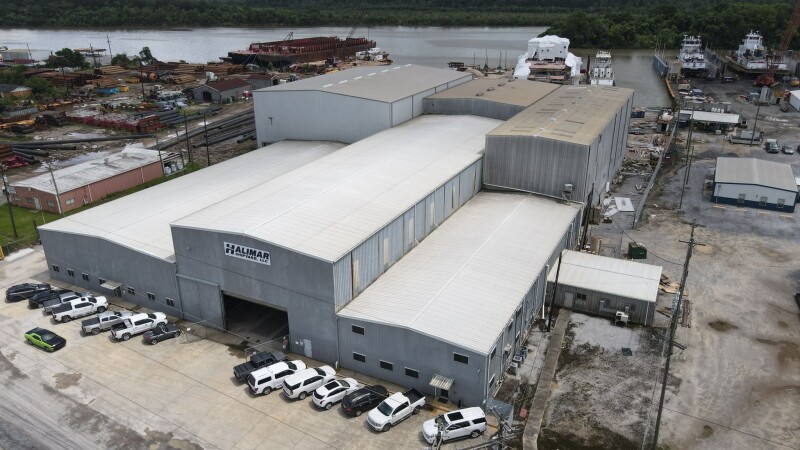
Shipbuilder Huntington Ingalls Industries Inc. (HII), Newport News, Va., on Monday announced it is partnering with Halimar Shipyard LLC, Morgan City, La, to construct the company's uncrewed surface vessels (USV) as the defense contractor works to scale up distributed manufacturing capacity for the autonomous naval platform.
Halimar, a new construction and repair yard with both aluminum and steel capabilities, will build complete 190' Romulus 151 vessels. It joins Breaux Brothers Enterprises Inc., New Iberia, La., another partner, which is currently constructing five Romulus 151 vessels.
"The number of hulls Halimar will build is yet to be determined, but they are beginning construction on their first Romulus USV," HII spokesman Greg McCarthy told WorkBoat. "Romulus construction quantities will depend on customer and opportunity requirements."
HII is the largest military shipbuilder in the United States, building both crewed and uncrewed vessels for the Navy. Its Romulus line of modular, AI-enabled USVs has been developed amid a broader push by the Navy and defense industry to field a large fleet of autonomous vessels. These vessels are designed for missions including intelligence, surveillance, and reconnaissance; mine countermeasures; strike operations; countering enemy unmanned systems; and launching and recovering uncrewed underwater and aerial vehicles.
HII said the Romulus platform's common manufacturing architecture is intended to allow scaling across multiple vessel sizes while simplifying production. Through a distributed shipbuilding model that spreads production across multiple established Gulf Coast shipyard partners, HII aims to accelerate Romulus delivery schedules, expand manufacturing capacity, and meet rising demand from the U.S. Navy and allied maritime forces for autonomous vessels, the company said.
"Our partnership with Halimar Shipyard represents another important step in building the industrial capacity needed to deliver autonomous maritime capability at scale," said Andy Green, executive vice president of HII and president of the company's Mission Technologies division. "Halimar's proven shipbuilding expertise, skilled workforce, and strategic Gulf Coast location strengthen our ability to accelerate production, improve supply chain resilience, and provide affordable, mission-ready autonomous systems."
William Hidalgo Jr., executive vice president and chief operating officer of Halimar Shipyard, said, "We are proud to partner with HII on the Romulus program and contribute to the future of autonomous maritime operations. Our team has decades of experience building high-quality vessels, and we look forward to applying that expertise to help deliver reliable, scalable production capacity that supports evolving mission needs."
HII is investing directly in its partner shipyards. In March, it announced plans to build a new assembly facility at Breaux Brothers and launched an initiative to integrate robotic welding, automated material handling, and digitally enabled quality assurance into an assembly-line environment optimized for Romulus production.
The company is also evaluating additional partners based on customer and opportunity requirements, McCarthy said. "HII is committed to growing the industrial base capable of building autonomous systems to support the U.S. Navy and customers worldwide," he added.
HII is working with fabricator Bayou Metal Supply & Manufacturing LLC, Slidell, La., and other partners to accelerate assembly work ahead of final integration of the vessels. Naval architecture and engineering firm Incat Crowther, Sydney, has contributed design and engineering work to the Romulus program.
In May, HII and partner MetalCraft Marine US Inc., Cape Vincent, N.Y., delivered and sea-tested a pair of 27' Romulus USV prototypes for the Marine Corps under a Defense Innovation Unit contract focused on smaller-form autonomous boats.
