



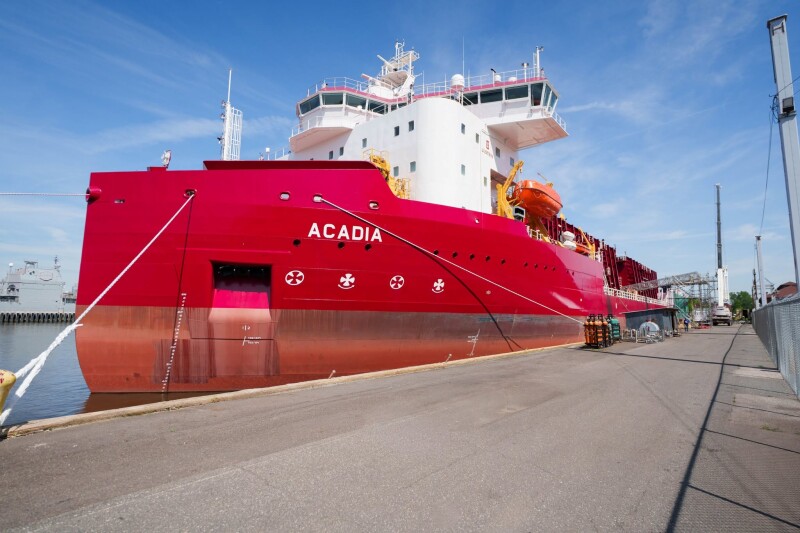
Hanwha Philly Shipyard Inc., Philadelphia, announced it has delivered the subsea rock installation vessel Acadia to Great Lakes Dredge & Dock Co. LLC, Houston, on Wednesday, placing the first vessel of its type in the U.S.-flag fleet.
The 461'x112', Jones Act-compliant Acadia is engineered to transport and install up to 20,000 metric tons of rock on the seabed, providing scour protection for subsea cables, oil and gas pipelines, telecommunications infrastructure, and offshore wind turbine foundations.
"Taking delivery of Acadia represents a transformative moment for Great Lakes and underscores our dedication to installing and protecting domestic and international offshore energy infrastructure," said Lasse Petterson, president and CEO of Great Lakes Dredge & Dock. "This highly specialized vessel positions us at the forefront of subsea rock installation in the U.S. and international markets and enables us to play a critical role in major projects such as Empire Wind 1 and Sunrise Wind that offer a reliable, affordable, clean energy solution to the State of New York."
“This delivery of Acadia represents far more than the completion of a vessel. It reflects the strength of American shipbuilding, the dedication of our workforce, and the growing capability of Hanwha Philly Shipyard to deliver highly specialized vessels that support critical infrastructure,” David Kim, CEO of Hanwha Philly Shipyard, said in a press release. “On behalf of all shipbuilders in Philly, we wish the crew of the Acadia fair winds and following seas on every adventure that follows.”
Great Lakes Dredge & Dock ordered the Acadia from the Philadelphia shipyard for $197 million in 2021, and the ship was originally scheduled for delivery in 2024.
The project encountered significant delays, and by 2024, Great Lakes had filed a request for a temporary restraining order and preliminary injunction in U.S. Eastern District Court, citing delays and disagreements over construction of the first-of-its-kind vessel. No figures detailing the cost impact of those delays have been made public.
The Acadia's first offshore wind project will be Equinor's Empire Wind 1, followed by Orsted's Sunrise Wind, both located off the coast of New York.
Great Lakes, which ordered the subsea rock installation vessel amid the Biden administration's aggressive push to expand the U.S. offshore wind industry, now faces a policy landscape that has sharply shifted under President Trump, who has moved to curtail offshore wind development.
After completing the two U.S. wind projects, Great Lakes will mobilize the Acadia to Europe for rock installation work with "a major offshore wind developer," keeping it utilized for most of 2027, the company said.
Ulstein Design and Solutions B.V., Rotterdam, the Netherlands, provided the basic design for the Acadia, which features EPA Tier 4 engines, plug-in shore power connection for loading in ports, and battery packs for peak-shaving. The vessel is also able to run on biofuel to reduce its CO2 footprint and is equipped with active emission control technology to minimize NOx emissions.
Following the Acadia's delivery, Hanwha Philly Shipyard — formerly Philly Shipyard, acquired by Hanwha Systems and Hanwha Ocean in a $100 million deal in 2024 — continues work on two National Security Multi-Mission Vessels for the Maritime Administration and three containerships for Matson Inc., Honolulu.
Great Lakes Dredge & Dock, the largest dredging contractor in the United States, is also under new ownership, now a wholly owned subsidiary of Saltchuk Resources Inc., Seattle, after the private, family-owned company acquired the publicly traded firm in a $1.5 billion deal that closed April 1.
