



Shortly after 2 p.m. on July 19, 2024, on the Houston Ship Channel near Lynchburg, Texas, a collision between the Liberia-flagged bulk carrier Yangze 7 and the 50'x20' towing vessel Miss Peggy caused the Miss Peggy to capsize and sink with a crew of five on board.
The crew aboard a good Samaritan vessel, the tugboat George M, rescued four of the Miss Peggy’s crew members. The fifth crew member died aboard the vessel. One of the surviving crew members was seriously injured, while another sustained minor injuries. According to the National Transportation Safety Board (NTSB), the salvage of the Miss Peggy and the pollution cleanup cost about $3.7 million. The 656' Yangze 7 — then owned by Ladon Shipping Pte Ltd. and operated by Shanghai Run Yuan Shipping Management Co Ltd. — sustained no damage.
That afternoon, both the Yangze 7 and the Miss Peggy — owned and operated by Houston Fleeting Services, a subsidiary of Ingram Marine Group Ltd. — were inbound on the Houston Ship Channel, with the ship headed to Kinder Morgan’s bulk terminal in Houston to take on coal. The 1,600-hp Miss Peggy, traveling lightboat, was bound for its home fleet at Houston Fleeting Services in Channelview, Texas. A Houston pilot was aboard the Yangze 7, and the Miss Peggy’s captain was at the helm of the towboat.
During its investigation, the NTSB found that the Houston pilot engaged in watching a video and placing a personal call “not related to operations” on his personal cell phone during the transit. According to phone records and the Yangze 7’s bridge audio recording, the Houston pilot answered a call at 1:22 p.m. from a fellow pilot, who was aboard the tanker Petrel, which was outbound on the Houston Ship Channel.
“The pilot continued his phone conversation while issuing various rudder and heading orders as the Yangze 7 progressed up the Houston Ship Channel,” the NTSB stated.
The NTSB report later stated that “the second officer told investigators that he was ‘very afraid’ because the pilot was ‘chatting’ using an earpiece while issuing steering orders.”
“He noted that the pilot’s phone conversation was ‘not about the vessel, not about safety, not about navigation’ and that he was afraid that the pilot would issue the wrong order,” the report stated.
As the ship neared the Crossover area, the Houston pilot checked in with Vessel Traffic Service (VTS) Houston-Galveston. The VTS operator noted two ships downbound, the LNG carrier Silvio and the oil tanker Eagle Hamilton.
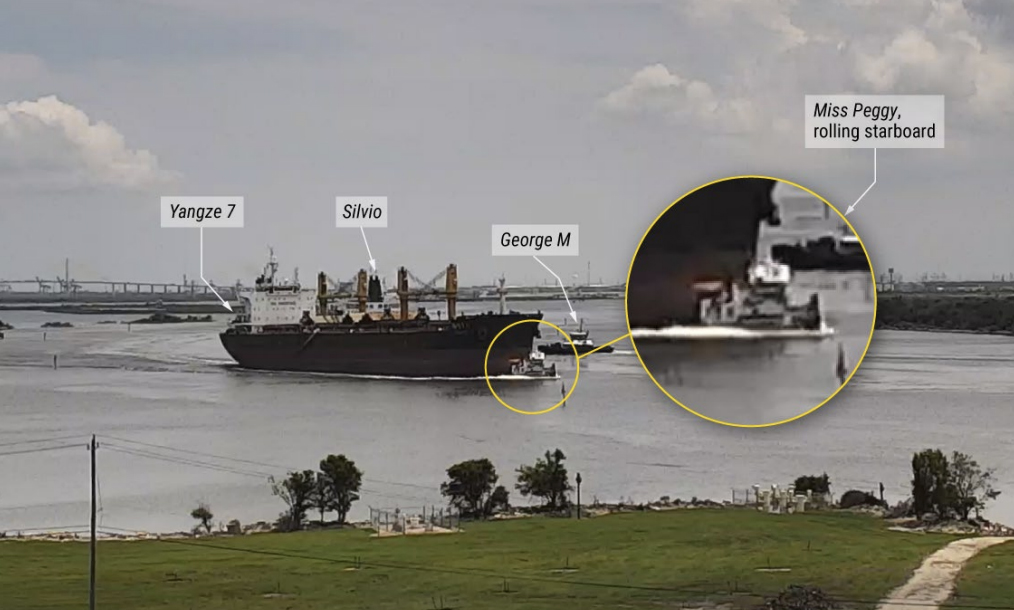
The Houston pilot aboard the Yangze 7 then made passing arrangements with the pilot aboard the Silvio. At the same time, a harbor tug, the George M, was following behind the Silvio. The mate aboard the George M, who had noticed the Yangze 7 closing on the Miss Peggy, radioed to warn the Yangze 7.
“Calling the Yangze 7, watch out for that tow right in front of you, captain,” the mate called over the radio.
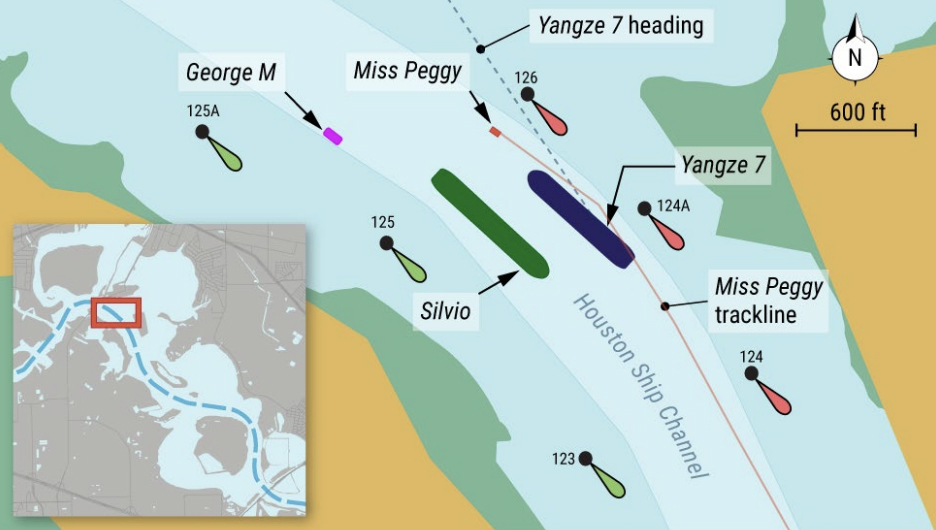
Despite that warning, and despite the bosun aboard the Yangze 7 previously reporting a vessel “about 20-30 meters” ahead, the pilot aboard the Yangze 7 never saw the Miss Peggy, nor did the captain aboard the towing vessel see the ship closing in.
At 2:03 p.m., the bulbous bow of the Yangze 7 struck the stern of the Miss Peggy, causing it to roll to starboard. About 30 seconds later, the mate aboard the George M radioed to the Yangze 7, “Captain, you just hit a tow, and it overturned in front of you.”
When the Miss Peggy capsized, the captain, who was in the wheelhouse, exited through a window and surfaced just outside.
“He saw [deckhand 1] in the water near him as the Yangze 7 passed by,” the NTSB report stated. “The captain told investigators that this was the first time he noticed the Yangze 7.”
The on-watch lead deckhand and the on-watch deckhand were both in the galley when the collision occurred. The lead deckhand, who lost consciousness at some point, somehow floated through an open door and made it to the surface. The deckhand did not make it out of the galley.
The off-watch lead deckhand was able to exit his stateroom after the vessel capsized. He was then able to open an exterior door and make it to the surface.
Immediately after the collision, the crew aboard the George M deployed the vessel’s Dacon rescue frame, while the captain maneuvered the tug into position to rescue the four crew members in the water.
Meanwhile, the Yangze 7 continued toward its final destination, arriving around 3:50 p.m.
“The pilot remained at the conn for the rest of the Yangze 7’s inbound transit, making or receiving a total of 22 phone calls with a total duration of about 12 minutes,” the NTSB report stated.
In its analysis, the NTSB focused its attention on the Houston pilot’s phone usage in particular.
“The pilot on board the Yangze 7 used his personal cell phone multiple times during the voyage, including a 39-minute call that ended a little over two minutes before the collision with the Miss Peggy,” the report stated.
In the next paragraph, the NTSB added, “During the 39-minute phone call, the pilot was likely cognitively distracted. Regardless of the purpose or why a device is being used, the use of cell phones or other electronic devices always increases the likelihood that an individual will disengage from their primary task, redirect their attention elsewhere, and become distracted.”
As a result, the NTSB recommended that the U.S. Coast Guard and the American Pilots’ Association prohibit non-operational use of personal electronic devices by river pilots. Investigators also found that the lack of situational awareness and the failure to maintain a proper lookout aboard both the Yangze 7 and the Miss Peggy likely contributed to the collision as well.
The body of Aquarius Lowman, the deckhand who died aboard the Miss Peggy, was recovered just a couple of days later when the vessel was salvaged.
