


The U.S. Navy has a math problem. Delays in new construction and maintenance have reduced SSN availability to less than two-thirds. At the same time, the number of available attack submarines is set to decline to 47 by 2030, a timeframe expected to coincide with peak strategic demand.
The Virginia-class is not alone. Columbia-class submarines are also experiencing 12 to 18-month delays. Among U.S. allies, availability of the UK’s Vanguard- and Astute-class SSNs is also critically low, stemming from aging vessels, maintenance bottlenecks and production delays.
Many people have documented how undersea fleet availability got to this point, and some points bear repeating. The bigger issue is how industry and government come together now to close the submarine gap.
Accelerating the adoption of additive manufacturing (AM) within the Navy and the maritime industrial base is a critical part of solving the SSN math problem. 3D printing has eliminated months of component lead times, according to Naval Sea Systems Command (NAVSEA), promising tangible improvements in schedule and fleet availability.
To truly make use of these benefits, industry needs the Navy’s continued support in adopting new means of production and transforming those into actionable requirements. The material maturity is there. The partnerships are being built. Funding and operational demand are beginning to take hold. Industry is ready to move with velocity to scale. What we need are broader material and process approvals that must come from the Navy.
There is no silver bullet that will solve America’s shipbuilding and sustainment woes and no single solution to close the SSN gap. Stakeholders must work in concert across multiple lines of effort, acknowledging limitations, while moving quickly to deploy capabilities.
Moving Beyond a 'Science Project’ to True Interchangeability
In 2025 alone, the Navy placed nearly 120 additive manufacturing parts into development, installed dozens of those parts and eliminated more than 1,400 cumulative days of delay, according to CNO Daryl Caudle. As he told the Surface Navy Association earlier this year, “That is not a science project. That is combat credibility gained back from the jaws of inefficiency.”
In the early part of 2025, NAVSEA approved 182 additively manufactured parts for use in ships and submarines, with more than 600 additional components undergoing engineering review. As of today, NAVSEA’s Systems Engineering and Logistics Directorate (NAVSEA 05) has released four military standards for material process combinations covering stainless steel, titanium and copper-nickel, with an additional six materials standards slated for approval in the future.
All of this represents progress, much of it directly relevant to accelerating the Virginia- and Columbia-class submarine programs. But these efforts are still in their early stages.
Pushing additive manufacturing beyond a “science project” will require true interchangeability, which means normalizing and reasonably relaxing certain requirements that made sense when suppliers were still demonstrating viability. Today, only a small selection of materials have interchangeability, meaning a producer can show the material properties are equivalent to a traditionally manufactured part and receive approval. Depending on the part, OEMs are seeing different requirements based on the manufacturing process. Parts that are structurally and materially equivalent to pre-qualified parts often require additional testing because of how they were produced. While any new technology requires a period of adjustment, these delays could jeopardize efficiency gains if left unaddressed.
Partnerships between the Navy and industry through the Maritime Industrial Base (MIB) program have been vital in validating additive manufacturing processes. Demonstrations on Level II and Level III parts have been successful, and the service continues to accelerate adoption to higher criticality parts. According to Capt. Jason Deichler, who leads the Navy hub for integrating AM into the submarine fleet, the service is beginning to apply AM to shipboard repair of critical components, targeting multiple Priority I Casualty Reports (CASREPs).
Adopting any new technology is a crawl, walk, run process, and tackling CASREPs and Level I parts shows the Navy is on its feet. The faster we can transition these successes from the laboratory to the manufacturing floor, the better it will be for the submarine force.
Partnerships to Produce at Scale
Investment is the other vital factor in scaling additive manufacturing. The Department of War announced roughly $1.6 billion toward advanced manufacturing, AI and automation for Navy Shipbuilding Investment and Industrial Base Revitalization in its plans for the historic shipbuilding investment made in the FY2025 reconciliation bill. This includes $450 million in large-scale Wire Arc Additive Manufacturing (WAAM) and machining capacity for the shipbuilding industrial base, as well as another $500 million for maritime industrial base adoption of advanced manufacturing techniques.
This investment, combined with a $65.8 billion FY2027 shipbuilding budget request and an emphasis on distributed manufacturing, signals that policymakers are serious about AM adoption. At the same time, if the goal is to drive industrial base efficiency, how the funding is spent matters tremendously. Confronting the challenge of revitalizing the submarine industrial base demands an industrial-scale solution. For example, a single laser bed printer might help a machine shop fabricate an obsolete part, but size matters. When suppliers are producing thousands of specialized units, they will need more than a few printers.
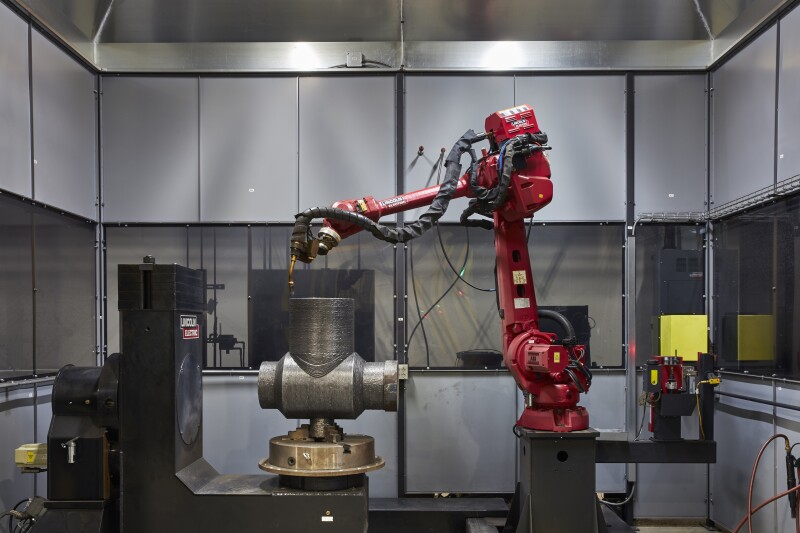
While some OEMs are investing in in-house printing capabilities, others, including Fairbanks Morse Defense and Hunt Valve, are leveraging a growing industrial AM capacity. Companies like Lincoln Electric are deploying heavy-industrial capacity to mass-produce large 3D-printed parts, such as submarine valves. Through its partnership with the MIB and government investment, Lincoln Electric recently added four robotic WAAM machines capable of laying 100 pounds of metal per hour at its Ohio manufacturing center. This capability could help alleviate the submarine gap by shortening component lead times and strengthening submarine supply chains.
Yet, just as shipbuilding suppliers contract with forging shops or casting houses, industry must be empowered to do the same with 3D printers. This is an area where Navy requirements and policy have not yet kept up with the technology. Industry’s biggest challenge is not finding willing partners for industrial-scale 3D printing. The challenge is getting approval at the Navy level and shipyard level to use those 3D-printed components on a specific part basis.
Qualifying What Is Produced, Not How It’s Produced
Both industry and the Navy customer see the advantages of additive manufacturing. Now, the promise of this technology must be supported by swift action. The Navy and MIB should be applauded for the progress they’re making in piloting critical innovations, approving materials and moving Level I components into development. To continue pushing forward, industry needs a clear demand signal to scale; and that signal will come through standardized requirements and broader material interchangeability.
Quality assurance, certification, safety and structural integrity will always be paramount. The manufacturing process needs to be understood and trusted, but streamlining approvals of additional manufacturing methodologies is the key to unlocking fleet-wide impact.
Bringing additive manufacturing to bear at a scale that will meet the needs of the submarine enterprise means shifting the approach to manufacturing, with a relentless focus on performance requirements and capacity to ensure mission readiness.
