



The Department of the Navy submitted its Fiscal Year 2027 budget request on April 21, asking Congress for $377.5 billion — a 23% increase over the previous year and a jump of more than $70 billion — with shipbuilding and the maritime industrial base at the center of the proposal.
The request is part of President Trump's broader $1.5 trillion national defense budget submitted to Congress on April 3.
"This is a strategy-driven budget," said John Phelan, who was Secretary of the Navy at the time of the announcement. "It's not about business as usual — it's about making generational investments in real, usable capability for our warfighters."
The shipbuilding portion of the request totals $65.8 billion and calls for the purchase of 34 vessels: 18 battle force ships and 16 auxiliary ships. The battle force buys include one Columbia-class submarine, two Virginia-class submarines, one FF(X) frigate, one Arleigh Burke-class destroyer, one America-class amphibious assault ship, and one San Antonio-class amphibious transport dock. The 16 auxiliary ships include six medium landing ships, two John Lewis-class oiler tankers, two submarine tender replacements, and one ocean surveillance ship. The budget also continues incremental funding for the third and fourth Ford-class aircraft carriers, CVN 80 and CVN 81.
The request includes funding for the design and development of a large surface combatant designated the BB(X) — formally reviving the "battleship" hull classification that the U.S. Navy last used with the decommissioning of USS Missouri in 1992. The BB designation had not appeared in Navy budget documents in more than three decades.
"This is the money that builds the future fleet," said Rear Adm. Ben Reynolds, Deputy Assistant Secretary of the Navy for Budget. "It funds the acquisition of 34 new ships and 123 new aircraft, directly translating dollars into the steel and systems that will guarantee our maritime dominance for decades to come."
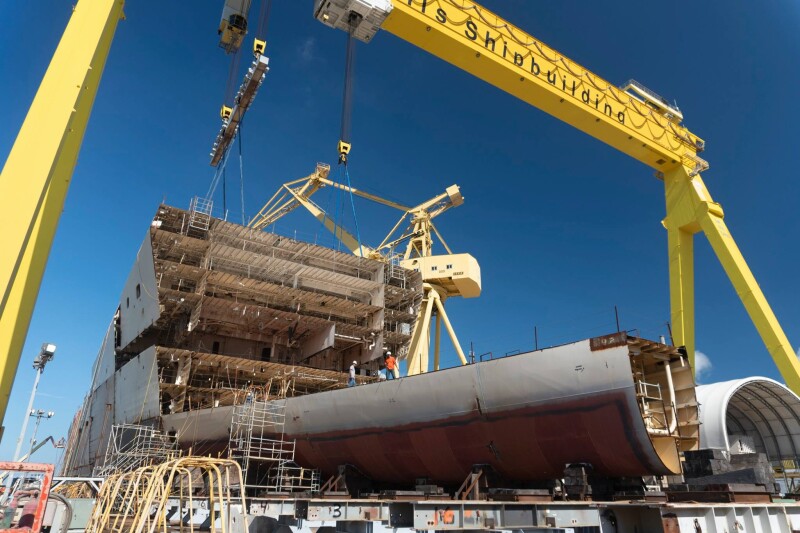
The Navy framed the shipbuilding push as central to what it is calling the "Golden Fleet Initiative," aimed at revitalizing the U.S. maritime industrial base. American shipyards have faced sustained capacity and workforce challenges in recent years, with the Navy's fleet size declining even as peer competitors — particularly China — have rapidly expanded their naval forces.
The $150 billion operations and maintenance request is targeted at pushing platform readiness to an "80% combat surge ready posture" by reducing maintenance backlogs — a persistent problem that has kept numerous ships and aircraft out of service. Deferred maintenance and drydock delays have been a recurring issue for the Navy, with some ships spending years awaiting repairs.
For Marine Corps amphibious and ground forces, the $6.3 billion ground procurement request includes 32 Navy/Marine Expeditionary Ship Interdiction System launchers, 103 Naval Strike Missiles, 42 Marine Air Defense Integrated Systems, and 16 Medium Range Intercept Capability systems.
"This budget significantly enhances our ability to be a globally responsive, resilient, and lethal naval expeditionary force in readiness," said Marine Corps Commandant Gen. Eric Smith. "It delivers much-needed investment in amphibious warships and medium landing ships, strengthens our aviation combat element, increases our magazine depth, and takes care of our strategic advantage, our Marines."
Aircraft procurement of $34.4 billion covers 123 aircraft, including 47 F-35s — double the prior year's buy — along with 12 P-8A maritime patrol aircraft, 22 CH-53K heavy-lift helicopters, and a mix of unmanned platforms. Weapons procurement totals $22.6 billion, covering Standard Missiles, Tactical Tomahawk Missiles, and Patriot PAC-3s.
The budget dedicates $70.1 billion to military personnel, funding a combined end strength of 621,500 sailors and Marines, with $2.5 billion directed toward quality-of-life improvements, including housing, dining, and childcare programs.
Research and development spending is set at $36.2 billion.
"The FY27 budget request is a definitive order to shift our Navy from a peacetime posture to a warfighting footing," said Chief of Naval Operations Adm. Daryl Caudle. "We are not just observing the security environment; we are actively shaping it with credible tailored forces to ensure peace through strength."
The request now goes to Congress, where appropriations committees will begin their review process.
