



The Trump administration’s $1.5 trillion fiscal 2027 defense budget request includes $68.5 billion for new Navy ships including 34 vessels, the most since 1945.
The orders would include 18 combat vessels plus logistics ships such as tankers and roll-on/roll-off transports.
In budget summaries the administration proposes a 10% cut in nondefense spending by about $73 billion, pushing more social spending and other responsibilities onto state and local governments. Those targeted include health research, public schools and higher education, renewable energy and climate grants.
The political risks of cutting popular government programs when Americans are under pressure from rising energy and other costs is alarming both Republican and Democratic members of Congress who would review the budget request.
At a Washington lunch event Wednesday, Trump asserted military spending must be the foremost national priority.
“We’re fighting wars. It’s not possible for us to take care of day care, Medicaid, Medicare, all of these individual things,” said Trump.
The Office of Management and Budget’s 2027 document enumerates shipbuilding plans under a heading of “Restoring America’s Maritime Dominance,” a recurring theme of the administration “to strategically recapitalize the maritime industrial base.”
The budget requests $65.8 billion in shipbuilding funding “to procure 18 battle force ships and 16 non-battle force ships,” according to OMB. “As waters around the world become increasingly contested, it is imperative that the United States be able to efficiently deliver the various naval platforms it requires, including both battle force and auxiliary vessels, to ensure maritime domain awareness and deterrence.”
Without detailing specifics the budget claims to establish “President Trump’s Golden Fleet, including initial funding for the Trump-class battleship and next generation frigates.” It calls to “maintain or increase the procurement of existing battle force platforms, including amphibious vessels, and Columbia-class and Virginia-class submarines.”
The procurement of non-combat platforms would be expanded to add strategic sealift and hospital vessels, Consolidated Cargo Replenishment at Sea tankers, a “special mission ship” and submarine tenders.
“The repair capacity of public shipyards would be increased, while improved production across the feet would help address delays and ensure the timely delivery of vessels,” the budget states.
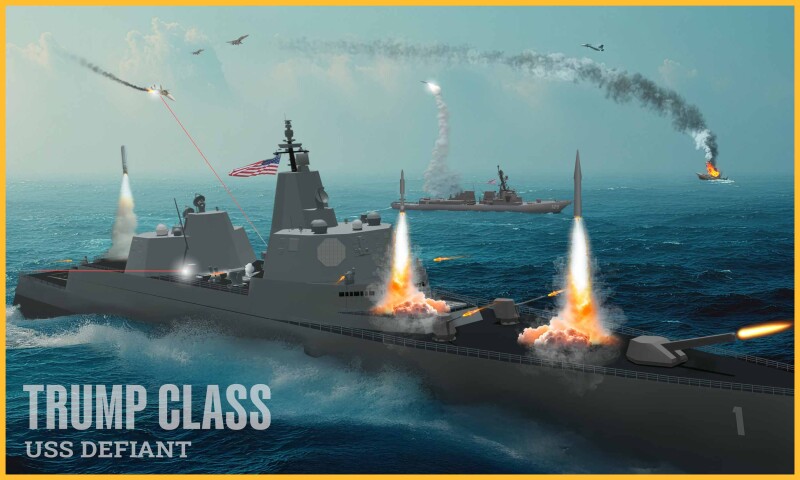
In December Trump and Navy officials announced the concept of a proposed USS Defiant (BBG-1) guided missile battleship.
The USS Defiant and subsequent Trump-class ships are in the design and planning phase, with construction and full funding subject to future Navy budgeting and congressional authorization. The recently signed defense bill includes $26 billion allocated for the construction of new Navy ships.
Trump said during a December press conference at his Mar-a-Lago estate in Florida that the program would begin “immediately” with two Trump-class ships, then “quickly” expand to 10 ships, and eventually grow to include 20 to 25 new vessels.
If built, the Defiant would mark the Navy’s first new battleship design since the Iowa-class ships, the last of which was commissioned during World War II. The Navy formally decommissioned its final battleships in the early 1990s, shifting surface combatant development toward cruisers and destroyers optimized for missile warfare and carrier escort missions.
