



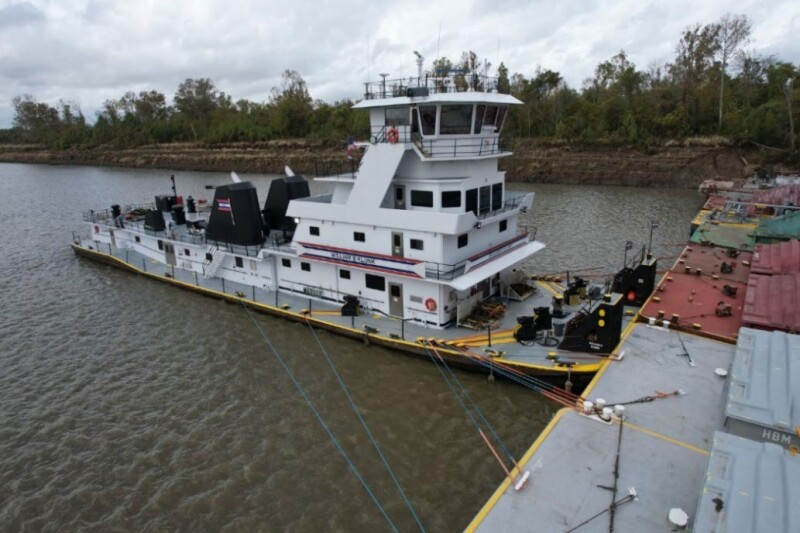
A towboat pilot’s use of his personal cell phone and extreme fatigue were key factors in a costly barge collision on the lower Mississippi River last year, federal investigators concluded in a report released Thursday.
The National Transportation Safety Board (NTSB) found that the pilot of the 8,000-hp towing vessel William B Klunk was distracted by personal phone use in the moments leading up to the April 17, 2024, incident near Baton Rouge, La. The 170'x48' vessel, operated by American Commercial Barge Line, Jeffersonville, Ind., was pushing 22 loaded hopper barges when it collided with moored barges in a fleeting area, causing 16 barges to break free and resulting in over $800,000 in damage.
In the six minutes before the crash, the pilot failed to adjust the rudder or throttle, according to investigators. Footage from the onboard image recorder showed the pilot using his personal phone and not monitoring the tow’s position just 40 seconds before the impact.
In addition, the pilot had been engaged in other nonoperational activities throughout the 1.5-hour transit, including an administrative call with a company safety officer, a personal call, and texting.
“Use of cell phones, including company cell phones (particularly for nonoperational conversations), should never interfere with a watchstander’s primary task to safely navigate a vessel and maintain a proper lookout,” the report said. “To reduce the risk of cell phone distraction, operating companies should establish protocols regarding both personal and work-related cell phone use, and vessel personnel should understand the importance in following them.”
Thirteen barges from the William B Klunk tow and three from the moored fleet were set adrift, causing damage to the barges, a fleet crew boat named Mr. Bubba, and two mooring dolphins. One crewmember who was on board the towing vessel Neil Martin at the fleeting area was injured during efforts to recover the runaway barges.
The NTSB also found the pilot was severely fatigued at the time of the incident. He had received only four hours of uninterrupted sleep in the 36 hours leading up to the collision and had been awake for nearly 18 hours.
“The risk of distraction increases when an individual is fatigued,” the report said. “Fatigue’s impacts to attention, vigilance, and multi-tasking can increase the likelihood that an individual will disengage from their primary task and become distracted by a secondary task.”
