



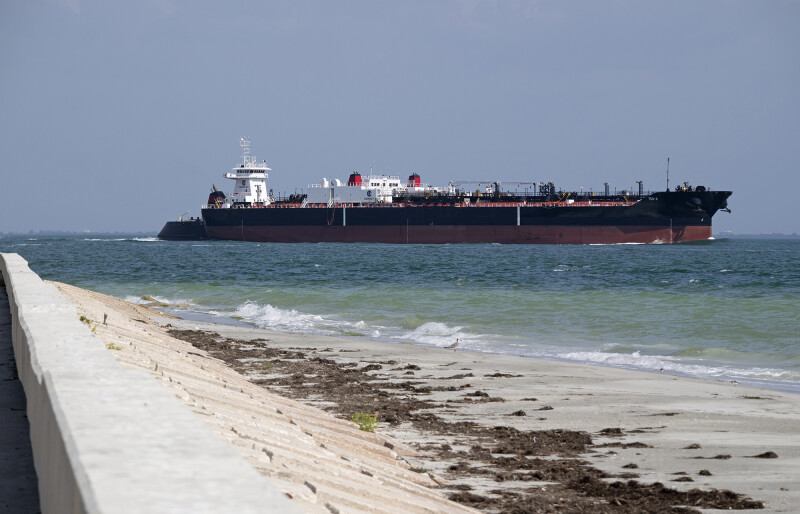
The Trump administration announced Friday it will extend its Jones Act waiver for an additional 90 days, drawing swift and sharp condemnation from virtually every corner of the U.S. maritime industry.
President Trump is extending the waiver in a bid to lower fuel prices as the war in Iran stretches into its second month. The law requires that goods shipped between U.S. ports be carried on vessels that are U.S.-built, -flagged, and -crewed. Trump initially waived the act on March 18 for 60 days to ease energy prices as the war cut off one-fifth of the world's oil supply, causing energy costs to soar. The extension will begin at 12 a.m. ET on May 18.
White House press secretary Taylor Rogers said in a statement that new data compiled since the initial waiver was issued revealed that significantly more supply was able to reach U.S. ports faster, and that the extension "provides both certainty and stability for the U.S. and global economies." The administration said more than 40 tankers have used, or will use, the Jones Act waiver, increasing the availability of transporting goods.
The national average gasoline price on Monday was $4.044 per gal., up $0.324 from March 16, according to the U.S. Energy Information Administration.
The administration said it is taking the step to extend the waiver three weeks before its original expiration to allow ample time for the maritime industry to ensure sufficient vessels are available to continue moving applicable goods to where they are needed.
The move reflects a broader push by the White House to dampen politically sensitive fuel price spikes before November's midterm elections, where affordability is expected to be a defining issue for voters.
"GUT PUNCH"
U.S. maritime trade associations and labor unions responded with unified opposition, arguing the extension harms American workers and national security while failing to deliver any measurable consumer benefit.
The American Waterways Operators (AWO), whose members operate the nation's tugboat, towboat, and barge fleet, called for an immediate end to the waiver. "This Jones Act waiver extension throws open America's maritime borders to foreign vessels and crews and puts American workers last," said Jennifer Carpenter, AWO president and CEO. "It is incongruous with the goal of restoring American maritime dominance and ignores the targeted, case-by-case waiver process provided by current law when genuine transportation needs cannot be met by American vessels. This broad Jones Act waiver is a gut punch to American workers and should be terminated immediately."
The Marine Engineers' Beneficial Association (MEBA) pointed to gasoline prices as evidence the policy has failed on its own terms. "The facts speak for themselves: the original waiver has done nothing to lower prices at the pump for the American consumer," said MEBA President Adam Vokac. "This extension is not a solution — it is a continuation of a failed policy."
Vokac added that the waiver contradicts the administration's stated priorities: "Extending this waiver does not advance an America First agenda. It simply hands a competitive advantage to foreign shipping companies and allows them to profit directly at the expense of the U.S. Merchant Marine and the tens of thousands of hardworking Americans who crew these vessels."
The Seafarers International Union (SIU) also strongly opposed the extension, warning that its effects extend beyond economics to workforce and national security. "The Jones Act is not simply an economic policy; it is a cornerstone of our national security, ensuring that America maintains a fleet of U.S.-flagged vessels crewed by highly trained American mariners who are ready to serve in both peace and war," the union said in a statement.
The SIU raised particular concern about the extension's effect on recruitment and retention: "Policies like this send the wrong signal to those considering a career at sea and to those currently serving — suggesting that their livelihoods and contributions can be set aside when it is most convenient."
The union also cautioned that repeated waivers erode investor confidence in the domestic maritime sector. "Capital does not flow into uncertainty. If cargo can be diverted at will to foreign-flag vessels, investors will simply take their money elsewhere. The result is predictable: fewer U.S.-flag ships, diminished shipyard activity, and a shrinking mariner pool."
The Offshore Marine Service Association (OMSA) echoed those concerns about investment. "Extending this waiver undermines that foundation by signaling that American ships can be sidelined, driving away the long-term investment, possibly permanently," said OMSA President Aaron Smith. "The initial waiver has not reduced gasoline prices, rather prices have increased in every U.S. market while benefiting NATO countries that have refused to support U.S. military operations."
Matt Paxton, President of the Shipbuilders Council of America, said the policy sends the wrong signal at the worst possible time. "At a time of global instability, the administration should be strengthening, not weakening, the American maritime, shipbuilding and maritime supplier base that is the foundation of our national security," Paxton said. "Waivers have unequivocally proven they do nothing to reduce gas prices for Americans. What waivers actually do is have a chilling effect on investments in commercial shipbuilding markets and create wide open ports and coastlines for any foreign ship or crew to call and gouge hardworking Americans while foreign energy companies and shippers get rich."
The American Maritime Congress called on the administration to pursue alternative measures — including maximizing direct imports of critical commodities, expanding pipeline and rail capacity, and using Defense Production Act authorities — arguing those steps "provide immediate, practical relief while preserving the integrity of the U.S. maritime industrial base." AMC President Fair Kim warned that foreign operators allowed in under the waiver include entities "connected to strategic adversaries" that "pay no U.S. taxes, comply with no U.S. immigration, labor, or environmental laws, and owe this country nothing."
Background
The Jones Act, passed in 1920, aims to protect the U.S. shipping sector. Critics — including energy producers, refiners, and agricultural groups — say the requirement to use U.S.-built and -crewed vessels raises shipping costs and limits capacity, particularly during disruptions. The Jones Act supports nearly 650,000 American jobs and more than $154 billion in annual economic output, according to the American Maritime Congress.
Trump has said crude and gasoline prices are likely to fall once the Iran conflict subsides, but analysts caution that costs could remain elevated even after hostilities end, as supply disruptions, higher shipping costs, and a lingering geopolitical risk premium continue to ripple through global energy markets.
