



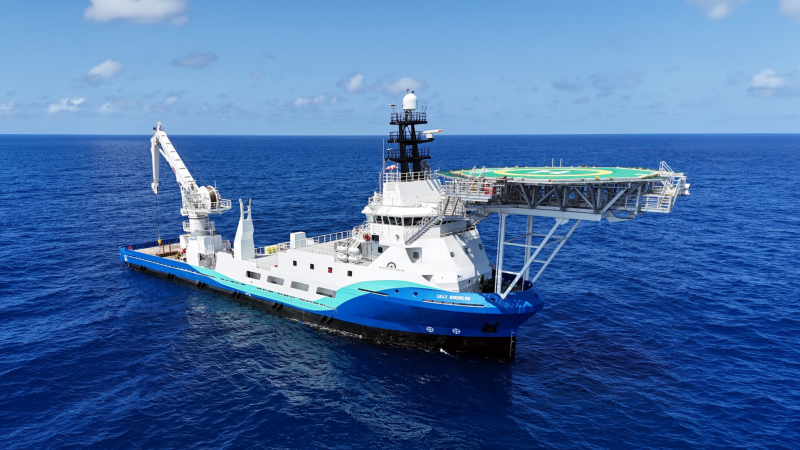
Bordelon Marine has completed the conversion and redelivery of the Lilly Bordelon, a Stingray Series 260 Class DP-2 ultra-light intervention vessel rebuilt from a platform supply vessel hull.
The vessel, suited for subsea inspection, maintenance, repair, and light construction work, was converted at Bordelon Marine Shipbuilders in Houma, La., and is ready for its first post-conversion assignment, according to Wes Bordelon, president and CEO of Bordelon Marine.
The company described the project as more extensive than a traditional conversion, with most major systems replaced or added. The existing hull and superstructure steel were retained, but the vessel received new thrusters, generators, switchboards, variable frequency drives, motor controls, cooling systems, pumps, electronics, automation, navigation, power management, and alarm and monitoring systems.
“The Lilly is not your typical conversion job,” Bordelon said. “Traditionally, owners will augment the design slightly, upgrade systems, and make some cosmetic improvements. But this project is more akin to repurposing a hull.”
The vessel is equipped with a 60-ton active heave-compensated crane with 3,000 meters of wire, a 17-meter USCG/ABS-certified helideck, and more than 5,500 sq. ft. of clear deck space. It also has a mezzanine deck supporting two work-class ROVs, with an integrated ROV control room.
Interior and exterior work included new HVAC and ventilation systems, joiner work, flooring, ceilings, lighting, galley, cold stores, staterooms, offices, an auxiliary mess, a lounge, a gym, and recoating of tanks, hull, and superstructure. The vessel’s personnel capacity was increased to 63 through new staterooms with individual heads and climate controls.
The vessel also received two through-hull USBL deployment systems.
Bordelon said the approach reduced the overall cost of the vessel by nearly half compared with a newbuild.
“In today’s environment, with difficult supply-chain conditions and extremely high build costs, starting with a well-maintained hull and repurposing it as the base shell was the smartest approach,” Bordelon said. “It also reduced the overall cost of the vessel by nearly half.”
Bordelon said he expects more operators to consider extensive rebuild programs as newbuild costs remain elevated.
“Build costs are not likely to come down anytime soon, if ever, so the challenge is finding new ways to meet today’s modern, high-spec requirements while still being fiscally responsible,” Bordelon said. “I believe extensive rebuild programs using existing, well-maintained hulls is the smartest path forward.”
