



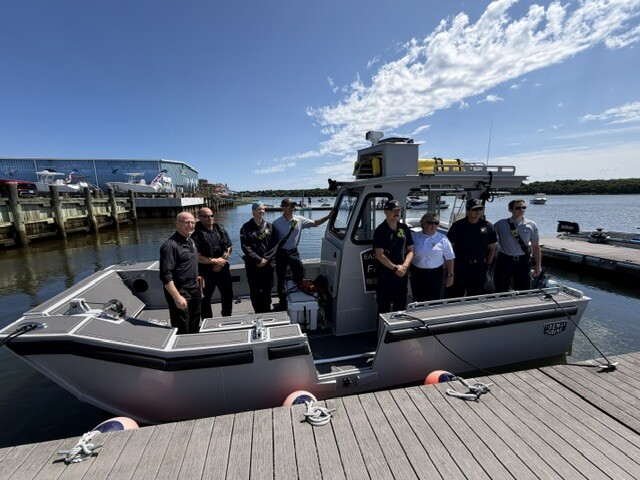
When the tide runs out of the shallow tributaries around Eastham, Mass., kayakers and other recreational boaters can find themselves stranded in places a conventional rescue boat may have trouble reaching.
That problem helped shape a new 23' HDPE rescue support boat built by Tideman Boats, North Andover, Mass., for the Eastham Fire Department. Designed to draw only about 8" to 9", the boat can work the tidal flats and shallow waterways around Cape Cod while retaining the capability to operate in open water.
“They get a lot of kayakers and adventurers down there,” said Patrick Cahill, vice president of sales and new business development at Tideman Boats. “The tides go out, so when they go out, then they’re stuck. The longer they’re there, they don’t have water with them, you’re going to get dehydrated.”
Eastham already operates a larger fireboat, Cahill said, but the new Tideman vessel fills a different role. Built specifically for rescue support rather than fire suppression, it replaces a smaller boat that was no longer meeting the department’s needs in the shallow-water environments where many of its calls occur.
“They were basically replacing the smaller boat that they had, and it just was not doing the job for them,” Cahill said. “They were looking for a boat that could hit the shallow water, but also be in the ocean.”
The requirement drove Tideman toward a tunnel-hull skiff design that could minimize draft without becoming a completely flat-bottomed boat. Cahill said the challenge was balancing access to extremely shallow water with the need to handle waves and changing conditions offshore.
“You kind of want to have a flat bottom so you can go in shallow water, but you don’t want it too flat because you’re also competing with waves quite a bit,” he said. “You want something that’s going to be able to sustain the waves and the impact.”
The boat is powered by a Yamaha 200-hp outboard and carries 73 gals. of fuel. Its beam is 8'5", and Cahill said the boat reached 40 knots during sea trials. It entered service in July.
Shallow draft alone, however, would not solve the department’s rescue problem. Tideman and Eastham also focused on how firefighters and EMTs would bring people aboard once they reached them.
A manually operated drop-down bow was added during the design process, allowing the crew to nose the boat onto a beach or tidal edge and recover people directly over the bow rather than lifting them over the side.
“The front recovery was an added feature that wasn’t originally thought of,” Cahill said. “We came up and said, ‘Hey, we could open up the front. You can actually do recovery from the front, not just the dive doors on the side.’”
The arrangement also gives crews another option for recovering equipment.
“You can nose right in to a situation, you can lower the front, and you can go to the beach,” Cahill said. “You can get the people off. You can even get the kayaks off and pull them on. It’s easier than pulling somebody over the side or netting somebody.”
Dive doors on both sides provide additional water access. The deck was laid out with room for firefighters and EMTs to treat exhausted or injured people, while a Stokes basket can be carried on top of the pilothouse. Removable spud anchors fore and aft allow the boat to hold position in shallow areas. Cahill said Tideman modified the spud-anchor arrangement during development after the initial setup still allowed some movement.
Ride quality was another consideration. Cahill said the HDPE construction helps absorb and disperse wave impact, which can become especially important when the crew is transporting someone who is already injured.
“When you’ve got an injury and waves are hitting a boat, you feel them,” he said. “Anything that can soften that blow is a lot better. The ride itself, absorbing that impact without feeling the pounding as much, it’s better for the casualty.”
The boat grew out of roughly two years of planning involving Fire Chief Lisa Albino and Eastham’s boat team. Cahill said department personnel brought lessons from their previous vessel into the process, including the need for more working deck space, better equipment placement, and easier casualty access.
“They knew what they wanted,” Cahill said. “We did more than one round on that boat.”
The design evolved through changes to the pilothouse, storage compartments, lighting, dive-door arrangement, and propulsion. Cahill said Eastham ultimately chose the Yamaha outboard in part because the department already had a local Yamaha dealer it trusted.
“It’s important that you can get service locally on the key parts of your boat,” he said. “Yamaha was important to them. It wasn’t what we bid. It’s what they asked for afterwards.”
Cahill said those changes reflected the long-term nature of the department’s investment.
“This is a boat that’s going to be 20, 30, 35 years in their operation,” he said. “You want to give the customer what they want.”
