



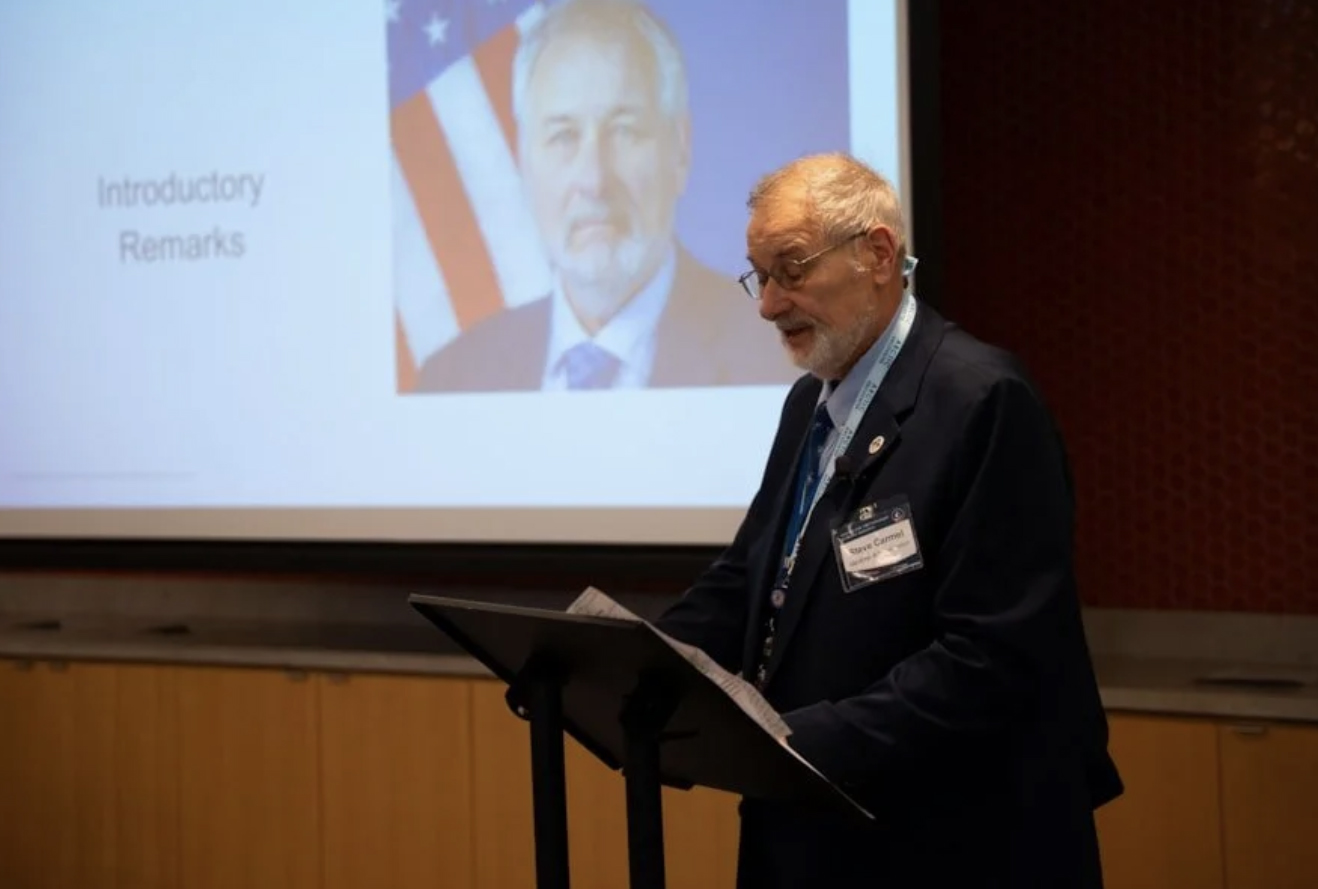
The U.S. Center for Maritime Innovation (USCMI), launched about a year ago to support the study, development, and deployment of emerging marine technologies, gathered stakeholders in Washington, D.C., May 21 for an “Innovation Café” focused on small modular reactor (SMR) technologies and their potential maritime applications. USCMI hosted the meeting in partnership with the Maritime Administration and the American Bureau of Shipping (ABS). Dialog centered on new propulsion and energy solutions for the maritime industry in the United States.
“The future of U.S. maritime strength depends on our ability to align innovation with real operational and economic outcomes,” said Maritime Administrator Stephen Carmel. “Bringing stakeholders together through forums like the USCMI Innovation Café ensures we are not only exploring transformative technologies like small modular reactors but doing so in a way that strengthens our industrial base, enhances resilience, and delivers practical value to the maritime transportation system.”
ABS, the center’s secretariat, hosted the meeting at its D.C. office. Participants included technology innovators, startups, shipping companies, shipyards, ports, SMR developers, and government stakeholders who assessed emerging SMR concepts, economics of deploying the technology, and pathways for adoption for commercial marine applications.
“These discussions create real value by connecting stakeholders, aligning perspectives, and helping to accelerate practical pathways for integrating innovative solutions like SMRs into the maritime ecosystem,” said David Walker, secretariat for the U.S. Center for Maritime Innovation.
The USCMI Innovation Café followed on the heels of the launch of a U.S. Department of Transportation and Maritime Administration initiative to develop SMRs specifically for commercial shipping. On May 7, Marad released a request for information (RFI) calling for “input from industry and innovators” on developing an SMR model for the U.S. maritime industry that would be efficient and affordable for commercial vessel applications, that would support American supply chains and promote energy independence, and that would be scalable and deployable across entire fleets. Marad is also seeking ways to integrate SMR production into shipyards, with applicable credentialing standards and liability, insurance, and inspection frameworks.
According to the U.S. Energy Information Administration, large-scale nuclear power plants typically produce between 550 megawatts (mw) and 1,500 mw of electricity, while SMRs would produce between 70 mw and 350 mw. A subset of SMRs, microreactors, would produce 20 MW or less.
For reference, a 100,000 hp ultra large container ship would draw the equivalent of about 75 mw of electricity, well within the output range of an SMR. Another application under consideration is the use of floating SMRs to provide service power for docked vessels or for port infrastructure. Barge-mounted SMRs have also been discussed as power sources for AI data centers.
