



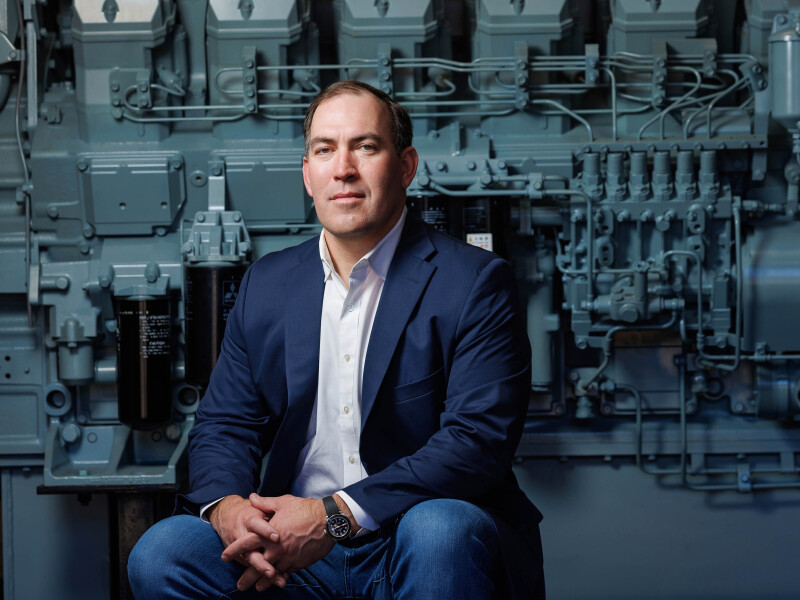
WorkBoat sat down with Brian Laborde, president and CEO of Laborde Products, Covington, La., to discuss how his family business has carved out a distinct position in the marine engine market. He explains how his company’s 100-person team competes successfully against multinational giants and why support, not just sales, defines long-term partnerships with customers.
Please give a background on the company's history.
Laborde Products is a family business. My grandfather was one of the founders of Tidewater Marine, so my father grew up around the workboat industry. My dad started a supply boat company with his brother, then decided to leave, but didn’t want to get totally away from the industry. He ultimately founded what is now Laborde Products, taking over a company called Star Power that was an engine distributor for Yanmar Marine engines in the sailboat and recreational industry.
My dad’s intention was always to take the company into the commercial side of things. He went to Japan to meet with Yanmar about the commercial business and also visited Mitsubishi about their commercial lines, which were not really present in the United States. Mitsubishi started a partnership with Laborde, and we started distributing Mitsubishi in 2000.
My history was running a marine company out of Houston. I was tasked with repowering a bunch of boats, and I worked directly with my dad on that. I was a customer of Laborde for about six years prior to joining the company. I joined about 15 years ago and took over running the company about 10 years ago.
During the Covid pandemic, when the world was shutting down, we really decided we needed to focus the business. We made the tough decision to put all of our eggs into the marine business. That’s where all our experience was. When we looked at our major competitors, their marine businesses were one of their smallest segments. We felt like if we were going to challenge these major companies, we had to specialize in a market they might overlook.
We made major investments in parts and engines going into Covid to ensure our customers weren’t going to have operational issues. Covid was the inflection point for our major growth. That was the point where our customers were like, this little company is different. When everything gets tight, we are going to make sure that the boats keep running.
Since then, we’ve stayed focused. We’re a marine engine company: propulsion, auxiliary power, and barge equipment. If it’s floating and it’s working, those customers are our customers.
Can you give an overview of your product offering?
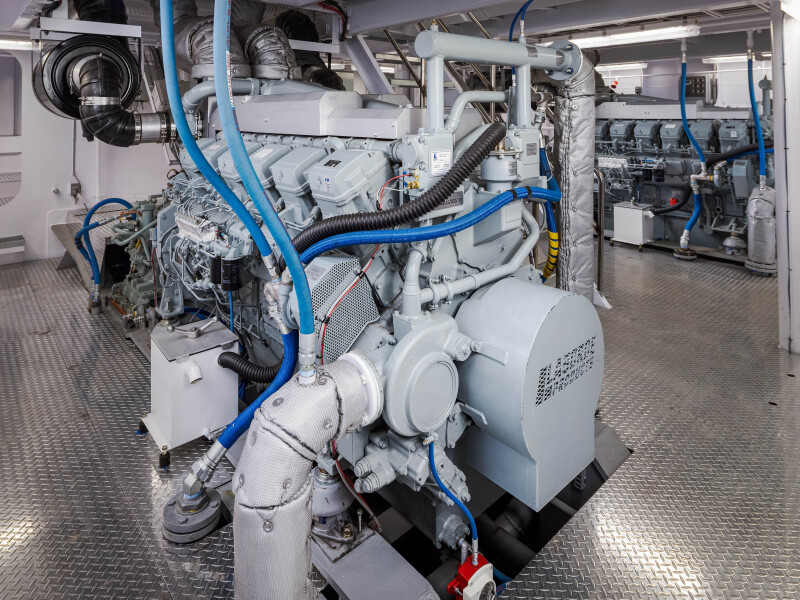
On the Mitsubishi side, we run from about 400 hp up to about 1,700 hp. That’s the river, coastal, and inland marine market. We do a lot of work in coastal tug markets on the East Coast and commercial fishing. We’re in the auxiliary power business from about 40 kW up to 125 kW.
We also represent Scania’s commercial marine line. All of the companies we represent are from outside of the United States. The Mitsubishi is a very heavy, robust, high-output engine. It’s great for a workboat. It has high torque. It pushes, but it’s not going fast. On the other side, Scania engines are high-output, low-weight. They are going into pilot boats, crew boats, vessels where you want to get on a plane and go fast. And so that engine is designed completely differently from our Mitsubishi.
We also represent a company out of Austria called Steyr. It is a very specialized product. The majority of our Steyr product goes into military applications. One of the big growth areas for that product is autonomous drone boats. That’s a blossoming market here in the United States. The military is trying to get people off of the boats for dangerous missions. We ultimately work with companies that develop the boats and participate in that market.
When you look at the markets you serve, how do you see opportunities?
The inland market is in a challenging space right now, and it’s our largest market. The cost of new assets has been escalating substantially. Emission standards have continued to rise, and the cost of higher EPA tier engines is exceptionally higher. Our Tier 4 product has expensive components: SCRs and aftertreatment systems. However, the market hasn’t necessarily accepted those higher costs.
If a customer were to build a 2,600-hp tug today, it would need to be EPA Tier 4. That vessel would cost about $4 million more than a Tier 3 tug, yet the rates paid to operate those two vessels are the same. I don’t expect to see substantial newbuilding until the market shifts in a way that the charters of these vessels will absorb higher rates, allowing us to build.
One of our biggest business segments is repowering vessels. Our growth for the next two to three years is going to be driven heavily by the replacement of older tier engines and competitors’ engines. To remove a competitor’s engine and put ours in isn’t just the cost of the engine. There are modifications that have to happen. When a customer makes the transition to Mitsubishi and Laborde, they’re making a major investment. However, our growth shows that the returns over time are substantially better. Every major company in the country is in the process of making that transition to Mitsubishi.
How are you handling the tariff situation?
Tariffs have been a big challenge. We took a very different track than our competition. We knew tariffs were going to impact us. We took some preemptive action to adjust pricing, but we made the decision to honor the contracts we had in place. That put financial pressure on our company, but we felt like “If somebody has made a deal with me, they’ve made a deal with me. It’s not a corporate decision, it’s a Brian decision.”
We have millions of dollars’ worth of projects that will play out in the next two or three years where our margins will get squeezed because of tariffs. But we decided it was the right thing. My name’s on this building. It’s the one thing you have that truly defines you. When we make a deal, we make a deal. Our customers had taken loans out; they had pricing. In the long run, customers will remember that we stick to our deals.
A lot of companies look at this like we’re in the engine sales business. We’re not. When we sell an engine, it’s just the first step in a relationship that’s going to last 15, 20, 30 years. As long as I’ve been in this business, when we go in, we never come out. When we sell a product, it’s just the very first step in a very long-term relationship. We take that seriously, and we take it personally.
What keeps you up at night?
The biggest challenge we talk about daily is constantly improving our support. We have engines operating all over the country. How do we support that customer that breaks down in the middle of nowhere? How do we get parts to him? How do we have the right part in the right place when it’s needed?
Last year, we opened a new office in Paducah, Ky., to have a strategic center in the upper river region. When I opened that location, we put probably $3 million in parts, inventory, and engines in that facility, so we can be closer to St. Louis, closer to Pittsburgh, when we do have a problem.
Every engine is great on the first day. Engine companies don’t truly prove themselves until the engine breaks. That’s when we earn our reputation. When a brand-new engine starts on day one, they’re all running perfectly. It’s when they break, when there’s an issue. How fast can we get there? Do we have the parts available? Do we have the people and resources to get them up and running? That’s when we truly earn the reputation of the company and the product.
What do you look for when assessing and establishing dealer partnerships?
We look for people who match our values. We look for people who are aggressive. A lot of times, we’re looking for a mom-and-pop person, a small operator who is hungry. When we call them at two o’clock in the morning and say we’ve got a boat down, it’s three hours away, we need you to go now, they’re excited to get the call.
We have about 50 dealers throughout the Eastern United States, and we are growing every year. When we can find partners who have that aggression, that eagerness, those are the best partners. I’d rather one guy in a truck than the best-looking facility in the world with the biggest corporate brand that’s not willing to go when I need them to.
How would you describe your leadership philosophy?
We hire the right people and then let them do their job. Everyone at Laborde Products plays a critical role. Whether it’s a driver running parts around or my senior executive team, every one of them is required to make decisions every day without talking to me.
This is also a business of mistakes. We make a lot of them. I’m a professional mistake-maker. It’s not about whether we’re going to make them, because we are. It’s about how we deal with the mistakes, and ultimately, how we learn from them, how we move forward.
What do you want readers to know about Laborde Products?
The biggest thing that differentiates our business is our partnership approach. We don’t view ourselves as a company that sells a product. We are consultants and partners. I take every engine personally. My name is on every one of them. My grandfather was an incredible guy. My dad took the risk to start this business. I’ve been blessed with the ability to take this company on with my brother Trace and carry the torch.
I defend that to the bitter end and make sure that in every decision we’re making, it’s not just about numbers. It’s about the legacy of the business, how we treat people. We want the Laborde name to be synonymous with the honor it was brought up with.
This interview has been edited for length and clarity.
