



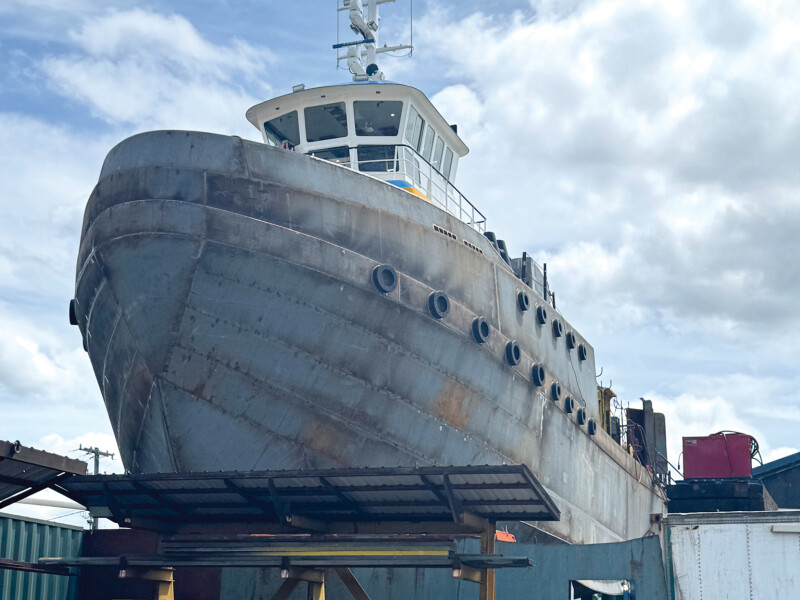
Western Towboat Co., Seattle, has a versatile fleet of harbor and oceangoing tugboats that tow a little bit of everything in Puget Sound and beyond. The company has a new Titan-class oceangoing tugboat, Northern Titan, under construction at its shipyard facility along the Lake Washington Ship Canal.
Once complete, Northern Titan will be the company’s eighth Titan-class tug in service, joining the other 120', 6,000-hp vessels in the series, towing cargo barges between Seattle and Whittier, Alaska.
“We are planning to most likely start another Titan-class tug in the first quarter of 2026,” said Capt. Russell Shrewsbury, the company’s vice president. “Our work demand has been really high. Now we just need to keep training and adding qualified crews to help us accomplish our customers’ workloads.”
Oceangoing tugs like Western’s Titan-class are the semitrucks of the sea. From drum winches on the aft deck, they tow petroleum products in tank barges and construction equipment, chemicals, and containers perched atop deck barges. These tugs support oil and gas exploration, offshore wind, and increasingly, private space operators. And yet, new construction in this corner of the towing industry has been dormant in recent years despite an aging fleet.

According to broker Marcon International Inc., some of these trends are reflected in the secondary market. The number of tugboats for sale globally and in the U.S. has fallen sharply in recent years, and the average age of vessels hitting the market is now approaching 33 years.
“Despite some appetite for older vessels requiring repowering to meet stringent [California Air Resources Board] regulations, the high cost of shipyard work often makes such investments challenging,” Marcon noted last fall in its towing industry report. “Owners are increasingly turning to their existing fleets for candidates for major overhauls to meet regional demand.”
The cost of older equipment is rising. But like a homebuyer wary of a fixer-upper at today’s prices, operators are scrutinizing the costs associated with bringing older tugs into their fleets. “This scarcity is driving up prices for available assets, although paying $1 million or more for a tug requiring repowering remains difficult to justify,” the Marcon report noted.
The oceangoing tugboat market was busy not long ago. Over the last decade or so, Sause Bros. Ocean Towing Co. Inc., Coos Bay, Ore.; Kirby Corp., Houston; Dunlap Towing Co. Inc., La Conner, Wash.; and Western Towboat all built new seagoing tugboats to bulk up their fleets. Vane Brothers Co., Baltimore, completed not one but two separate classes of model bow tugs that can push or pull fuel barges.
The net result of all that building last decade is a relatively stable market with sufficient towing equipment for the type and volume of work available, according to Frank Manning, president of shipbuilder Diversified Marine Inc., Portland, Ore.
“I think everyone was trying to get ahead of the Tier 4 requirement for oceangoing tug applications,” said Manning. “With Tier 4, there is the added fear of requiring urea for most engines available on the market.”
The rapid rise in new construction costs has also put a damper on the market for newbuild oceangoing tugs. Those higher build costs coincide with a steep rise in borrowing costs and the capital needed to service a loan on a long-term towing asset. Day rates for these assets, in many cases, have not risen in tandem with higher costs.
“The cost to construct a new vessel is just way too expensive,” said Shane Guidry, chairman and CEO of Harvey Gulf International Marine LLC, New Orleans. “Secondly, even if you took on the risk of constructing a vessel at 50% more than what the industry has built vessels for in prior years, oil companies are not willing to pay the day rate you need to service the debt and make a return investment.”

Outside of new construction, there have been some notable projects to repower or overhaul oceangoing tugboats in recent years. Curtin Maritime Corp., Long Beach, Calif., recently completed a full repower of the Invader-class tugboat Lindsey C.
The Invader-class tugs built at McDermott Shipyard, Morgan City, La., in the mid-1970s earned a reputation among mariners for their speed and performance, particularly in rougher seas. The Lindsey C repower project, which required extensive reengineering, replaced the two 3,600-hp EMD main engines with Wabtec 8L250s delivering 3,350 hp each.
Dawn Services LLC, Harvey, La., recently refurbished the 22-year-old former Corbin Foss, which had been laid up in Pascagoula, Miss., for some time. The 150' vessel, newly named Capt. John J. Charpentier in honor of the company’s founder, delivers 8,200 total horsepower and 108 tons of bollard pull.

The fleet of Crowley Maritime Corp., Jacksonville, Fla., which at one time included 25 Invader-class tugboats, has evolved into a more diverse mix of ocean-towing vessels and capabilities. It has four dedicated Invader-class tugs that continue to handle oceangoing tows between Florida and Puerto Rico, along with a combination of Ocean-, Alert-, and Titan-class vessels. Taken together, the company continues to operate one of the most capable ocean-towing fleets in the U.S.
John Ara, vice president of sales and chartering for Crowley Shipping, said that the fleet includes the four Ocean-class tugs, all of which are rated DP1 or DP2, reflecting their dynamic positioning capabilities, while delivering 150 tons of bollard pull. It also counts three Alert-class prevention and response tugs. The Alert-series tugs, each boasting 130 tons of bollard pull, previously supported tanker escorts from Valdez, Alaska.
“The Ocean class is performing project towing all over the world and some scrap tows. They are very versatile. Of the U.S.-flagged tugboats that are true tugboats, they are the only ones with DP,” said Ara. “They perform tandem tows, triple tows, and even quadruple tows for some big offshore floating production units.”
The Alert-class tugs are supporting offshore wind development along the East Coast, primarily towing barges between shoreside facilities and the wind turbine sites over the horizon. Crowley also has chartered a limited number of tugs to boost its capabilities supporting the offshore wind sector.
Earl W. Redd, which earned accolades in the mid-2010s as the first EPA Tier-4 rated oceangoing tugboat, has operated under charter to Saltchuk’s Foss Maritime Co., Seattle, which operates it from the East Coast supporting offshore wind projects at various stages of development.

The 5,364-hp boat was originally built for Tug Construction LLC, Portland, Ore., which has been rebranded as Ursa Major Marine Holdings LLC. The company is currently building two Robert Allan Ltd.-designed ship-assist tugs at Diversified Marine and is monitoring other markets for possible new construction, according to Manning.
Young Brothers LLC, a Saltchuk subsidiary in Hawaii, was another early adopter of Tier 4 propulsion for its Kapena class of ocean-towing tugboats designed by Damen Shipyards Group. The company, which moves cars, containers, and all manner of other cargo between the Hawaiian Islands, has acquired the 5,000-hp Mount Baker and Mount Drum tugs from Kirby Offshore Marine. Young Brothers also took delivery last year of the 265' barge Kalohi and the 365' barge Naulu from Conrad Shipyard, Morgan City.
Signet Maritime Corp., Houston, and Harvey Gulf are among the companies that have assets supporting SpaceX, Hawthorne, Calif., and Blue Origin, Kent, Wash., two leading companies in private space exploration. Contractual agreements limit what these companies can share about the work. But videos shared on social media show Signet Warhorse III towing a droneship as well as a rocket booster for SpaceX, and Harvey Gulf’s versatile Harvey Stone performing similar tows for Blue Origin.
Towing companies involved in these unique operations declined to comment on their work, and Blue Origin and SpaceX did not respond to inquiries.
