


The Trump administration is pushing to establish a fifth public shipyard to support maintenance and repair needs for an expanding U.S. Navy fleet, according to Russell Vought, director of the Office of Management and Budget, as the White House presses ahead with its broader maritime industrial strategy.
Vought outlined the administration’s position during remarks at IndoPac 2026, hosted by The Washington Times on June 24, where he framed the proposed shipyard as a necessary complement to President Donald Trump's push to restore U.S. shipbuilding capacity and grow the Navy's fleet.
“If we’re going to spend a one-and-a-half trillion dollars, or have the types of direct foreign investment that’s coming in, we want to make sure that we have the ability to have enough public shipyards to do maintenance,” Vought said at the IndoPac event.
The proposal comes as the administration seeks to dramatically expand the Navy's fleet while addressing long-standing maintenance bottlenecks that have delayed repairs and dragged down operational readiness fleetwide. The fiscal 2027 budget request includes $65.8 billion for shipbuilding and sets a target of 450 vessels by 2031, encompassing battle force ships, auxiliary vessels and unmanned platforms. The current fleet stands at roughly 295 ships.
The administration’s fiscal 2027 budget request includes $65.8 billion for shipbuilding and calls for expanding the Navy’s fleet to 450 vessels by 2031, including battle force ships, auxiliary vessels and unmanned platforms. The current fleet stands at roughly 295 ships.
The budget request also includes $1.85 billion in reconciliation funding to study the use of foreign shipyards for U.S. warship construction, including the possibility of procuring an initial vessel from shipbuilders in South Korea or Japan.
Vought said scaling maintenance capacity alongside fleet growth is essential to the administration’s broader maritime strategy. In addition to the proposed fifth shipyard, he said OMB has established a dedicated shipbuilding office to help oversee implementation of Trump’s April 2025 executive order aimed at restoring American maritime dominance.
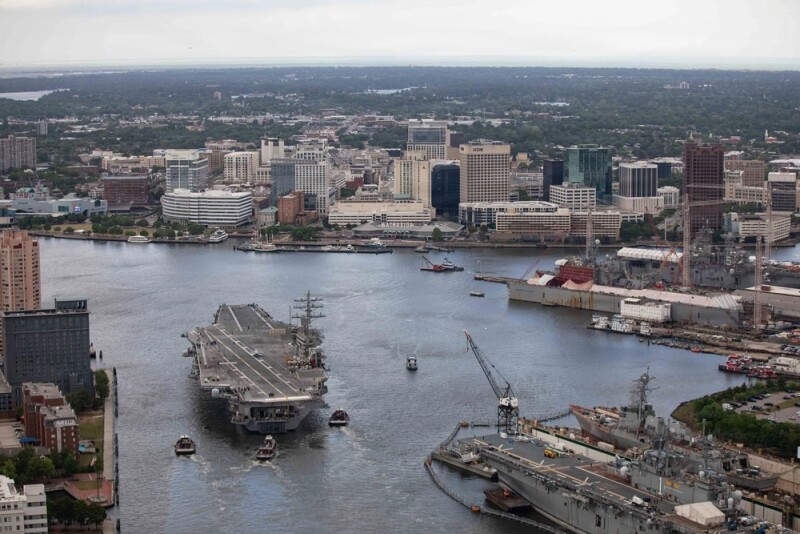
The U.S. currently operates four public naval shipyards: Norfolk Naval Shipyard, Portsmouth Naval Shipyard, Puget Sound Naval Shipyard and Intermediate Maintenance Facility and Pearl Harbor Naval Shipyard and Intermediate Maintenance Facility.
These facilities handle major maintenance overhauls and modernization work for the Navy’s nuclear-powered aircraft carriers and submarines. All four are currently undergoing modernization under the Shipyard Infrastructure Optimization Program, a 20-year effort launched in 2018 to improve capacity and efficiency.
The administration’s push for additional shipyard capacity follows ongoing concerns about maintenance delays across the fleet, particularly in the submarine force.
Vought pointed to the April decision to decommission the Los Angeles-class attack submarine Boise after years of maintenance delays.
“We all agree that at that point it needed to occur, but that had come after 10, 15 years of bad management, and we need to fix that,” Vought said at the event.
As part of the broader maritime strategy, Vought said OMB has established a dedicated shipbuilding office to coordinate shipbuilding priorities across the federal government.
“What’s different this time is that the president and administration put the shipbuilding office within OMB almost as if it’s a standalone management division,” Vought said. “And that is different, it’s very important.”
Vought said the administration sees the office as a long-term mechanism to maintain national focus on both commercial and military shipbuilding.
“I view it as kind of that seal of importance to the country that we’re always going to have a government-wide emphasis on maritime dominance, on shipbuilding, on using our resources, all of government to maintain adequate shipbuilding in this country, both commercial and military,” he said.
He also emphasized the urgency of rebuilding U.S. shipbuilding capacity amid growing global competition.
“Everyone is going at this with aggressiveness to say that we don’t have a lot of time, we’re way behind, we have backlogs everywhere in our military classes,” Vought said. “What China is proving, and South Korea and Japan and others, is that they can build ships fast and we can’t, and we have to fix that.”
Vought also pointed to broader maritime investments included in the administration’s defense spending plans, including Coast Guard fleet modernization.
The proposed fifth public shipyard, Vought said, is part of a broader maritime revival strategy that includes increasing domestic shipbuilding capacity, expanding the maritime workforce and strengthening industrial readiness as the U.S. seeks to compete with China’s growing naval and commercial shipbuilding capabilities.
