



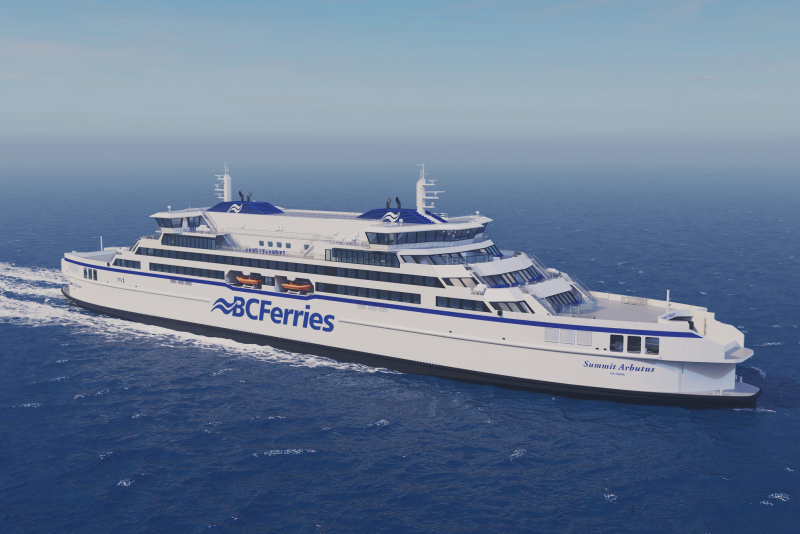
Corvus Energy, Nesttun, Norway, will supply battery energy storage systems for four hybrid-electric, double-ended ferries under BC Ferries’ New Major Vessels program.
The contract covers 40 MWh of installed battery capacity, with 10 MWh aboard each vessel. The four Summit-class ferries will be named Summit Arbutus, Summit Cedar, Summit Maple and Summit Spruce.
Corvus will also supply battery interface bases and pack control systems designed to accommodate as much as 70 MWh of total battery capacity per vessel. The additional capacity would allow the ferries to operate with near-zero emissions for up to two hours once shore-charging infrastructure becomes available, according to the company.
Preparing the vessels for the larger battery installations during construction is intended to avoid major structural modifications later.
The ferries will use Corvus’ Dolphin NxtGen Power battery system, which incorporates liquid-cooled cells. The battery systems will be integrated into the vessels’ power and propulsion packages.
“We are delighted to be selected again by BC Ferries for this flagship project. BC Ferries continues to drive one of the most ambitious and technically advanced ferry electrification programs in the world,” said Fredrik Witte, CEO of Corvus Energy. “Our Dolphin NxtGen technology brings the next leap in performance and safety, enabling these vessels to operate efficiently today while paving the way for a fully electric future. We are extra proud that these batteries have been developed at our Product Development Hub in Vancouver, BC.”
Corvus previously supplied battery systems for BC Ferries’ Island-class fleet and maintains operations in British Columbia.
Designed in collaboration with LMG Marin, each Summit-class ferry will have capacity for as many as 360 vehicles and 2,100 passengers and crew. The vessels will initially operate with diesel-battery hybrid propulsion and will be compatible with biofuel or renewable diesel, Corvus said in a statement.
The design will allow the ferries to transition toward battery-electric operation as charging infrastructure is installed. The first Summit-class vessels are scheduled to arrive in 2029.
“BC Ferries is looking towards the future of what passenger ferry transport can be for the people, businesses and communities that rely on our ferries every day,” said Ed Hooper, BC Ferries’ head of fleet renewal. “Our challenge today is an aging fleet, most notably impacting our major routes. When the new Summit Class vessels begin to arrive in 2029, we will be adding more capacity and building better reliability into the way we do business.”
The New Major Vessels program is the largest capital investment in BC Ferries’ history. The operator serves 25 routes and 47 terminals, carrying approximately 22.7 million passengers and 9.7 million vehicles annually.
