



Several months after President Trump unveiled his Maritime Action Plan (MAP) to revive U.S. shipbuilding, the proposal is starting to show quiet signs of life. Various players, both inside the administration and on Capitol Hill, are working behind the scenes to resolve differences between the White House and Congress and build a unified legislative strategy for moving forward.
While the entire proposal is unlikely to be enacted this year, congressional staff and industry leaders say its broad bipartisan support provides hope that some parts of it may pass before the November elections. If not, it is certain to carry over into 2027.
The most concrete legislative action so far was a joint hearing on the issue held on April 22 by two of the House committees that have jurisdiction over the complex issue.
Besides highlighting the need for “Revitalizing Shipbuilding and the Maritime Industrial Base,” as the hearing was titled, witnesses quickly focused on well-known challenges such as huge cost overruns, long delays, and industrial problems that have plagued American shipbuilding for decades.
The Trump administration’s MAP proposal, released in February, lays out a comprehensive strategy to revive the ailing U.S. shipbuilding industry and restore the nation’s maritime industrial capacity to meet national security and economic objectives. The strategy is organized around four pillars: Rebuilding U.S. shipbuilding capacity and capabilities, reforming workforce education and training, protecting the maritime industrial base, and supporting national security and industrial resilience.
The MAP proposal is based on a similar sweeping plan introduced earlier in the House and Senate known as the SHIPS (Shipbuilding and Harbor Infrastructure for Prosperity and Security) Act.
The goals of the SHIPS Act, sponsors said in a press release, are to “ensure national oversight and consistent funding for the maritime industry, enhance the competitiveness of U.S.-flagged vessels, rebuild the U.S. shipyard base, and expand efforts to recruit, train, and retain skilled mariners and shipyard workers.”
While both the White House and congressional maritime proposals are closely aligned, the MAP includes various proposed executive agency deregulatory steps, some of which could be enacted without congressional action.
BIPARTISANSHIP FOR SHIPS
Despite the current partisan political environment in Washington, the SHIPS Act has attracted a wide array of Republican and Democratic cosponsors in both chambers of Congress, reflecting the growing awareness of the crisis facing the U.S. maritime industry and its economic and national security implications. It's lead sponsors in the Reps. John Garamendi, D-Calif., and Trent Kelly, R-Miss., and Sens. Todd Young, R-Ind., and Mark Kelly, D-Ariz.
“I’ve never seen so much energy on shipbuilding before,” said Garrett Rice, president of Master Boat Builders Inc., Coden, Ala. “We couldn’t be more excited about MAP.”
Master Boat Builders is a private shipyard that has built hundreds of tugboats since 1979 and now is also building modules to support the construction of larger naval ships.
“As far as funding, in truth, I don’t see that happening this year,” Rice said. “Congress has a hard time voting on anything, but you see a lot of support on both sides of the aisle, and that’s what’s going to drive it forward. Industry is working together to help the legislators prioritize this.”
Rice said both the MAP and SHIPS Act proposals are good, not just for the industry, but for the country as a whole. “It’s building ways to create both cargo and ships,” he said. “By increasing capacity, it gives us an avenue to new business. If the work is there, the yards will respond.”
PATH FORWARD
WorkBoat interviews indicate there is a lot of closed-door discussion underway involving industry representatives, congressional staff, and executive agency officials who are seeking to reconcile technical and policy differences between the MAP and SHIPS Act proposals. Given the very wide range of issues and numerous federal agencies involved, those ongoing negotiations are complex and time-consuming.
Once those differences are resolved, it is expected that amendments will be drafted to replace existing bills with new language incorporating the final compromises. Once that takes place, both chambers of Congress could take up the measure quickly. Still, challenges remain, particularly considering recent political gridlock, the upcoming November elections, and a shrinking congressional calendar.
“If the SHIPS Act doesn’t move before the [congressional] August recess,” one Capitol Hill staffer said, “it’s unlikely to pass this year.”
THE COSTS
A major question is how Congress will come up with the huge amount of money needed for such a massive overhaul of U.S. maritime policy and a huge expansion of the shipping fleet and workforce. The Pentagon is facing billions of dollars in unbudgeted costs for the war with Iran at a time when recent tax cuts are already deepening record-setting federal deficits.
For now, no overall cost estimate exists for all the expenses that the MAP or SHIPS Act proposal would entail.
The MAP envisions “hundreds of billions of dollars in new investments” to build ships in America, funded through a mix of mechanisms, mainly a new Maritime Security Trust Fund financed by universal entry charges on foreign-built vessels, as well as a proposed new land-port maintenance tax. A cargo fee of 1 cent per kilogram would yield an estimated $66 billion over 10 years, while a fee of 25 cents per kilogram would yield close to $1.5 trillion, according to the document.
As with import tariffs, experts say, such new fees could be passed on to consumers, fueling inflation.
The White House released a cost estimate for the 2026 Maritime Action Plan of roughly $45 billion to $55 billion over 10 years, mainly for shipbuilding subsidies and loan guarantees, port and shipyard infrastructure grants, workforce development, and procurement incentives.
On Capitol Hill, the nonpartisan Congressional Budget Office (CBO) is required to produce a cost estimate for authorizing legislation once a congressional committee has formally approved the bill and sent it to the full House or Senate for consideration.
Even though that hasn’t happened yet (the SHIPS legislation has been referred to 12 committees in the House), Congress could ultimately pass a maritime package without waiting for a CBO “score” (as its estimates are called) or a realistic idea of how much it is likely to cost.
OBSTACLES
For all the enthusiasm about the administration’s attention to shipbuilding, the April 22 hearing on the Maritime Action Plan provided a reality check about the many intractable issues that have long hamstrung American shipping.
The hearingwas jointly sponsored by two panels of the House Armed Services Committee, as well as the House Transportation and Infrastructure Subcommittee on Coast Guard and Maritime Transportation. Among those testifying was Stephen Carmel, administrator of the U.S. Maritime Administration, who said that the ultimate cause of American shipbuilding problems is a lack of sufficient cargo.
“Rebuilding American maritime power requires restoring cargo to its role as the organizing principle of the system,” he said.
Federal subsidies to shipyards are not enough by themselves to revive the U.S. shipbuilding industry unless there is adequate cargo to ship, he said.
“Cargo demand enables vessel deployment,” Carmel said. “Without sustained cargo flows, vessels do not operate, regardless of fleet size or nominal capacity.”
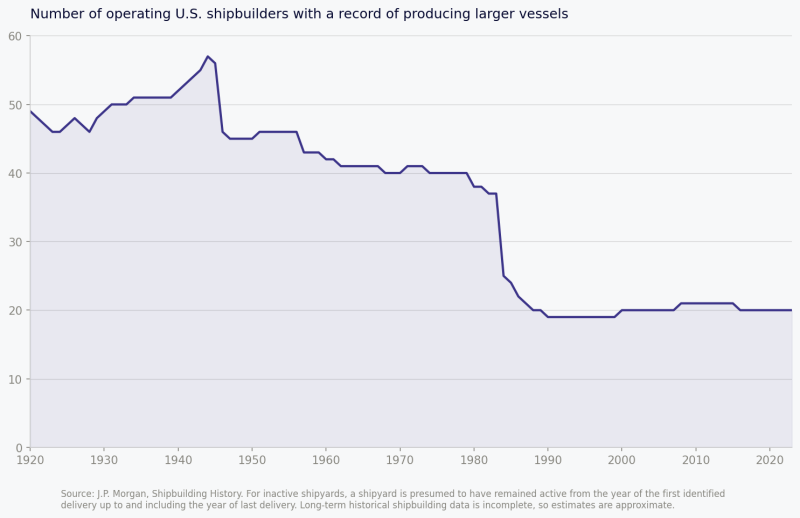
Carmel noted that the U.S.-flag fleet engaged in international trade consists of only about 80 privately owned vessels, carrying less than 1% of U.S. international trade by volume. He added that the U.S. accounts for less than 1% of global commercial shipbuilding output, while China’s share exceeds 55% and is growing. Maritime transportation, he noted, moves approximately 80% of U.S. trade by volume and roughly 60% by value, yet U.S.-flag vessels play almost no role in that carriage.
“The U.S. is a major maritime trading nation without corresponding control over maritime transport capacity,” he said. “These indicators describe a system that is not just underperforming but disconnected from the economic activity it is intended to support.”
Shelby Oakley is a director in the Government Accountability Office (GAO), which has conducted numerous investigations into troubled federal shipbuilding projects and has made over 100 recommended improvements.
“Navy and Coast Guard shipbuilding programs have consistently fallen short of expectations over the last two decades,” she said. “Collectively, they are billions of dollars over cost and years behind schedule.”
Recent examples she cited are the Coast Guard’s $20 billion Offshore Patrol Cutter program, years overdue with no ships delivered and two cutters canceled, and partial termination of the Navy’s Constellation-class frigate.
Oakley said there is no singular solution to the Navy and Coast Guard’s ship construction problems. However, she predicted the services could “significantly improve results” if they had better portfolio management practices, better design discipline and practices (such as finishing the design before starting construction), and better management of the industrial base.
Eric Labs, senior naval analyst for the Congressional Budget Office, noted that the Navy and the shipbuilding industrial base have had the resources in recent years to expand the Navy’s fleet but have been unable to deliver ships on time.
Build times are getting significantly longer, he said. The shipbuilding industry took five to six years to build destroyers and submarines in the 2000s, but now need nine to 10 years. The biggest aircraft carriers used to take seven to eight years to build, but they now take 10 to 11 years.
Labs said the CBO estimates that Trump’s proposed Golden Fleet could ease pressure in some shipbuilding areas, such as frigate construction, but increase it in others, such as large surface combat ships, specifically the proposed Trump-class guided-missile battleship.
If the Navy proceeds with buying the envisioned 15 to 20 Trump battleships, he said, it may have to forgo the 28 DD(X) future destroyers the service had planned to build from 2032 to 2054 to replace Arleigh Burke-class destroyers.
Compounding these issues are some apparently conflicting policies by the Trump administration.
For instance, Trump’s unilaterally imposed tariffs on foreign steel have also had the effect of raising the price of domestically produced steel.
Also, South Korea, the world’s second-largest shipbuilder after China, has been seen as the irreplaceable mentor, partner, and investor to help modernize and revive American shipbuilding. However, U.S.-South Korean relations were seriously strained following an Immigration and Customs Enforcement (ICE) raid last year on the $4.3 billion Hyundai electric car battery factory in Georgia.
More than 300 South Korean workers were arrested and deported in the largest-ever single ICE enforcement action, shutting down the plant, causing a major diplomatic dispute and threatening future foreign investment in the United States.
