



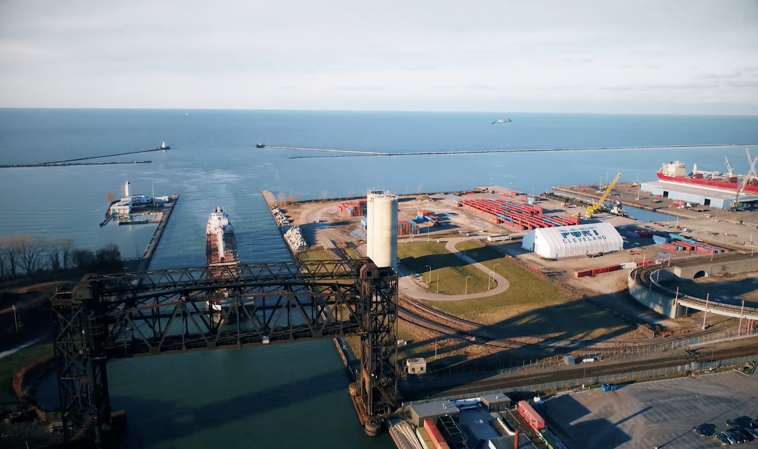
The Port of Cleveland and Milo Harbour Inc. have signed a memorandum of understanding to develop a cross-Lake Erie truck ferry connecting Cleveland with Wheatley, Ontario.
The proposed service, targeted to begin in early 2028, would carry trucks and trailers between Northeast Ohio and southern Ontario. The partners said the route could handle up to 300 round-trip truckloads daily, with one-way crossings taking approximately two to three hours.
A cargo terminal would be established at Milo Harbour in Wheatley, providing an alternative to highway and rail routes through the Windsor-Detroit gateway. Approximately one-quarter of U.S.-Canada merchandise trade currently moves through that border crossing, according to the Port of Cleveland.
“This new service further solidifies the Port of Cleveland as a leader in providing innovative services within the Great Lakes maritime trade,” said David Gutheil, the port’s chief operating officer. “We are proud to partner with Milo Harbour, who shares our vision to seek solutions that build the maritime trade relationship between Ohio and Canada.”
Cargo arriving in Cleveland would connect with the port’s existing highway and rail network, which reaches approximately half of the U.S. population within 500 miles. Canadian shippers could also use Cleveland’s international container service to reach European markets, while Ohio exporters would gain another route into Canada.
The project is intended to supplement existing truck and rail networks as shippers contend with border congestion, driver shortages and aging transportation infrastructure. Moving some long-haul truck traffic onto Lake Erie could also reduce highway congestion, road wear and diesel emissions, the port said.
“This project represents a strategic opportunity for Wheatley, as well as the province of Ontario and all of Canada,” said Kieran Stewart, Milo Harbour project director. “The team at Milo Harbour Inc. are committed to supporting Ontario and Canada’s plan to diversify trade and ensure our supply chains are stronger than ever. Along with our partners at the Port of Cleveland, we are becoming part of the solution to build Fortress North America.”
The service would use existing industrial property, warehouses, cargo-handling equipment and operational space at both ports. Future work could include customs and border-processing facilities, terminal improvements, a roll-on/roll-off ramp and marine infrastructure supporting barge operations.
The Port of Cleveland is also using funding from the Environmental Protection Agency’s Clean Ports Program to purchase electric cranes, forklifts and reach stackers.
Planning and stakeholder engagement are continuing as the partners evaluate infrastructure needs, regulatory approvals and operating requirements for the proposed ferry service.
