



With the current presidential administration showing apathy toward electric vehicles — including boats — electric propulsion for the commercial marine industry is basically holding station. Projects are still underway, and electrically powered vessels are operating, but the buzz surrounding them as recently as a few years ago has subsided.
“We don’t want to be the laggard electrically on a world view, and we are,” said Elias Van Sickle, COO and founder of SWITCH Maritime, a company that built a hydrogen-powered 75' ferry, Sea Change. “It’s to our advantage to push electrification forward.”
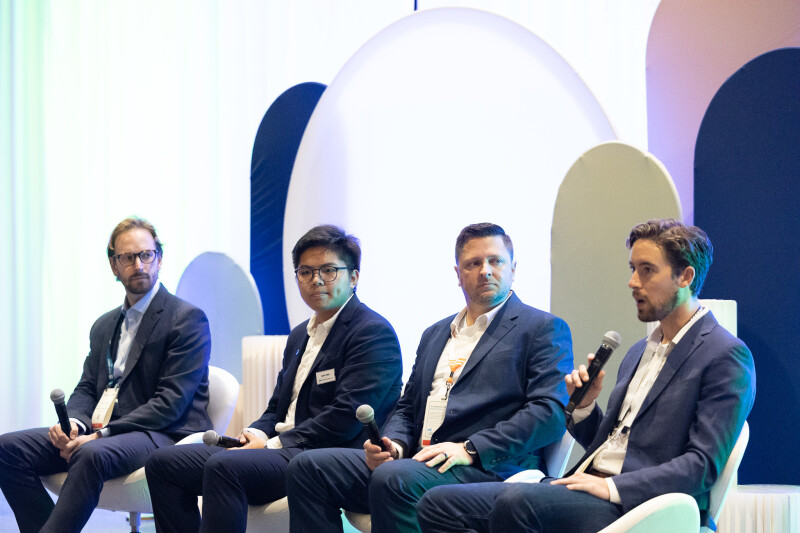
He was part of a discussion on the current state of green power in the marine industry on day two of the 2025 International WorkBoat Show. Moderated by Erik Derecktor, commercial manager at Derecktor Shipyards, the panel also included Joe Hudspeth, director of sales at Elliott Bay Design Group, which designs a range of workboats and other vessels, including new hybrid-electric ferries for Washington State, Minh Tran, project manager for San Francisco Bay Ferry, and David Tyler, co-founder and managing director of Artemis Technologies. Artemis makes foiling electrically powered vessels, including pilot boats and ferries.
Van Sickle’s comment was an answer to the opening question, “Why is green technology still relevant?”
Hudspeth said that there’s still money to be had through grants and that even if progress has slowed, keeping up with technology in the bigger picture is important. “We’re living in a digital and electronic world, and we need to be prepared for it,” he said.
It’s not as if electric propulsion doesn’t still make good sense for certain applications. One of those is the San Francisco Bay ferries. The boats run the same routes at the same speeds, so the power demand should remain predictable.
“We’re still proving that through our transition to battery electric vessels, we’re reducing emissions and fuel consumption,” said Tran.
Added Tyler, “When I’m talking to customers about our technology, I’m not talking about emissions.” He said that the foiling systems on Artemis designs result in significant fuel savings, and the electric propulsion systems are easier to maintain.
As with any technology, the idea is to make money. That means selling products in volume, and to do that, these companies can’t stay stuck in demonstrator or concept mode.
Artemis made a step in the right direction by getting its battery approved by Lloyd's Register and hopes to sell the power system separately to boat and propulsion system makers.
Hudspeth acknowledged that every boat is different, but stressed, “We need to look at what we can do from a modular approach. You have to look at it from the total cost of ownership.”
When he talks to a potential client about hydrogen, Van Sickle is up front about the fuel’s limitations. One big advantage that hydrogen has is that it doesn’t need an expensive charging station installed to make it usable.
Speaking of charging stations, the cost of electricity seems to keep going up. San Francisco Ferry has worked with local utility suppliers to negotiate a rate structure for planned future high-speed charging stations.
Sometimes, when there is a lack of space for a land-based power source, an operator could look at a floating data center. Eliot Bay Design Group developed a clean harbor mobile power solution for a facility.
With any new technology, the U.S. Coast Guard must ensure it is safely applied, so implementing electric propulsion has come with the requisite hoops through which to jump. With hydrogen, Van Sickle said the Norwegian Maritime Authority supported the new technology and labeled it as experimental, so it didn’t need to meet as many standards.
Artemis launched its first boat four years ago, and it was certified in the U.K. on a risk-based assessment for new technology. The company developed its own battery chemistry and put fire suppression systems in each battery box, which lessened the requirements for some of the usual fire-protection requirements.
Hudspeth said the most frustrating part of compliance is that the Coast Guard tends to focus on guidelines. “We can use guidelines to shape and modify something,” he said. “But I would rather have regulations. Having clarity would be good for some of these new technologies and how they are implemented.”
The other key when introducing a new technology is getting the captain, crew, and maintenance technicians comfortable with it. “Be engaged with the crew and operators from day one,” said Tan. “We have testimonials from our deckhands and our captains for the bridge layout and cockpit of our new vessels.”
While there haven’t been any new announcements about future increases in battery power or time between charges, different chemistries have varying requirements. One battery could have a life expectancy of 12,000 cycles, but another with a different chemical makeup could have 10,000. “Finding a chemistry and a charge rate that works for your application is the healthy way to go,” said Tyler. “It’s only going to get cheaper as more of these projects get deployed.”
