



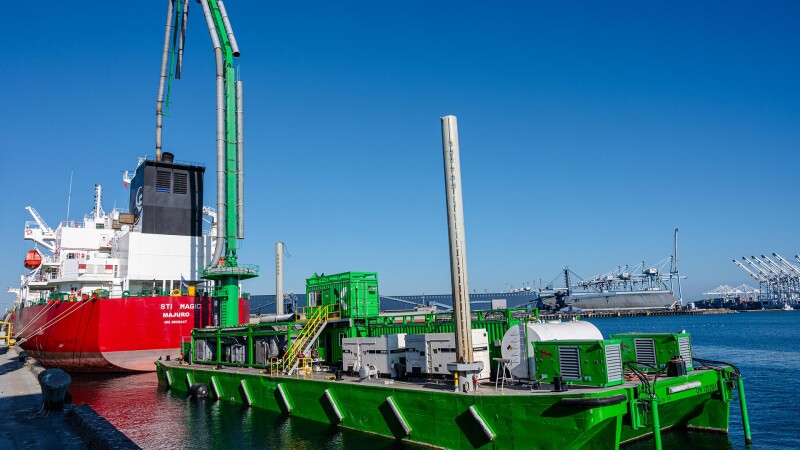
Stax Engineering, Long Beach, Calif., has secured a $150 million financing commitment from the private capital group of Bain Capital LP, Boston, to fund contracted builds through 2027 and speed up deployment of its emissions capture technology ahead of a Jan. 1, 2027, compliance deadline for tankers under the California Air Resources Board's (CARB) At-Berth Regulation, the company announced June 30.
The financing will refinance Stax's existing debt and provide new capital to complete builds already under contract, with Bain Capital serving as the sole financing partner on the deal.
The investment comes as Stax moves to expand its tanker service footprint in Northern California, building on operations it has run for Southern California tankers since early 2025. The company has signed a new agreement with IMTT, New Orleans, to provide emissions capture and control services at IMTT's Richmond, Calif., terminal, a bulk liquid storage and logistics facility that serves the Bay Area's maritime energy and industrial supply chain.
That deal follows a separate agreement with TransMontaigne Partners LLC, Denver, covering its Richmond and Martinez, Calif., facilities. Together, the two agreements are expected to support more than 6,400 at-berth service hours through 2031, according to Stax.
"We're seeing strong momentum from tanker operators who are adopting emissions capture and control as their path to compliance," said Mike Walker, CEO of Stax Engineering. "With over 2,700 completed vessel calls, Stax is already operating at scale and is the market leader in tanker emissions capture. With this financing, we can build the capacity needed to serve our Northern California tanker customers and continue scaling a solution that works."
David Healey, a managing director at Bain Capital, said the firm's decision to back Stax reflected confidence in the company's operating track record. "We have been impressed by Mike and his team's execution capabilities, the strength of Stax's customer relationships, and the role its technology can play as ports and vessel operators invest in cleaner at-berth operations," Healey said. "Stax has demonstrated strong traction in a market facing increased complexity and we are pleased to support the company in this next phase of growth."
Stax has operated in the California ports of Benicia and Oakland since 2024 and is now expanding further into the Bay Area through the Richmond agreement with IMTT. The company said the move positions it to serve the Carquinez Strait corridor, which accounts for roughly 400 tanker vessel visits and more than 9,600 at-berth hours annually.
Traci Johnson, IMTT's vice president of environmental, health, safety and security, said the agreement supports the terminal operator's broader strategy as it expands its renewable fuels business. "As IMTT continues to invest and grow its renewable fuels portfolio, leveraging technology to control emissions will remain an essential element of our construction and operating strategies," Johnson said. "Our agreement with STAX gives us added confidence that we can continue to grow and thrive in the energy transition and seamlessly meet California's evolving compliance standards."
Tankers present distinct challenges for emissions control compared with other vessel types, according to Stax, citing sensitive cargo, non-standardized connection points and explosion-proof electrical requirements that can complicate shore power hookups. Stax's system is barge-based and connects to a vessel's exhaust stacks from the water, which the company says allows for emissions capture without vessel modifications or disruption to cargo operations.
Stax began testing its tanker service in early 2025 and received an executive order from CARB for tanker service in August 2025, making it, according to the company, the first emissions capture and control fleet authorized to service containerships, auto carriers, and tankers in California. Stax already serves tanker operations in Southern California at the ports of Long Beach and Los Angeles, including agreements with Olympus Terminals LLC, Long Beach, and Shell plc, London.
The company says its system captures up to 99% of harmful emissions from vessels at berth. According to Stax, it has treated more than 2,700 vessels for over 46,000 hours to date, capturing more than 350 tons of pollutants.
