



U.S. ports and terminal operators are investing in equipment and technologies that modernize operations and slash emissions.
The projects come as U.S. ports face a broader equipment investment need. A May survey from the National Association of Waterfront Employers (NAWE), a trade association, found that 25 senior port and terminal executives estimate U.S. ports will need $6.7 billion in cargo-handling equipment investment over the next five years. The total includes $2.74 billion for new ship-to-shore crane purchases, $2.4 billion for large yard cargo-handling equipment and additional ship-to-shore cranes, $917 million for rail-mounted large yard cargo-handling equipment, and $790 million for repairs to existing cranes and cargo-handling equipment.
“These findings underscore the scale and urgency of the investment challenge facing U.S. ports,” NAWE President Carl Bentzel said in the survey announcement. “Modern cargo handling equipment is essential to ensuring terminal productivity, supply chain resilience, and the ability of U.S. ports to compete with international gateways.”
The investment push is also being shaped by federal infrastructure programs and changing power needs across port operations. Another trade group, the American Association of Port Authorities (AAPA), which represents public port authorities across the U.S., said those programs remain part of the port modernization picture.
“America’s ports are modernizing in innovative ways to improve the efficient flow of cargo as volumes continue to grow,” said Sang Yi, AAPA president and CEO. “The federal government recognizes the importance of investing in our ports through key infrastructure grant programs like the Port Infrastructure Development Program, and AAPA continues to support its members’ use of various forms of energy to properly power port operations that serve the global community.”
CRANE INVESTMENT
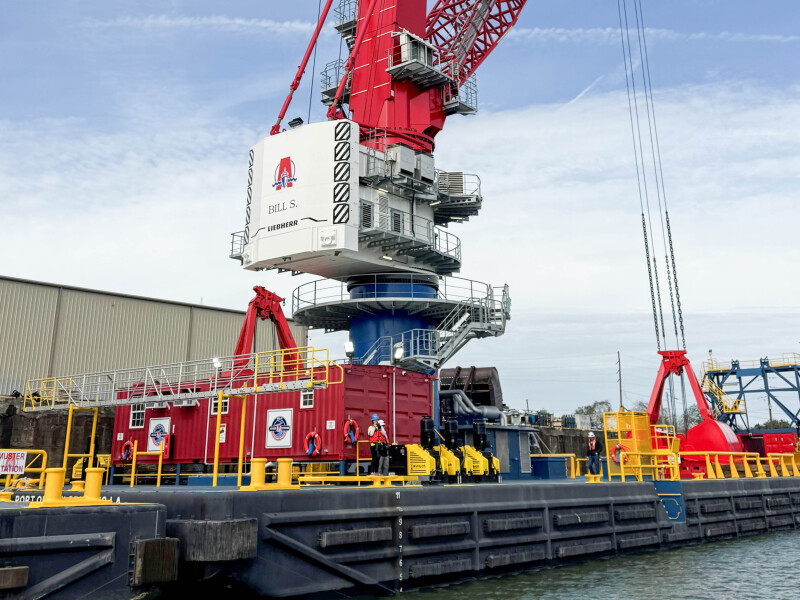
Associated Terminals, Convent, La., has added two CBG 500 E cranes manufactured by Liebherr Maritime Cranes and mounted on 250'x72' crane barges built by LAD Services, Morgan City, La. The cranes are the first of their kind operating in the region, according to Associated Terminals.
“The Lower Mississippi River is one of the most important trade corridors in North America, and our customers continue to demand greater efficiency, flexibility, and reliability,” said Zeljko Franks, COO at Associated Terminals. “The decision to invest in [these] cranes was driven by our commitment to improving cargo-handling performance while positioning our operations for the future.”
Associated Terminals said the crane-barge platform will support mobile handling of bulk and breakbulk commodities, including grain, fertilizer, aggregates, steel products, and project cargo across the Lower Mississippi and Gulf Coast region.
The company worked with Liebherr and other project partners throughout the design process, Franks said.
“Rather than purchasing an off-the-shelf solution, we helped develop a system specifically designed for the demands of Mississippi River cargo operations,” he said. “From cargo-handling requirements and power management to maintenance access and long-term reliability, our team played an active role in ensuring the equipment would meet the needs of our customers and workforce for decades to come.”
The crane-barge configuration allows Associated Terminals to bring high-capacity cargo-handling equipment to customer locations while maintaining throughput and reliability, Franks said. The cranes’ controls, lifting capacity, and reach support faster loading and unloading while helping the company maintain safety standards.
For customers, Franks said, the investment is aimed at improving productivity, increasing operational flexibility, and reducing vessel turnaround times.
Curtis Blank, director of maintenance and engineering at Associated Terminals, said, “We expect the biggest gains in cargo throughput, vessel turnaround, energy efficiency, and equipment reliability. The cranes are capable of very high handling rates, allowing us to move more cargo in less time and improve overall vessel productivity.”
The cranes incorporate Liebherr’s LiCaTronic energy recovery system and battery-supported power management. The systems help reduce fuel consumption and optimize power usage while also enhancing diagnostics and monitoring capabilities that can help the company manage equipment performance and reduce downtime, Blank said.
EMISSIONS CAPTURE
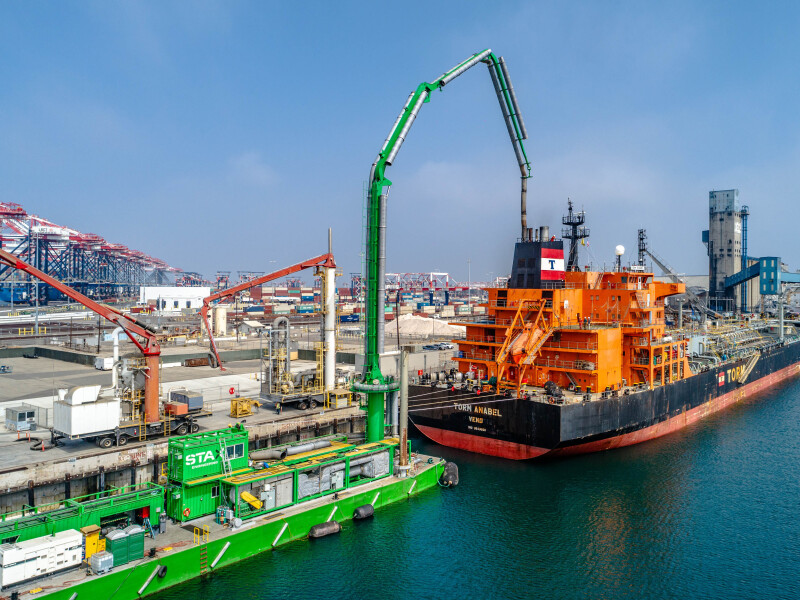
Some companies are focusing on emissions from vessels already in service. STAX Engineering, Long Beach, Calif., uses barge-based, emissions-capture systems that pull alongside ships at berth and connect to their exhaust pipes.
The company says the system captures exhaust directly from the ship’s stack, funnels it into the barge, and filters out 99% of particulate matter and 95% of nitrogen oxides before releasing treated gas. According to STAX, cargo and crew operations can continue while the vessel remains in its assigned berth.
“STAX Engineering is an emissions capture and control company that gives ports and vessel operators a way to cut harmful at-berth pollutants from today’s fleet without waiting on costly ship retrofits, full electrification, or major grid upgrades,” said Mike Walker, CEO of STAX Engineering. “As air-quality rules tighten, we’re addressing the hardest part of the problem: how to clean up vessels that are already in service and still have decades of life left.”
Walker said the technology helps where shore power is not available or practical. He also pointed to tankers and other vessels that often cannot plug in safely.
“Ports need a mix of solutions — shore power, cleaner fuels, and emissions capture — to decarbonize in a realistic way,” Walker said. “Electrification is critical, but it’s expensive, grid-dependent, and not feasible for every vessel type or berth configuration. Emissions capture fills those gaps by reducing pollution from existing fleets at the source, delivering immediate air quality benefits while longer-term infrastructure scales.”
STAX barges can serve containerships, auto carriers, and tankers from nearly any angle and do not require ship modifications or changes to port infrastructure. The company operates eight barges, has treated more than 2,400 vessels over more than 42,000 service hours, and has captured more than 330 tons of pollutants.
STAX is operating across California, including the ports of Los Angeles and Long Beach, and is in discussions with shippers and ports in other U.S. regions and abroad, Walker said.
“Over the next decade, we see emissions capture becoming a standard part of how ports bring existing vessels into compliance quickly, while shore power and new fuels scale up,” he said. “It’s the lever that can deliver measurable health benefits for neighboring communities now, instead of asking them to wait years for major infrastructure projects to be finished.”
ELECTRIFICATION
Federal funding is supporting port equipment projects. In October 2024, the Port of Cleveland in Ohio was awarded $94.26 million through the U.S. Environmental Protection Agency’s Clean Ports Program for its Cleveland Harbor Electrification Initiative. The funding is expected to replace 13 pieces of cargo-handling equipment, replace two older-generation diesel tugboats, add electric vehicle charging equipment, and install a battery energy storage system with solar and shore power.
The port is working with Logistec USA Inc., Houston, The Great Lakes Towing Co., Cleveland, and Cleveland Public Power on the project. The multiphase initiative is expected to reduce port-related carbon emissions by 40% and improve efficiency by 2028.
The project also includes community outreach and workforce development. The port said it plans to work with Davis Aerospace and Maritime High School in Cleveland on internships and workforce training programs involving Clean Ports-installed equipment, including zero-emission mobile equipment and renewable energy systems.
