


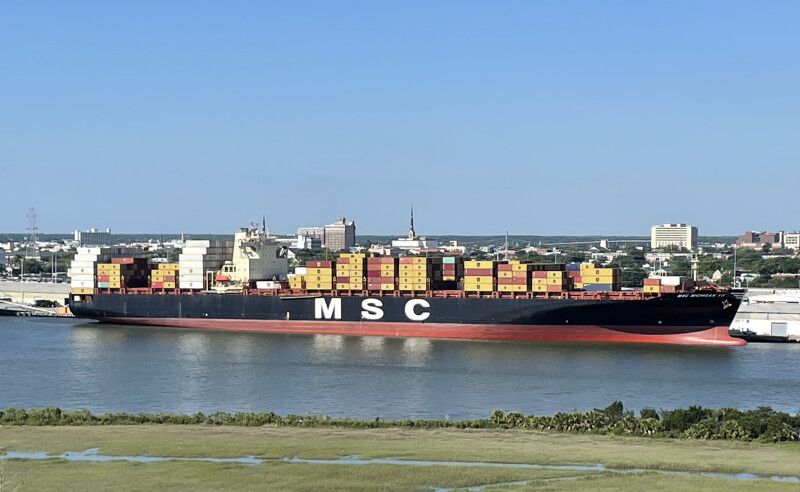
A vessel operating company and its chief engineer were sentenced Monday in federal court in South Carolina over the June 2024 runaway transit of the Liberia-flagged containership MSC Michigan VII through Charleston (S.C.) Harbor — an incident that forced the evacuation of the Arthur Ravenel Jr. Bridge, cleared local beaches, injured two people and damaged vessels and piers.
MSC Shipmanagement Ltd. pleaded guilty and was sentenced to a $6 million criminal fine and four years' probation for failing to report a hazardous condition aboard the ship and for obstructing an investigation by the National Transportation Safety Board (NTSB) and the U.S. Coast Guard, the Justice Department said. The company must also complete a root-cause analysis of the conditions that led to the casualty.
Chief engineer Fernando San Diego San Juan, who pleaded guilty earlier to the same two counts, was fined $2,000. Local media reported that San Diego San Juan will return to the Philippines and has 14 days to appeal, and that prosecutors told the court he had inherited preexisting problems aboard the vessel, had not been home since April 2024 and is dealing with significant health issues.
The 994'x131' MSC Michigan VII — a 6,648-TEU capacity containership built in 2000 — sailed from Charleston on June 5, 2024, bound up the Cooper River to a turning basin before heading back downriver, under the Ravenel Bridge and out through Charleston Harbor to sea.
During the outbound leg, the linkage rod separated from the main engine's governor after the crew made a manual adjustment to it, according to the Justice Department. With the governor disconnected, the engine could not be slowed, and the ship ran at roughly 16 to 17 knots. Police cleared the Ravenel Bridge — an eight-lane, 2.5-mile span linking Charleston and Mount Pleasant — on concern the ship would strike it. Beaches were also cleared over concerns about the vessel's wake, which injured two people and damaged ships and piers.
The harbor pilot from Charleston Branch Pilots Association took the ship under the bridge and out to open water without a strike.
Damage from the transit was later estimated at more than $500,000, and the ship was held in Charleston under detention for roughly seven weeks before departing July 23, 2024. The Coast Guard declared the event a major marine casualty. Charleston Branch Pilots pilot Christopher Thornton received a Coast Guard public service award later that month for his handling of the vessel.
In their plea agreements, MSC and San Diego San Juan admitted that the rpm ordered on the bridge telegraph could sometimes only be reached by manually changing the length of the linkage rod between the governor and the fuel rack — a job that should be done only by trained technicians, none of whom were among the ship's engineers.
Instead, during maneuvering, engine room crew watched the telegraph order in the engine control room and went to the governor to turn the rod until the engine reached the ordered rpm. Bridge watchstanders also called the engine control room at times to ask that rpm be raised or lowered to match the telegraph.
San Diego San Juan admitted knowing the practice was hazardous because repeated manual adjustment could cause the rod to fail, but let it continue. The nuts on both ends of the rod had been loosened by the engine department so the rod could be turned more easily. Locking washers designed to keep those nuts from backing out had been removed from both ends; the Coast Guard found one of them on the deck beneath the governor.
Both the engine's failure to make the ordered rpm and the manual adjustment of the linkage rod during maneuvering were hazardous conditions that had to be reported to the Coast Guard and were not, prosecutors said.
Coast Guard and NTSB investigators asked San Diego San Juan whether the linkage rod was ever adjusted. He said the crew never touched it and that only a qualified technician would. In a later interview, asked whether there had been past delays between the telegraph order and the engine's response, he said there had not — though he knew the rod had been manually adjusted before to match telegraph orders, causing exactly that delay. Asked again whether anyone had ever adjusted the rod, he answered "no," and said he was unaware of crew making adjustments.
During the Coast Guard's post-incident inspection, San Diego San Juan told another crewmember what he had told investigators and instructed that crewmember and two others to say the same thing so they would be on "the same page" — an attempt, prosecutors said, to keep them from disclosing the manual adjustments.
Justice Department officials tied the case directly to the Francis Scott Key Bridge disaster three months earlier.
"The hazardous condition onboard this vessel, and MSC's failure to report it, could have ended in a fatal bridge strike as occurred months earlier in Baltimore. Had the MSC Michigan VII been heading into port instead of out to sea, the result would likely have been catastrophic," said Principal Deputy Assistant Attorney General Adam Gustafson of the Justice Department's Energy and Natural Resources Division. "By their reckless actions, these defendants put a coastal community, critical infrastructure, and the marine environment at risk. Congress made clear in the Ports and Waterways Safety Act that safe navigation and the protection of our waterways are matters of national importance. The Department of Justice will continue to ensure that vessel operators who violate these obligations are held accountable."
The containership Dali lost power and struck the Key Bridge in Baltimore on March 26, 2024, killing six highway workers. The NTSB's final report, adopted in November 2025, traced the blackout to a loose signal wire connection caused by improperly installed wire-label banding, and faulted the Maryland Transportation Authority for not conducting a bridge vulnerability assessment. Maryland announced a $2.25 billion settlement with owner Grace Ocean Private Ltd. and manager Synergy Marine Pte Ltd. in 2026; the Justice Department settled its own claim for more than $100 million in 2024.
U.S. Attorney Bryan P. Stirling for the District of South Carolina said, "The Charleston Harbor is the lifeblood of the iconic Lowcountry coastal region, facilitating $88 billion in economic impact to our state each year, serving thousands of local residents and welcoming millions of visitors each year. The defendants' actions put all of that and lives in grave danger when it disregarded maritime law in a time of potential crisis. The true heroes here are our local law enforcement, who evacuated the Ravenel bridge and local beaches, and the harbor pilot who navigated the vessel safely out to sea. Today's sentencing reminds mariners and their operating companies that they have a responsibility to protect our waterways and communities when operating these enormous vessels."
Supervisory Special Agent Brian O'Sullivan of the Coast Guard Investigative Service said, "This guilty plea highlights the vital role that independent, rigorous law enforcement investigations play in protecting our nation's infrastructure. This guilty plea is a direct result of the meticulous work of CGIS special agents working closely with the Department of Justice and the local Captain of the Port. We will continue to dedicate our resources to ensuring the safety and security of the Port of Charleston."
Coast Guard Sector Charleston, the Coast Guard Investigative Service, and the NTSB investigated. Assistant Section Chief Stephen Da Ponte of the Environmental Crimes Section and Assistant U.S. Attorneys Dean H. Secor and W. Cole Shannon prosecuted the case.
