



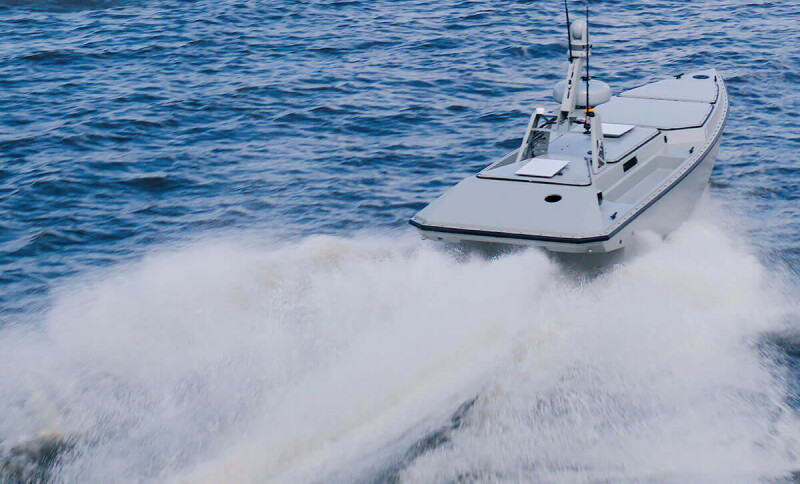
Red Cat Holdings' Blue Ops division is making its entry into the unmanned surface vessel (USV) market with the Variant 7, a 7.8-meter autonomous maritime platform designed for military and government customers. The Florida- and Georgia-based company is moving quickly — from conception to water in under a year — and has ambitious production targets ahead.
Barry Hinckley, president of Blue Ops, spoke with Workboat about the new vessel, its capabilities, and the company's trajectory.
The Variant 7 is Blue Ops' debut USV. According to Hinckley, it is "designed for extended range and endurance, high payload capacity, and multi-domain integration."
He added that Blue Ops' differentiator lies not in any single metric, but in a combination of factors: "an open MOSA architecture, proprietary semi-autonomous command and control, integrated UAV launch/recovery, and compatibility with Red Cat's broader ISR and autonomy ecosystem."
The performance numbers back up the ambition. The Variant 7 carries up to 650 kg of mission payload, reaches a top speed of 40 knots in combat configuration, sustains 32 knots operationally, and can travel up to 800 nautical miles on a single load of fuel — with an unmanned endurance rating exceeding 60 hours. Its 1,200-liter fuel capacity feeds a 270-hp Steyr six-cylinder diesel, available with either a Mercury Marine MerCruiser Bravo 3 outdrive or a waterjet drive configuration.
The hull is constructed from advanced composite HDPE and fiberglass, rated for Sea State 4 marginal conditions and Sea State 3 optimal operations. Lifting points are built into the structure to support crane and airlift operations, and the vessel can also be deployed via standard trailer or travel lift.
The development timeline has been aggressive. "The V7 was conceived in 2025, entered production in October 2025, was in the water by December 2025, and moved into autonomy integration in January 2026," Hinckley said.
Depending on configuration, a single vessel can be constructed in as little as several days to a week.
Blue Ops is preparing to scale substantially. The company is targeting production of more than 200 boats this year, with over 1,000 planned for 2027, supported by its Florida headquarters and Georgia factory.
The Variant 7 is designed to be reconfigured across a wide range of missions. "The Variant 7 is positioned for maritime strike, force protection, coastal security, reconnaissance/ISR, and interoperable multi-domain operations with UAVs," Hinckley said.
The platform supports modular payload bays with options for munitions, ISR packages, electronic warfare tools, and communications and navigation technologies. It can also be outfitted for surface-to-air missile roles and unmanned aerial systems launch and recovery.
The sensor suite includes a day/night electro-optical targeting system with enhanced stabilization, dual-redundant imaging, and an acoustic detection and classification suite.
Control is handled through what Blue Ops describes as proprietary semi-autonomous command and control. "The Variant 7 uses proprietary semi-autonomous command and control, enabling operators to supervise and direct missions while leveraging onboard autonomy for navigation, sensing, and task execution," Hinckley explained. "The platform is designed for flexible operation across autonomous and operator-controlled modes, depending on mission requirements."
A notable feature of the Variant 7 is the integration of Allen Control Systems' "Bullfrog" AI-driven counter-UAS machine gun mounted at the bow. The partnership with ACS reflects a broader effort to address the growing small drone threat at sea. "Red Cat and ACS partnered to extend autonomous counter-drone and precision-engagement capability into the maritime domain, where mobile forces need a cost-effective way to defeat proliferating small UAS threats," Hinckley said.
The Bullfrog is rated to detect, identify, and neutralize Group 1 through 3 drones.
Blue Ops has not conducted live fire tests with the Variant 7, and the vessel has not seen combat action. However, military interest has been building steadily. The company conducted sea trials and testing with various U.S. government and military agencies, and Hinckley noted that interest "increased significantly since Operation Epic Fury" following an initial surge after the vessel's public unveiling in late February at Blue Ops' Demonstration and Innovation Days.
The strategic rationale is straightforward. "The U.S. Navy and allied militaries are looking for lower-cost, scalable, autonomous maritime systems that can extend reach, reduce risk to crews, support force protection, coastal security, ISR, and distributed operations in contested environments," Hinckley said.
Red Cat has tied its maritime ambitions explicitly to the need for American-made, scalable USVs suited to rising threats, particularly in the Indo-Pacific, as part of a broader all-domain Family of Systems approach.
The Variant 7 is the flagship of a growing Blue Ops family that will also include the smaller Variant 5 and additional models to follow.
