



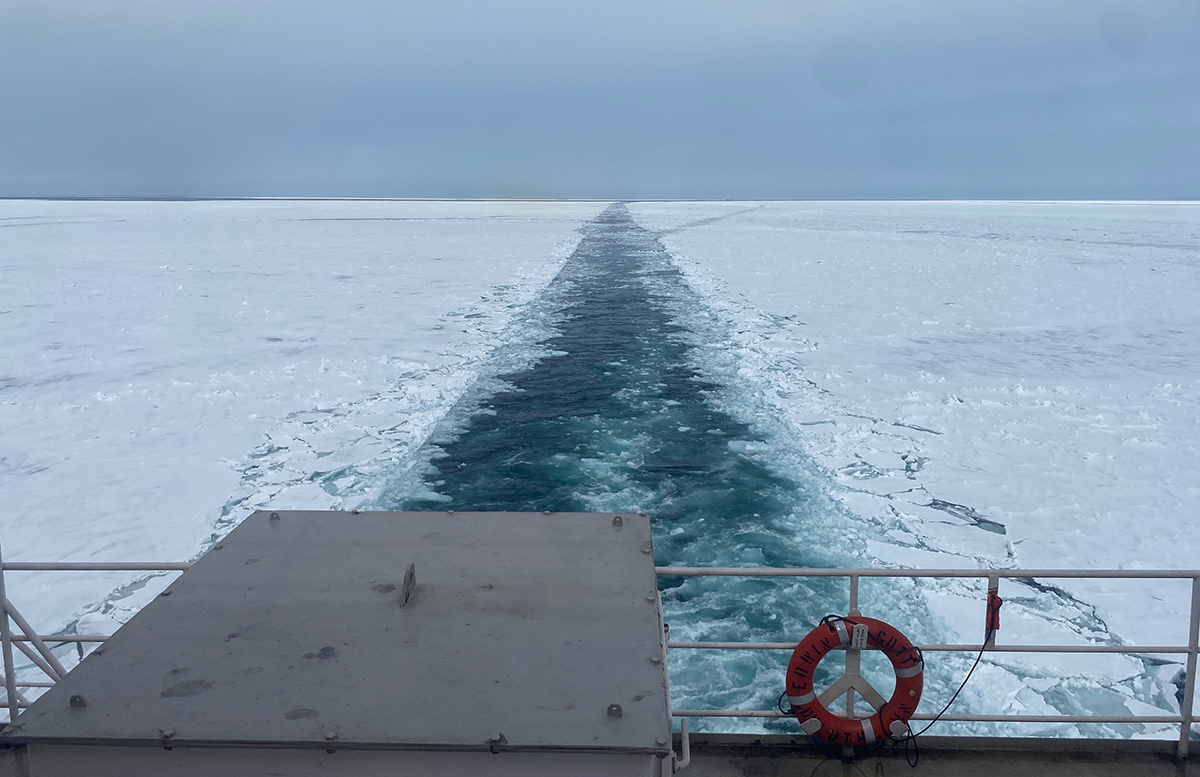
During this year’s ice season on the Great Lakes, U.S. shippers lost a total of 1,953 hours or 82 ship days due to limited icebreaking capabilities on the lakes. According to the Lake Carriers’ Association, which represents the U.S.-flag Great Lakes fleet, that amounts to about a third of the entire shipping season, marked by the opening and closing of the Soo Locks in Sault Ste. Marie, Mich.
The Soo Locks provide access for lakers and other vessels between Lake Superior and the other lakes. The locks were closed this year between January 15 and March 25.
When the locks opened March 25, though, it took 96 hours for the first vessel, loaded with iron ore, to pass through the St. Marys River due to icy conditions on the waterway and inadequate icebreaker availability. According to LCA, as many as 19 vessels were stopped at one point due to ice in the vicinity of the Soo Locks.
This past ice season put a spotlight on the U.S. Coast Guard’s aging domestic icebreaker fleet, said Eric Peace, vice president of the Lake Carriers’ Association. The Coast Guard’s lone domestic heavy icebreaker, the Mackinaw, spent the ice season below the Soo Locks, unable to transit the locks due to a bow thruster casualty, Peace said. That left the icebreaking job above the locks to the Coast Guard cutter Spar.
“The Spar was a constant above the locks but just not as capable as a heavy icebreaker (she is an ice capable buoy tender and not a true icebreaker),” Peace said. “We did have the Canadians for a while, which included the Vincent Massey and Risley, but they were slave to Thunder Bay, Ontario. The Canadians measure their success differently, using an eight-hour response time to anywhere on the lakes, while the U.S. Coast Guard uses open waterway measurements. So while the U.S. Coast Guard was dedicated to the shared waterway, the Canadians had to work Canadian vessels and ports, per their measurements.”
Peace noted that Canada also charges a flat fee for icebreaking services between December 21 and April 15 for all vessels calling on Canadian ports.
“That means that, if a U.S. Coast Guard icebreaker escorts a U.S. ship into a Canadian port, the U.S. shipping company has to pay the Canadian government,” he said. “It also means that, even if you had no icebreaker escort or even no ice, you still have to pay the Canadian government.”
At the same time, Canadian lakers have free access to the Soo Locks, Peace said.
The Mackinaw’s restriction to below the locks was especially unfortunate this year, Peace said, due to heavy snow-covered ice in Whitefish Bay on the southeastern end of Lake Superior. Shipping was at a standstill for most of March, with delays extending into April, according to the Lake Carriers’ Association.
Besides the Mackinaw, the U.S. Coast Guard has a pair of buoy tenders and six tugboats, all able to provide a limited amount of icebreaking services.
“The six tugs are over 45 years old and break down on a regular basis,” Peace said. “Parts are difficult to find for repairs and often end up sidelining them for weeks waiting for repairs.”
And while adding to the U.S. fleet of icebreakers has been in the news of late, almost all the focus has been on the Coast Guard’s polar icebreaker fleet, including contracts for Arctic Security Cutters. The United States delineates between its polar icebreaking fleet and its domestic, or Great Lakes, fleet.
“The U.S. Coast Guard icebreaking fleet has taken priority to the domestic icebreaking mission,” Peace said. “We have struggled to get the U.S. Coast Guard to prioritize the domestic mission, which is in bad shape with really old tugs and only one Mackinaw. We had funding in the House reconciliation bill last year for a new heavy icebreaker, but that was cut in the Senate version.”
All those issues came to a head this past ice season, which started in early December and extended into March, during which time residents in the Great Lakes region depend on shipping for heating oil, iron ore, and other raw materials.
“This is a national problem that requires America’s attention,” said Jim Weakley, president of the Lake Carriers’ Association. “Our companies’ ability to move the building blocks of North American manufacturing, which drives our economy and growth, extend well beyond the Great Lakes region. The nation needs another U.S. Coast Guard heavy Great Lakes icebreaker.”
Besides weather impacts, there’s a push to extend the shipping season on the St. Lawrence Season. Increased trade sounds good, but Peace said extending the season will only further tax the system’s limited icebreaking capacity.
“As they open it earlier and close it later, it stresses the icebreaking assets on the upper lakes, putting more Canadian and foreign vessels in the mix and spreading icebreaking assets from Duluth to well past Montreal,” Peace said. “It’s completely unmanageable with the lack of assets.”
